
Freedom First Society

Posts

Women in Combat

On September 10, 2015, the U.S. Marine Corps released an executive summary of a nine-month study of how an integrated force of men and women performs in a combat environment. The summary included some tempered resistance to the revolutionary feminist drive to open up combat roles to women.

The Marine Corps study was conducted in response to a January 2013 decision by President Obama’s radical Secretary of Defense, Leon Panetta, to rescind the ban on women serving in combat jobs.   To ease the transition, Panetta gave the services until the fall of 2015 to develop their plans to comply and to argue if any jobs should be excluded. President Obama’s current Secretary of Defense, Ashton Carter (CFR and Rhodes Scholar), has already declared that he hopes to open all combat jobs to women.

And President Obama, himself, is certainly on board with the drive to place women in combat roles. In his February 12, 2013 State of the Union address, the president stated: “We will draw upon the courage and skills of our sisters and daughters and moms, because women have proven under fire that they are ready for combat.”

Reporting on the release of the Marine Corps summary, the Establishment’s Washington Post argued: “The Pentagon faces increasing pressure to fully integrate women, following the historic Aug. 21 graduation of two female officers from the Army’s Ranger School.”

What the Post did not say was that much of that pressure comes from feminists within the Pentagon, and that the external pressure comes from organized forces pursuing a long established revolutionary strategy known as revolutionary parliamentarianism (pressure from above and pressure from below).

Still Some Resistance

The Post report continued: “The Marine Corps’ research will serve as fodder for those who are against fully integrating women. It found that all-male squads, teams and crews demonstrated better performance on 93 of 134 tasks evaluated (69 percent) than units with women in them.”

Perhaps the greatest resistance in the Marine Corps study to the integration drive was its pointed reference to the conclusion of the “1992 Presidential Commission on the Assignment of Women in the Armed Forces, the last extensive examination of gender integration within U.S. ground combat units”:

A military unit at maximum combat effectiveness is a military unit least likely to suffer casualties. Winning in war is often only a matter of inches, and unnecessary distraction or any dilution of the combat effectiveness puts the mission and lives in jeopardy. Risking the lives of a military unit in combat to provide career opportunities or accommodate the personal desires or interests of an individual, or group of individuals, is more than bad military judgment. It is morally wrong.

Well said! However, we should not assume that the pressure originates with the “personal desires” of some group (i.e, women in the services) to have equal opportunity to serve in combat. As we shall see, there is much more to the story.

The Real Drivers

To understand the real drivers of the worldwide culture war, let’s start with the more obvious, but poorly understood, feminist movement.

Brig. General Andrew J. Gatsis, USA Ret., 1921–2016Brigadier General Andrew J. Gatsis, one of the most decorated officers ever to serve in our armed forces, was also an intense student of military strategy and tactics. He completed courses and taught at many our nation’s military schools. From personal infantry combat experience in several of our nation’s wars and from his studies he was a vocal opponent of placing women in combat roles.   He testified before Congress in opposition, and he spoke and wrote on the topic.

In a through analysis for the March 16, 1987 issue of The New American magazine, General Gatsis wrote:

The Women’s Movement is the militant arm of a plan to place the family at the disposal of the state. From its very inception, the Equal Rights Amendment (ERA) has remained the prime goal of the feminists, despite its repeated defeat. However, the feminists have always had an ongoing parallel plan — to force legal equality on society through the back door, through statute-by-statute enactment. No better environment exists to advance this plan than our Armed Forces, since the military is socialistic in nature….

The structure through which they work is the top command and control center of our military forces, the Pentagon, which is saturated with feminists. Over the past decade, members of various women’s organizations, such as NOW, have been placed in key positions of authority, where they formulate policies concerning the U.S. military readiness posture. The result is that the demands of the women’s movement have eclipsed national security considerations.

The very sound reasons why women should not be sent into combat generally fall into two categories: the negative impact on military effectiveness and the destruction of a pillar of civilization — respect for and protection of women as the weaker and softer sex.   We turn back the clock on civilization when we expose women to the horrors of combat.

In his 1987 article, General Gatsis explained: “Our soldiers are taught out of necessity to be brutal and to kill. Like it or not, these are the talents that win battles. It is immoral to place our daughters in this role when it is not necessary.”

Asking the Right Questions

It is so tempting to get caught up in arguing why the Pentagon plans do not make sense. But confining our arguments to their mere wrongness is a prescription for continued defeat. The same goes for the drive for same-sex marriage, legalization of pot, or allowing open homosexuals or transgender individuals to serve in the armed forces.

Rather than asking why common sense is constantly being trampled, Americans need to be asking, “who are the powerful people and organizations behind the drive?” and “what are the motives and real agendas of those providing the ultimate funding and direction?”

Simply put, the frontline individuals involved in revolutionary issues do not have the organization, connections, drive, or wherewithal to change society. The great 20th Century historian Oswald Spengler had it figured out when he wrote in his classic Decline of the West:

There is no proletarian, not even a Communist, movement, that has not operated in the interest of money, in the directions indicated by money, and for the time permitted by money — and that, without the idealist amongst its leaders having the slightest suspicion of the fact.

NOW (National Organization of Women) founder Betty Friedan, whose 1963 book The Feminine Mystique launched the feminist revolution, once said that the feminist revolution would involve a restructuring of “all our institutions: child-rearing, education, marriage, the family, medicine, work, politics, the economy, religion, psychological theory, human sexuality, morality, and the very evolution of the race.”

Friedan was one of the signers of The Humanist Manifesto II (1973), which called for “a world order based upon transnational federal government” and “an international authority” to provide “massive technical, agricultural, medical and economic assistance, including birth control techniques, to the developing portions of the globe.”

But what about Insider funding and political muscle for the movement? We grab one example from the Washington Post article. The Post sought to overcome the adverse conclusions in the Marine Corps study by citing the objections of Katelyn van Dam, identified as a “Marine Corps veteran who has advocated for full integration.” She is also identified as “a spokesman for the Truman Project and Center [for National Policy]’s No Exceptions initiative, which calls for opening all military jobs to women immediately.”

The Center for National Policy (CNP) describes itself as “an independent policy institute, which brings together leaders from government, the private sector, and civil society to develop strong, smart and principled solutions to the global challenges Americans now face.” [Emphasis added.] The CNP is larded with advisors from the Council on Foreign Relations (CFR), including Leslie Gelb, President Emeritus of the CFR. The Council on Foreign Relations is an extremely influential Internationalist front group.

Drafting Women Into Combat

Where is this heading? Revolutionaries are never satisfied, short of totalitarian revolution. After any victory, they just up the ante. It is easy to see that allowing women to serve in combat is only step one in the revolutionary drive.  Requiring women to serve is certainly part of the revolutionary agenda.

In his 1987 analysis, General Gatsis referred to a February 1982 memorandum “Deputy Defense Secretary Frank Carlucci (the newly assigned NSC advisor to President Reagan) sent … to the Service Secretaries with the following demand:

… I want you to identify specifically the military career paths, officer and enlisted, which are closed or in any way restricted to women by combat limitations you have in place.

“Any military commander would immediately recognize this type of language as a directive to eliminate combat barriers against women or otherwise be identified as uncooperative and inefficient….” Gatsis added: “Don’t be deceived: The registration of women is always just around the corner….”

Years later (January 26, 2004) in “Will They Draft Your Daughter?” The New American observed:

“The equal rights amendment would make voluntary, as well as compulsory, military service available to women and men on the same basis,” declared New York Congresswoman Bella Abzug, a radical Marxist and founder of the modern feminist movement. Writing in the April 1971 Yale Law Review, Professor Thomas Emerson, another radical ERA proponent, insisted that exempting women from the draft would be intolerably “sexist”….

“No woman should be authorized to stay home to raise her children,” insisted feminist “foremother” Simone de Beauvoir. “Society should be totally different. Women should not have that choice precisely because if there is such a choice, too many women would make that one.”

With the Supreme Court decision on same-sex marriage fresh in our memories, no one should assume that Court interpretation of a future ERA or some other “discovered” legal doctrine would not demand such compliance.

Recommendation: Read and share Media-Controlled Delusion (booklet).Media Controlled Delusion

The Establishment-controlled media consistently allow revolutionaries to conceal their real agendas and their underlying organization, while trumpeting their public protests. The movement to place women in combat is but one example.

If our nation is to remain free, such widespread deception cannot be tolerated. In the small booklet mentioned above, your writer examines several timely examples of the deception and suggests what can be done to overcome it.
 

Nullification’s Five Deadly Secrets

An old theoretical “remedy” for overgrown or tyrannical federal government, namely the states’ “nullification” of unconstitutional laws or rulings, has gained some new advocates of late.

Of course, any proposed solution to that serious problem — and particularly one purportedly championed by Thomas Jefferson (see “The Founders’ Battle over the Nullification Heresy”), like this one — is worth examining by conservatives.

It is quite natural, therefore, to ask such basic questions about nullification as:

  • What does “nullification” mean, exactly?
  • Is it legal?
  • Is it even a viable remedy — especially in today’s political environment, dominated by a collectivist media?
  • What risks, costs, or downsides does it involve?
  • Are there preferable alternatives — some less risky, for example, or perhaps more legal?

Unfortunately, however, we find that the proponents of nullification avoid these responsible questions — or else, they answer them in a manner that evades the great mass of relevant evidence. Our purpose in this article will therefore be to answer these five questions, directly and clearly and with plenty of support.

  1. What does “Nullification” mean?

Nullification’s proponents have almost always used this term with a sweeping lack of precision.

We should point out first that, despite the form of the name, it does not mean simply a state’s pronouncement that they have found a federal law or ruling unconstitutional, and therefore null and void. Nobody has used the term, today or in the past, in that sense; it means more. 1

Thomas Woods, Jr., perhaps today’s foremost proponent of nullification, seems to have quite a shaky grasp of the term’s meaning. In a website that goes under his name, he writes, “State nullification is the idea that the states can and must refuse to enforce unconstitutional federal laws.”

This definition is sadly inaccurate, both practically and historically. First, it assumes that the federal government is always dependent on state governments to enforce its laws. Second, it ignores the very long-established American judicial ruling that the federal government cannot require state governments to help enforce any federal laws. (This principle even has a name, “the Anti-Commandeering Doctrine.”) So, clearly that cannot be the sort of situation Woods intends “nullification” to address. 2

“Nullification” goes also beyond states’ “interposing” when the federal government exceeds its constitutional limits. This latter term was used by James Madison in the Virginia Resolution (passed Dec. 24, 1798), which was a response to the unconstitutional and quite tyrannical “Alien and Sedition Acts.” The Resolution stated that in such cases, states “have the right, and are in duty bound, to interpose, for arresting the progress of the evil, and for maintaining, within their respective limits, the authorities, rights and liberties, appertaining to them.” (See, also, “The Founders’ Battle over the Nullification Heresy.”)

Indeed, Madison had already decided that states do not hold a legal right to pronounce an unconstitutional federal law, authoritatively, to be “void, and of no force or effect.” Therefore, lest anyone draw the wrong conclusion, he had that last phrase struck from the Resolution before the Virginia legislature passed it. So, although both terms have often been used imprecisely, and sometimes been confused with each other, “nullification” goes beyond “interposition.”

What then is “nullification” – and where and when was the possibility first raised? Most likely the first discussion of the concept — though he did not use the term “nullification” — was in Federalist Papers 15 & 16, written by Alexander Hamilton.

In Paper 16, Hamilton distinguished carefully “between a mere NON-COMPLIANCE and a DIRECT and ACTIVE RESISTANCE. If the interposition of the State legislatures be necessary to give effect to a measure of the Union, they have only NOT TO ACT, or TO ACT EVASIVELY, and the measure is defeated.” Hamilton continued:

But if the execution of the laws of the national government should not require the intervention of the State legislatures, if they were to pass into immediate operation upon the citizens themselves, the particular [i.e., state] governments could not interrupt their progress without an open and violent exertion of an unconstitutional power…. They would be obliged to act, and in such a manner as would leave no doubt that they had encroached on the national rights. An experiment of this nature would always be hazardous in the face of a constitution in any degree competent to its own defense, and of a people enlightened enough to distinguish between a legal exercise and an illegal usurpation of authority. (Interpolations and emphasis ours.)

The term “nullification” was coined in 1798, with the latter kind of law in view (specifically, the Alien and Sedition Acts: see “The Founders’ Battle 0ver the Nullification Heresy.”) Thus, the whole idea of nullification is to take the measures necessary to prevent the law from being enforced within the state; and that practically, such “measures” will entail the use of force — or at least, the credible threat of it. As Wikipedia points out,

In writing the Kentucky Resolutions, Jefferson warned that, “unless arrested at the threshold,” the Alien and Sedition Acts would “necessarily drive these states into revolution and blood.” … George Washington was so appalled by [the resolutions] that he told Patrick Henry that if “systematically and pertinaciously pursued,” they would “dissolve the union or produce coercion.” [34]  [Emphasis ours.]

Willingness to bring about one or both, however, is definitely characteristic of “nullification.” Thus, a recent example of actual nullification would be the move by several states to make it illegal — indeed, a felony — to enforce federal gun laws within their borders. So, that kind of action is what we will discuss in the remaining sections.

  1. Is nullification legal?

Even on the face of it, nullification seems illegal. In the case of unconstitutional federal laws, nullification would involve not only allowing disobedience to federal law, on the part of either the state or its citizens (or both), but also the enforcement of a prohibition on any enforcing of that federal law. Such behavior is in direct violation of the Supremacy Clause (Article VI, paragraph 2) of the Constitution:

This Constitution, and the Laws of the United States which shall be made in pursuance thereof; and all treaties made, or which shall be made, under the authority of the United States, shall be the supreme law of the land; and the judges in every State shall be bound thereby, anything in the constitution or laws of any State to the contrary notwithstanding.

What, then, about nullification of Constitution-twisting judicial rulings? Are we legally obligated to accept them, or can we discount and nullify them?

Explicitly, the Constitution gives federal courts jurisdiction in certain matters: it gives the Supreme Court original jurisdiction in a few matters, and appellate jurisdiction, “both as to law and fact,” over all other federal issues — including cases arising under the Constitution or the laws of the U.S. — “with such exceptions, and under such regulations as the Congress shall make.” (Article III, Sec. 2; emphasis added).

The inescapable conclusion is that authoritative decisions about the constitutionality of federal laws are the province of the federal courts, not the states. This is the conclusion of an overwhelming weight of authorities and experts – including, as we have already seen, James Madison. Both the Constitutional Convention, the state ratifying conventions, and over half a dozen Federalist Papers show clearly that the founders of our Constitution attributed this authority only to the federal courts. Also, this is how the federal courts themselves have repeatedly, consistently ruled.

Significantly, no other state went along with Kentucky or Virginia, in response to the 1798 resolutions. On the contrary, four states did nothing, seven states responded by formally rejecting the Kentucky and Virginia resolutions, and three states passed resolutions expressing disapproval of them. At least six states affirmed that the question of constitutionality of a federal law lies with the federal courts, not the states. (See, also, “The Founders’ Battle over the Nullification Heresy.”)

Later, prior to the Civil War, a few states – both Southern and Northern ones — did claim the right of nullification. Its most notable invocation, supported by the Vice President, John C. Calhoun from South Carolina, was that state’s declaration that the federal Tariffs of 1828 and 1832 were unconstitutional and thus null and void within the state’s boundaries. This led to the so-called Nullification Crisis (1832-33). Although President Andrew Jackson was prepared to quash this uprising by force, that turned out to be unnecessary.

Also, some states tried to nullify fugitive-slave laws within their borders. The Supreme Court overturned these efforts, in such cases as Prigg v. Pennsylvania (1842) and Ableman v. Booth (1859), the latter of which was the Court’s most thorough treatment of the nullification issue to date.

Much later, in 1954, the Supreme Court’s school-desegregation decision in Brown v. Board of Education of Topeka led to a resuscitation of states’ claims to a right of nullification or interposition. Arkansas, Virginia, Louisiana, and Florida passed interposition and nullification laws. The Supreme Court rejected Arkansas’ law, on the usual grounds, in Cooper v. Aaron (1958).

From the Civil War until the 1950’s, however, virtually no one claimed such a right for the states. Starting from the drafting of the Constitution and until the 1950’s, the overwhelming consensus was that according to the Constitution, states do not have a right of nullification, for reasons we have stated. In short, it is illegal.

  1. Is nullification a viable remedy?

Given this understanding of what nullification is, and of its illegality, we are in a much better position to consider how viable an approach it is.

So what are the realistic chances for success, for a state wishing to resist the federal government forcefully? That depends of course on how determined the federal government is to enforce its law or ruling.

There are very few examples, historically, of a case where a state has put the nullification theory to a practical test. Perhaps the only example is Pennsylvania’s reaction to the first Supreme Court case that dealt with nullification, United States v. Peters (1809). The Pennsylvania legislature had originally passed a law claiming that a federal court’s decision in an earlier case had been unconstitutional and was therefore “null and void.”

In the Peters case, the Supreme Court overturned that Pennsylvania statute, denying that the state had the authority to nullify a federal court’s judgment. What happened next deserves careful consideration (the footnotes referenced are in the Wikipedia article we quote):

In response, the Governor of Pennsylvania called out the state militia to prevent enforcement of the Supreme Court’s judgment. However, the U.S. Marshal summoned a posse, carried out the Supreme Court’s order, and arrested the leaders of the state militia. The Pennsylvania legislature passed a resolution declaring the action of the Supreme Court unconstitutional, invoking states’ rights, and appealing to the other states for support.[42] Eleven states responded by disapproving Pennsylvania’s attempted nullification. No state supported Pennsylvania.[43] The Governor of Pennsylvania made a plea to President James Madison to intervene, but Madison affirmed the authority of the Supreme Court. The Pennsylvania legislature backed down and withdrew the militia.[44] Thus, Pennsylvania’s attempt to nullify the federal court judgment failed.[45]

Isn’t that the result any state can expect, if it tries something similar? Certainly it is, unless that state has much better support for its cause, from the American public in general, than Pennsylvania enjoyed in 1809.

But there is another crucial factor that nullification proponents conveniently ignore that virtually guarantees the outcome. The proponents refuse to acknowledge the determined “Big Government” forces, agendas, and deceptive tactics that have misled the public over decades into accepting the step-by-step erection of our current massive unconstitutional federal bureaucracy. The grip of those forces on our media and Washington would in no way be impacted by attempts at State nullification. In fact, attempts at nullification likely aid that agenda (see point 4).

So today, that “much better support” is too much to expect. The public is far too ignorant of and about the Constitution, and too gulled by the Establishment-controlled media, to form any correctly targeted, informed resistance — or even to be motivated to do so. (Nor would it help a state’s chances of success, in the case of nullification, that the federal government would be legally correct.)

Against a determined federal government, especially one supported by our Establishment-controlled media, today no state could reasonably hope to succeed in an attempt at nullification.

  1. What risks, costs, or downsides does it involve?

We should qualify our previous statement, however: no state could hope to do so, without first preparing the way by partaking in a wisely-targeted, well-organized, nationwide, successful effort to educate and inform the public.

In today’s environment, that educating and informing would certainly need to be about both our Constitutional system and the well-organized, well-funded, internationalist conspiracy seeking to destroy that system.

When considering the costs of any rational solution today, we must point out that taking part — and succeeding — in such a nationwide educational effort is a necessary price. Unfortunately, today’s proponents of nullification do not at all follow their hero Thomas Jefferson, in his almost constant emphasis on the prerequisite of such education:

The most effectual means of preventing [the perversion of power into tyranny are] to illuminate, as far as practicable, the minds of the people at large, and more especially to give them knowledge of those facts which history exhibits, that possessed thereby of the experience of other ages and countries, they may be enabled to know ambition under all its shapes, and prompt to exert their natural powers to defeat its purposes. — Thomas Jefferson: Diffusion of Knowledge Bill, 1779. The Writings of Thomas Jefferson, Federal Edition 2:221, Papers 2:526

If a nation expects to be ignorant and free in a state of civilization, it expects what never was and never will be. — Thomas Jefferson to Charles Yancey, 1816. The Writings of Thomas Jefferson, Memorial Edition (ME) 14:384

If once [the people] become inattentive to the public affairs, you and I, and Congress and Assemblies, Judges and Governors, shall all become wolves. It seems to be the law of our general nature, in spite of individual exceptions. — Thomas Jefferson to Edward Carrington, 1787. ME 6:58

I know no safe depositary of the ultimate powers of the society but the people themselves; and if we think them not enlightened enough to exercise their control with a wholesome discretion, the remedy is not to take it from them, but to inform their discretion by education. This is the true corrective of abuses of constitutional power. — Thomas Jefferson to William C. Jarvis, 1820. ME 15:278

Most importantly, if such education were accomplished, there would be no need for nullification — completely legal recourses would be practical (see 5, below), thus avoiding the very serious downsides to nullification.

Even presuming an informed electorate, there is obviously a substantial amount of other cost or risk in any threat, or actual use, of force against a hostile government. Jefferson eventually recognized (see “The Founders’ Battle over the Nullification Heresy”), that an actual show of force might even turn potential comrades into our enemies.

But in addition to the obvious risks of military humiliation or defeat, there are some less obvious, yet impactful, downsides we should consider:

  • War is a changer of the societies that take part in it, even those to which it does not do great military or economic damage.
  • War is a ready excuse for the government to expand its power. In today’s environment, we cannot even rule out the possibility that the eventuality of civil war could be used by internationalist Insiders as a pretext to call for international military intervention. This could happen, on our own soil, under the aegis of N.A.T.O. or of the U.N. The loss of liberty that could readily ensue is a frightful prospect.
  • Another risk that attaches to any illegal activity, and which many people may not have considered, is loss of respect for the law, and for the enforcers of the law. These are real and quite corrosive effects that even a small amount of common or accepted law-breaking creates. We quote here from Freedom First Society’s founding book, Organize for Victory!

Otherwise responsible citizens weaken the rule of law, and so its protective shield, when they put themselves above the law by deciding which laws they will obey and which they will ignore. The rule of law is such an important asset in any civilization that even a significant corruption of the law does not justify either civil disobedience or treating the law with contempt.

Respecting the law does not mean that we should regard all laws as just and accept them as such. Certainly many official acts are not legal or even constitutional.   However, when there are problems within the legal system, rather than promoting cynicism, the responsible approach is to observe the law and work to make it more worthy of respect….

Legal systems are major social accomplishments. They are not put together during periods of chaos and confusion. We can preserve the umbrella of safety the law provides only by helping to see that the law is respected.

As a strategy, civil disobedience is not only wrong, it is also dangerous and counterproductive. Its widespread practice leads to anarchy, while providing an easy path to tyranny. In fact, lawlessness paves the way for a police state. (pp. 198,199)

  1. Are there preferable alternatives to nullification — say, less risky, and/or more legal?

Even Thomas Jefferson, the patron saint of the nullification proponents, came to recognize a serious risk of any insurrection (see “The Founders’ Battle over the Nullification Heresy”) and pointed us to a better alternative:

In this state [Virginia], we fear that [violations of the Constitution] may produce insurrection. Nothing could be so fatal. Anything like force [used against the violators] would check the progress of the public opinion and rally them round the government. This is not the kind of opposition the American people will permit. But keep away all show of force and they will bear down the evil propensities of the government by the constitutional means of election and petition. (Emphasis ours.) — Thomas Jefferson to Edmund Pendleton, Feb. 14, 1799. ME 10:105

It is truly odd how the proponents of supposedly easy, “silver-bullet” fixes like nullification tend to discount or overlook the mighty power of the ballot box. For example, those who call for a risky, Article V constitutional convention to create “term limits” for Congressmen, completely overlook the best term limits that anyone could devise: the requirement of Congresspersons to face periodic and fairly frequent elections.

Nor do our “silver bullet” proponents show much sagacity when they intone repeatedly their alarms of an “out of control” federal government. The fact that the same Congress which passes all these unconstitutional bills is for the most part repeatedly re-elected shows that the American people approve, to the extent they are aware, of the job their elected representatives are doing.

Even more overlooked, perhaps, are the great powers that Congress holds over the other two branches of the federal government. In regard to the Executive branch, for example, Congress holds the “power of the purse” which James Madison so celebrated. There is virtually no power that either the President, or the massive bureaucracy over which he or she presides, can exercise which Congress does not first approve and fund.

And most ignored of all, probably, is the power that Congress holds over the Judicial branch of the federal government. We could not begin to improve on the clear, full, and accurate description that Don Fotheringham has provided of this important power. We will only add that it is the constitutional, legal, safe, but fully effective means that our Founding Fathers built into our federal system.

What is missing then, from the legal, constitutional, relatively risk-free approach? Nothing — except for the necessary understanding and fortitude on the people’s part. As Thomas Jefferson warned, whichever approach we choose to uphold our constitutional liberty, we will be unsuccessful in our efforts unless we provide the needed educational undergirding.

To provide that educational undergirding is the basic purpose of the Freedom First Society. We invite all freedom-loving Americans to partake in the wisely targeted, nationwide sort of educational effort that is an absolutely necessary condition for the upholding and preserving of our liberty.

Notes

  1. Nor is nullification a mere legalizing, at the state level, of something the federal government makes illegal. That would not involve even the state’s making a pronouncement, about the constitutionality of the federal law. It would simply be its not duplicating the federal government’s outlawing (of whatever). Thus, for example, several states have legalized one or more forms of marijuana use, in contrast with federal law. It happens that in this matter the federal government has decided not to allocate its resources to the costly undertaking of restricting the use of marijuana. This makes it de facto legal. But this is not a case of “nullification” of a federal law; it is simply a case of the federal government biting off more than it can chew in outlawing something.
  1. Admittedly, there are cases where the federal government depends explicitly on state-government cooperation in order to carry out a program. This is the case with several parts of Obamacare. But that is the exception, not the rule: As just mentioned, it is a well established principle that the federal government cannot demand such cooperation. The states are quite free not to give their help. So, recent calls to “nullify Obamacare” do not involve “nullification” in its full ramifications: the Tenth Amendment Center describes them more accurately as “nullification in effect.”


The Founders’ Battle over the Nullification Heresy

Although nullification itself was not discussed much at the time of the Constitution’s drafting and ratification, the consensus at that time was that authoritative decisions about the constitutionality of federal laws would be the province of the federal courts, not the states.

This was the view of an overwhelming weight of authorities and experts. Both the Constitutional Convention, the state ratifying conventions, and over half a dozen Federalist Papers show clearly that the founders of our Constitution attributed this authority only to the federal courts. And that implied that nullification was illegal.

But what should the states do, if Congress steps way out of its constitutional bounds and the Judicial branch colludes (or could be expected to do so) in the usurpation? That issue raised its head a mere eleven years after the Constitution was written — with the passing of the unconstitutional and quite tyrannical “Alien and Sedition Acts”. Both James Madison and Thomas Jefferson were extremely disturbed by this legislation.

In his Virginia Resolution (passed Dec. 24, 1798), a response to those acts, Madison floated the idea of a state’s “interposing” against an unconstitutional federal law. This Resolution did not indicate, though, what concrete acts “interposition” might involve. Later, in the Report of 1800, Madison gave some specific examples: communicating with other states about the unconstitutional federal law, attempting to enlist the support of other states, petitioning Congress to repeal the law, introducing Constitutional amendments in Congress, or calling a constitutional convention. None of these is very surprising — much less, of questionable legality.

Most likely the first discussion of the “nullification” concept — though he did not use the term — was actually in Federalist Papers 15 & 16, written by Alexander Hamilton.

In Paper 16, Hamilton distinguished carefully “between a mere NON-COMPLIANCE and a DIRECT and ACTIVE RESISTANCE. If the interposition of the State legislatures be necessary to give effect to a measure of the Union, they have only NOT TO ACT, or TO ACT EVASIVELY, and the measure is defeated.” Hamilton continued:

But if the execution of the laws of the national government should not require the intervention of the State legislatures, if they were to pass into immediate operation upon the citizens themselves, the particular [i.e., state] governments could not interrupt their progress without an open and violent exertion of an unconstitutional power…. They would be obliged to act, and in such a manner as would leave no doubt that they had encroached on the national rights. An experiment of this nature would always be hazardous in the face of a constitution in any degree competent to its own defense, and of a people enlightened enough to distinguish between a legal exercise and an illegal usurpation of authority…. Attempts of this kind would not often be made with levity or rashness, because they could seldom be made without danger to the authors…. (Interpolations and emphasis ours.)

Unfortunately, in the face of the Alien & Sedition Acts, for a very brief time in 1798-99 Thomas Jefferson succumbed to the temptation to lay that very course. The “Kentucky Resolutions” of 1798 were likewise a state’s response to those acts. Jefferson, who was Vice-President, was their original author, though this was not widely known at the time. (Jefferson and Madison were close friends and fellow members of the Democratic-Republican Party, and carried on extensive correspondence during this period. Each wrote his Resolutions anonymously.) It was in the Kentucky Resolutions that Jefferson coined the term “nullification”.

The Kentucky Legislature itself was more reserved in their statements than was Jefferson: before they passed his Resolutions they removed the term “nullification” (although they restored it in their 1799 version). Also, their 1798 version ended by expressing the hope “… that the Co-states recurring to their natural right in cases not made federal [by the Constitution], will concur in declaring these [Alien and Sedition] acts void and of no force, and will each unite with this Commonwealth in requesting their repeal at the next session of Congress.”

Jefferson’s original drafts were more straightforward, about what “nullification” truly involved: in those drafts the same passage reads:

… and that the co-states, recurring to their natural right in cases not made federal, will concur in declaring these acts void and of no force, & will each take measures of it’s own for providing that neither these acts, nor any others of the general government, not plainly & intentionally authorised by the constitution, shall be exercised within their respective territories. (Emphasis added.)

Here Jefferson went boldly where Madison feared to tread: what Jefferson meant by the term, and what he hoped for from the other states, involved not only the state’s pronouncement of the “null and void” status of an unconstitutional federal law, but also the state’s taking whatever measures are necessary to make sure the law is not enforced within its boundaries.

This is the whole point of nullification. But practically, in such cases as Jefferson had in mind, those “measures” would entail the use of force – or at least, the credible threat of it.

Jefferson was fully aware that it might involve actual violence. On Nov. 17, 1798, after he had finished his draft of the Kentucky resolves, he wrote in a letter to Madison, “I inclose you a copy of the draught of the Kentuckey resolves. I think we should distinctly affirm all the important principles they contain, so as to hold to that ground in future, and leave the matter in such a train as that we may not be committed absolutely to push the matter to extremities, & yet may be free to push as far as events will render prudent.” (Emphasis added.)

By early 1799, however, Jefferson had decided that any actual use of violence would be counterproductive — for some of the same reasons Hamilton had mentioned years earlier. In a letter to Madison on Jan. 30, Jefferson wrote that “Firmness on our part, but a passive firmness, is the true course.  Anything rash or threatening might check the favorable dispositions of [several States that had petitioned against the Alien & Sedition Acts], & rally them again around the measures which are ruining us.” (Emphasis added.)

Instead, in late August 1799 Jefferson suggested a different radical remedy — secession. In letters to Madison and to Wilson C. Nicholas, he outlined his new plan for strengthening public support for the principles expressed in the resolutions.

Jefferson suggested that a new set of resolves be passed by the legislatures of Kentucky and Virginia, and sent to the various states, which, after encouraging their support for the resolutions, would add that:

[Kentucky and Virginia were] fully confident that the good sense of the American people and their attachment to those very rights which we are now vindicating will, before it shall be too late, rally with us round the true principles of our federal compact; but determined, were we to be disappointed in this, to sever ourselves from that union we so much value, rather than give up the rights of self government which we have reserved, & in which alone we see liberty, safety & happiness. (Emphasis ours.)

This idea horrified Madison, it seems. He paid a visit to Jefferson the very next week, and convinced him to back down from his plan.

Most serious Jefferson historians, as well as most other American leaders at the time, have been dismayed by his actions during this period. As Wikipedia points out,

In writing the Kentucky Resolutions, Jefferson warned that, “unless arrested at the threshold,” the Alien and Sedition Acts would “necessarily drive these states into revolution and blood.” Historian Ron Chernow says of this “he wasn’t calling for peaceful protests or civil disobedience: he was calling for outright rebellion, if needed, against the federal government of which he was vice president.” Jefferson “thus set forth a radical doctrine of states’ rights that effectively undermined the constitution.” [34] … George Washington was so appalled by [the resolutions] that he told Patrick Henry that if “systematically and pertinaciously pursued,” they would “dissolve the union or produce coercion.” [34]  (Emphases ours; interpolation Chernow’s.)


State Nullification of “Unconstitutional” Federal Laws

‘Nullification,’ the theory that states can invalidate federal laws that they deem unconstitutional, had its heyday in the slavery debate that preceded the Civil War, but it has found new currency since 2010.

The theory has never been validated by a federal court, yet some Republican officeholders have suggested states can nullify laws, including Senator Joni Ernst, who gave the GOP rebuttal to the State of the Union. Missouri legislators passed a bill that would have nullified all federal gun laws and prohibited their enforcement.
“Nullification, Now Coming to the Supreme Court?” The Atlantic (theantlantic.com), January 21, 2015.

Concerned Americans looking for a quick way to restrain the federal government are continually offered dangerous tangents that “rely on faulty assumptions regarding the source of our problems.”

One of the most dangerous “remedies” right now is the organized drive to pressure state legislatures into calling a constitutional convention, using the process spelled out in Article V of the Constitution. (See our campaign to “Expose the Article V Con-con Fraud.”)

And other groups are pushing various forms of state action to nullify federal laws. In fact, one group, The John Birch Society, in July of this year (2015) posted a video clip arguing that state nullification is the responsible alternative to a Con-con.

However, those who promote State nullification of unconstitutional federal laws are advocating a confrontational step fraught with danger that misleads its supporters as to what can be accomplished. For the nullification movement completely ignores the real driver of federal usurpation and so its proposals would leave that influence intact.

We stand by what we wrote in our March 2011 Action Report, with the key excerpt:

“The Wrong Medicine

Our objection has nothing to do with whether states have the right to nullify federal laws, propose a constitutional amendment, or even call for a constitutional convention. The issue is whether those are the right things to do. Unfortunately, the arguments supporting any of those steps rely on faulty assumptions regarding the source of our problems.” — March 2011 Freedom First Society Action Report

We strongly suggest that those looking for solutions to an out-of-control federal government read our entire analysis, beginning on page 3 of that report.

“Living” Is Fatal For Constitutions

 A long exposed constitutional heresy undergirds the June 26, 2015 Supreme Court decision supporting same-sex marriage.

[T]he candid citizen must confess that if the policy of the government, upon vital questions affecting the whole people, is to be irrevocably fixed by decisions of the Supreme Court, the instant they are made, in ordinary litigation between parties in personal actions, the people will have ceased to be their own rulers, having to that extent practically resigned their government into the hands of that eminent tribunal.
 — First Inaugural Address by Abraham Lincoln, March 4, 1861, in A. LINCOLN, SPEECHES AND LETTERS 171–72 (M. Roe ed. 1894).

As many Americans know, the U.S. Constitution’s Tenth Amendment says, in essence, that the federal government has no power or authority that is not granted to it, explicitly, in this Constitution; and it cannot prohibit to the States any power or authority not prohibited to them, explicitly, in this Constitution. Thus the amendment makes very clear the force and purpose of our Constitution.

Now, try to imagine a scenario in which “We The People”, in drafting this Amendment (via our elected representatives), decide to add this proviso: “However, the federal government has, in addition, the authority to interpret the Constitution without regard to the text’s meaning; thus, it may find therein any new powers or authorities it wishes it to grant to itself, and any new prohibitions of power or authority it wishes it to make to the States.

Would that scenario make any sense? Would not such a proviso nullify the previous statement in the Tenth Amendment – or rather, even effect its opposite – and thereby nullify the Constitution? Of course it would.

However, a majority of current Supreme Court justices have, in effect, assumed this proviso; and its presumption formed the basis of the Supreme Court decision overturning state laws against same-sex marriage. Moreover, its presumption was behind many other Constitution-twisting Supreme Court decisions in the past, such as the abortion-legalizing decision in 1973.

A “Living” Constitution

In what form, and what terms, does this presumption appear? Incredibly, it has been elevated to the status of a legal doctrine – one actually promoted in some judicial circles, though hardly ever mentioned in the news media. As such, it has a name: it is the idea that we have a “living” Constitution – one that evolves with the changing times, without having to be amended by a stipulated, time-consuming procedure.

It goes without saying, that none of the proponents of this presumption would want their writings treated with the willful twisting of intent they advise us to apply to the Constitution. For then, we could read into their writings the very opposite of their intended sense, on any day(s) that we deemed it appropriate.

The idea did not always go under the name “living Constitution,” however. As former Supreme Court Chief Justice William Rehnquist points out, it reared its head first in the notorious Dred Scott decision (1857), which overturned the Missouri Compromise (about slavery). The basis of that Supreme Court decision was a flagrant distortion of the Fifth Amendment’s “due process” clause:

[No person shall] be deprived of life, liberty, or property without due process of law….

Please note, “process of law” means just that: a legal procedure – or more specifically, a trial. “Due process” means simply, a trial conducted according to the applicable procedural rules. Thus, the “due process” clause enjoins the following of the appropriate procedural law; it says nothing about the substantive law being applied via the procedure.

This clear, original sense of the legal concept “due process of law” is sometimes called “procedural due process” (an obvious circumlocution). This is to distinguish it from the nebulous meaning into which Dred Scott twisted the phrase. The latter is often called “substantive due process,” a contradiction in terms: it means, basically, what substantive law (as opposed to, procedural law) would qualify as fair and right, in the situation, according to the judge’s inmost feelings and intuitions. In short: it is a rationalization for the judge’s own twisting of the law.

It is good to read the Court’s original statement, from that decision, as well as the decision’s pungent rebuttal from one of the dissenting justices. For neither its invocation nor its rebuttal has probably ever been, or could be, expressed any more accurately. In his dissenting opinion in the recent Supreme Court decision about same-sex marriage, Chief Justice John G. Roberts quoted both statements:

[T]he Court invalidated the Missouri Compromise on the ground that legislation restricting the institution of slavery violated the implied rights of slaveholders. The Court relied on its own conception of liberty and property in doing so. It asserted that “an act of Congress which deprives a citizen of the United States of his liberty or property, merely because he came himself or brought his property into a particular Territory of the United States . . . could hardly be dignified with the name of due process of law.” In a dissent that has outlasted the majority opinion, Justice Curtis explained that when the “fixed rules which govern the interpretation of laws [are] abandoned, and the theoretical opinions of individuals are allowed to control” the Constitution’s meaning, “we have no longer a Constitution; we are under the government of individual men, who for the time being have power to declare what the Constitution is, according to their own views of what it ought to mean.”  [pp. 50-51; the interpolation and first ellipsis are by Chief Justice Roberts]

The “due process” and other clauses in the Fifth Amendment restrict the Federal government. After the Civil War, the Fourteenth Amendment invoked the “due process” language again – against the states. But fortunately, the “substantive due process” idea did no further damage –until 1897.

In that year, the Fourteenth Amendment’s “due process” clause became the basis for more Constitution-twisting in Allgeyer v. Louisiana (165 U. S. 578). Likewise based on “substantive due process”, but gaining more notoriety, was 1905’s Lochner v. New York decision (198 U. S. 45). That case started a rash of similar decisions, in a now discredited judicial period known as “the Lochner era”. By making use of the “substantive due process” idea, during this time “the Court struck down nearly 200 laws as violations of individual liberty, often over strong dissents contending that ‘[t]he criterion of constitutionality is not whether we believe the law to be for the public good.’” (Roberts, ibid., pg. 52 in the decision document.)

Interestingly, the first use of the word “living” to describe the Constitution as a malleable, twistable discourse was apparently in a 1908 book by Woodrow Wilson, who urged the approach. In true Progressive style, he preached an adaptable, evolutionary Constitution through creative text-twisting.

The end of the Lochner era is usually estimated at about 1937. After that year a strong reaction set in as the judicial consensus arose that in its use of “substantive due process”, the Court had far overreached its authority. But numerous decisions since then (e.g., 1973’s Roe v. Wade) testify to the powerful temptation this idea holds still for justices who wish to alter public policy. In response to its most recent deployment, Chief Justice Roberts opined that the majority’s “aggressive application of substantive due process breaks sharply with decades of precedent and returns the Court to the unprincipled approach of Lochner.” (pg. 54 in the decision document.)

So What Can We Do?

So, how do we control a federal judiciary that believes it has a divine right – and maybe an obligation – to twist the Constitution? It should be obvious that the only sort of Constitutional amendment that could address the problem would be one that repeals the Fourteenth Amendment’s “due process” clause. But how likely does the passage of such an amendment seem? And any call for a different amendment as an alleged solution would clearly be specious.

Is there a more-sensible approach? Indeed there is, one that requires only a simple majority of Congress. In an incisive article, Don Fotheringham has introduced us to the solution that our Founding Fathers built into the Constitution. Every American should read this enlightening article.

Furthermore, every American needs to recognize that we cannot rely on the mass news media to inform the rest of the citizenry about the problem, much less about the solution. As a forthcoming booklet from FFS, Media-Controlled Delusion, makes clear, the media are far too interested in promoting their own, usually liberal agendas – such as, the hidden agenda regarding same-sex marriage (see that booklet’s Chap. 3).

Instead, concerned Americans must join in an organized effort to educate their fellow citizens – an effort that bypasses the major media – such as our own “Campaign for Decency – Curb The Courts”. This is the only kind of approach, today, that has a chance to succeed. But there is no reason at all why it cannot. Contact the FFS to find out more.


Cuban-Americans vs. Obama re Cuba

If Obama’s intended reversal of our longstanding policy towards Cuba were an improvement, we would naturally expect Cuban-American politicians to be among the first to welcome it. By the same token, we would naturally expect the President to have listened closely to that group, in weighing potential changes to our Cuba policy: “They are the best interpreters of the opinion of the almost three million Cubans and descendants of Cubans living in the United States,” as Carlos Alberto Montaner, a Cuban-born author, journalist and syndicated columnist, points out.

Instead, we find a schism between these leaders and Obama. A few months prior to Obama’s December 2014 call for “normalization” of our relations with Cuba — which would naturally include removal of our trade embargo and sanctions against that country — one of these leaders, U.S. Representative Mario Díaz-Balart (R-Florida), noted that “there is not one Cuban-American elected official, state or local level or federal level, who does not support the sanctions, and does not support the embargo.” And six months after Obama’s announcement of his intended change, these politicians are still all opposed to normalization of U.S.-Cuban relations. Indeed, as Obama knows quite well, these leaders will likely be his policy’s staunchest opponents in Congress.

The incongruity of such a schism raises serious questions about Obama’s shift in U.S. policy towards Cuba: What do the Cuban-American leaders disagree with, in Obama’s radical policy change? Why do they find his argument for it unpersuasive? And — since, clearly, he is not catering to Cuban-Americans with this radical shift in policy — to what constituency (if any) is he catering? Let’s take these questions in turn.

  1. What do the Cuban-American leaders dislike about Obama’s policy change?

The main argument that Cuban-American leaders use to counter Obama’s proposal is that his plans to allow trade with and investment in Cuba will only enhance, not reduce, the Castro regime’s power. Far from easing or ending the oppression of the Cuban masses (as Obama suggests), the actual effect of his changes will be to make the Communist regime’s power more secure and unaccountable.

The basic reason for this is that, under Obama’s new policy, no change of ideology or practice is required of the Communist — and thus, socialist — government of Cuba. And, in any socialist country, the government owns the means of production, i.e., the “businesses” producing everything people buy. Thus, doing business with Cuba is, really, doing business with the Communist regime. And that will not free the Cuban people; on the contrary, it will help their oppressors — as Rep. Díaz-Balart points out (in an interview by a New York Times reporter):

There are around 200 plus countries in the world, I believe but two or three have relations with the Castro regime, I believe most of them do business with the Castro regime, Canada, being one of them, Mexico … they do business there, tourism and everything else. Has that, has doing business with the vast majority of the countries of the world, has that freed the Cuban people? Has that done something to free the Cuban people? … No, what it has done is just the opposite. It has allowed the revenue for the regime in order to continue to oppress its people.

It is true that in recent years the Cuban government has, after the fashion of the Chinese government, seemed to “loosen” its grip on the economy a bit, allowing a few ostensibly private businesses to be created. But by the most generous estimates, the Cuban government owns outright, still, more than 80% of the economy.

But the crucial point economically is not who owns the businesses in name, but rather whether the government controls these assets. That is exactly why fascism — in which non-governmental parties “own” the businesses, nominally, but all the decisions are made by government — has the same economic features as socialism.

It is obvious that Cuba’s “loosening” of its grip on the economy amounts to nothing more than a tactical, meaningless substitution of fascism for a fragment of its socialist economy. Taking a position contrary to his employer’s, Jorge Benitez, director of NATOSource and a senior fellow at the Atlantic Council, has argued strongly against lifting the embargo, partly for this reason:

The most overlooked fact in this debate is that every euro, ruble, peso or Canadian dollar invested in Cuba goes directly to Castro and his cronies. Foreign businesses are not allowed to pay wages to their Cuban employees. Instead, they are required to turn the money over to the state. The Castro government keeps most of the foreign money and hands out only pennies to the Cuban people. Lifting U.S. sanctions would only add our dollars to this corrupt trade.

Rep. Díaz-Balart also argues adamantly against the use of American dollars to increase the fascist segment of Cuba’s economy and he further insists that lifting sanctions unilaterally is against the wishes of the majority of the internal Cuban opposition, who want a path to be free.

He reminds us that, given their de facto control of the entire economy — whether in socialist or fascist style — the Cuban regime can easily ensure that only companies that endorse it will be able to carry on operations there:

[Y]ou can’t take away the fact that the regime has been there for 55 years, controls the entire financial structure in Cuba, decides who can open a private restaurant in Cuba or not, and if … you are someone unfavorable of the regime it would be very difficult to do that, that is just the reality of life there.

So here is the question, do we then, unilaterally lift sanctions not asking for something in return. And if we are going to ask for something in return, what should that be? I think there are some basic freedoms that have to be demanded in return for lifting the sanctions: freedom of press, otherwise you have no freedom, whether we like it or not …; independent labor unions …; political parties, freeing the political prisoners. Or do we go there and invest and go there with our flipflops to the beaches while Cubans are being held in prisons just for their beliefs?

  1. Why do Cuban-American leaders find Obama’s argument for his change unpersuasive?

The main argument of Obama, and of other partisans of his changes, goes basically like this: “We have been following the old policy for half a century now, and what has it achieved? The Castro regime is still in power, still oppressing the Cuban people. It’s time to try something new.”

On the surface, this argument seems powerful. But lying beneath the surface, it contains a couple of unstated assumptions, which — as relevant premises of the argument — need scrutiny.

First, the argument assumes that the only way we can know whether a policy will work is to try it out for a reasonable length of time and see what it produces. But what if we made this claim in regard to economic policies? It would amount to claiming that we can’t know what a particular policy will produce, from an economic standpoint, until we put it in place for a few decades and check the result. Most economists, I think, would be quite surprised to hear this. So, the argument’s first hidden premise claims too much.

The second is no less doubtful: It holds that the goal of the policy was — or at least, should have been — the removal of the tyrannical, Communist regime from power. Now, the founders of our country would never have conceded the idea that any part of our foreign policy (i.e., outside of our own self-defense) should have as its ultimate goal to remove a foreign tyranny from power. Before he became our sixth President (in 1825), John Quincy Adams was already distinguished as a diplomat and a brilliant crafter of foreign policy: In 1823, while serving as Secretary of State, he authored what became known as the Monroe Doctrine, one of the longest-standing tenets of U.S. foreign policy. On July 4, 1821, in a historic address on U.S. foreign policy, Adams made this clear-sighted statement:

America … has, in the lapse of nearly half a century, without a single exception, respected the independence of other nations, while asserting and maintaining her own. She has abstained from interference in the concerns of others, even when the conflict has been for principles to which she clings…. Wherever the standard of freedom and independence has been or shall be unfurled, there will her heart, her benedictions and her prayers be. But she goes not abroad in search of monsters to destroy. She is the well-wisher to the freedom and independence of all. She is the champion and vindicator only of her own…. She well knows that by once enlisting under other banners than her own, were they even the banners of foreign independence, she would involve herself beyond the power of extrication in all the wars of interest and intrigue, of individual avarice, envy and ambition, which assume the colors and usurp the standards of freedom. The fundamental maxims of her policy would insensibly change from liberty to force. The frontlet upon her brows would no longer beam with the ineffable splendor of freedom and independence; but in its stead would soon be substituted an imperial diadem, flashing in false and tarnished lustre the murky radiance of dominion and power. She might become the dictatress of the world: she would be no longer the ruler of her own spirit.

Nor for Cuban-American leaders, such as Rep. Mario Díaz-Balart, was regime-change ever the foreign-policy goal. He affirms repeatedly that his goal for, and the purpose of, the longtime policy is to refrain from helping the Communist regime; and, in this and other, limited, targeted ways to “help the Cuban people free themselves from this regime.” And certainly, the embargo and sanctions have presumably a goal of keeping Americans from unwittingly undermining their own security interests. All of this falls well short of the intent to undertake regime-change ourselves.

Nor was there a hint in Rep. Díaz-Balart’s discussion of the old policy that he considered this policy a failure: it has obviously blocked (some) help to the tyrannical regime, and also helped the Cuban people to be in a better position to free themselves from the rule of the Castros. And that is all that it was intended to do — at least, from Rep. Díaz-Balart’s perspective.

So the two assumptions implicit in the above argument would, to Cuban-American leaders, be doubtful at best. The argument dependent on them would, therefore, naturally seem unsound to these leaders.

But another argument appears sometimes. U.S. Sen. Jeff Flake (R-Arizona) has over the last decade been perhaps the strongest proponent in Congress for normalization of our Cuban relations. He offers the argument that “engagement” of Americans with the Cuban people will increase the latter group’s taste for liberty; and that this, in itself, will put more pressure on the Castro regime. Sen. Flake offered this argument as early as 2003:

A genuine get-tough policy with Cuba would export something Americans know a little about: freedom. Let’s get rid of travel license applications altogether…. All Americans should be free to go to Cuba without government interference…. Cuba would be flooded with American visitors — and American ideas. For Fidel Castro, that would be the toughest policy of all.

Recently Flake used it again, asserting that “When people get more freedom, they want even more of it.” Now, the unstated assumption here is the outlandish proposition that people who are isolated from the rest of the world, with no freedom of speech and under a repressive dictatorship, will have rather less of an appreciation for liberty. In fact, it is precisely (and fairly obviously) those who have the least liberty, who will appreciate it and “want more of it” the most. We may safely assume that the Cubans living under this oppressive, Communist dictatorship have — already, and without our intervention — at least as much appreciation for the value of liberty as do Americans today in general. Sen. Flake’s proposition is an outrageous insult to the good sense, and even to the humanity, of the Cubans living under this oppression.

Christopher Sabatini — who is the senior director of policy at the Americas Society and Council of the Americas and founder and editor in chief of their hemispheric policy magazine Americas Quarterly — and also chairs the AS/COA’s “Cuba Working Group” — stated the argument, in October 2014, with even more audacity:

Human rights abuses continue in Cuba and U.S.A.I.D. contractor Alan Gross remains in prison. But it is precisely for that reason that President Obama needs to continue to lift the veil of isolation the U.S. has placed over Cuba — doing so will promote a greater flow of information and independent activity that has led to political opening across the world. It’s no coincidence that there’s never been democratic change in a country under as tight as an embargo as the one the U.S. has had on Cuba for 53 years; and it’s no coincidence that it has failed. [Emphasis is ours.]

Now, as indicated above, Cuba has been trading freely with almost the whole rest of the world for quite a while. So Sabatini’s suggestion that our own embargo may have placed such a “veil of isolation” upon Cuba as actually to prevent democratic change there, falls to the ground. But notice the extreme boldness of the statement which we have emphasized (in bold, appropriately) that the continuing repression is — not a sign that we have a brutal, tyrannical regime (90 miles from our shore) that is the enemy of liberty as conceived of in America, and therefore we should avoid helping this anti-democratic, despotic regime — no, rather it’s a sign that we need to lift the embargo, the travel restrictions, the sanctions — in short, normalize our relations with the admittedly brutal dictators. How can you get any bolder than that? But Cuban-American leaders repudiate this astonishing line of reasoning.

  1. To what constituency, then, IS Obama catering, with this radical shift in our Cuba policy?

Very few Americans have even heard of, much less are familiar with, the groups (and their publication) that Mr. Sabatini helps lead. But those groups are a prime example of the very small but very powerful foreign-policy lobby that has apparently been driving Obama’s Cuban-policy shift. Here are links to an open letter they wrote to President Obama in May 2014, detailing changes they want to our Cuba policy, and a follow-up open letter to him they published in January.

This lobby includes not only the Americas Society and the Council of The Americas, but also the Inter-American Dialogue (IAD) and the Forum of the Americas. These groups all have at least two things in common: they have been pushing for decades, the changes that Obama is now promoting; and, they were founded by David Rockefeller.

In fact, David Rockefeller has been by far the biggest driving force in Western Hemisphere foreign policy over the last several decades. For example, he has been almost the whole driving force behind the Summits of the Americas, which are intermittent gatherings of heads or representatives of many nations of the Western Hemisphere. President Obama attended the seventh, most recent such Summit, held in Panama City, Panama on April 10-11, 2015; and there he met with Cuba’s President Raul Castro.

Dr. Rockefeller’s deep foreign-policy interests and experience range far wider than the Western Hemisphere. It would take a while to detail a reasonable sample of his prominent involvements in foreign policy, starting as far back as World War II. (In June 2015, he had the good fortune to celebrate his 100th birthday). Significantly, he was for 15 years the Chairman of the Council on Foreign Relations (CFR), and is currently an Honorary Chairman of that group. One good place to go for helpful background on this little-known, relatively small yet super-powerful group — which has virtually controlled U.S. foreign policy since before World War II — is the recent book by Don Fotheringham, The President-Makers. Members of that hugely influential group also include the President and CEO of the Americas Society and Council of the Americas, Susan Segal; and Obama’s Assistant Secretary for Western Hemisphere Affairs, Roberta S. Jacobson. (A recent interview of Ms. Jacobson by Ms. Segal is posted here.)

Now, let us consider: Would anyone with the foreign-policy experience — probably unsurpassed — and expertise of David Rockefeller think, seriously, that normalization of our relations with Cuba would be in the interests of American-style liberty in the Western Hemisphere? Would he not see quite clearly that it can only help to prop up the reigning Communist regime?

Well, note that the CFR’s “Nelson and David Rockefeller Senior Fellow for Latin America Studies” and Director for Latin America Studies, Julia E. Sweig, has been outed as a long-standing friend and supporter of some of the most extreme elements in Cuba’s Communist regime — including two indicted (and then deported) terrorists. Reportedly, “Sweig’s promotional services for the Castro regime reached a level where the U.S. Defense Intelligence Agency top Cuba spycatcher, Chris Simmons (now retired), named her a Cuban ‘Agent of Influence.’” So, based on his CFR chairmanship alone, we may reasonably doubt that American-style liberty could possibly be Rockefeller’s paramount goal.

In fact, he has made clear that his real goal is something else entirely: According to his own admission, published in his own autobiography, his aim has been the convergence of all nations into a one-world economic and political order:

For more than a century ideological extremists at either end of the political spectrum have seized upon well-publicized incidents such as my encounter with Castro to attack the Rockefeller family for the inordinate influence they claim we wield over American political and economic institutions. Some even believe we are part of a secret cabal working against the best interests of the United States, characterizing my family and me as internationalists and of conspiring with others around the world to build a more integrated global political and economic structure — one world, if you will. If that’s the charge, I stand guilty, and I am proud of it. [From his 2002 autobiography, Memoirs, p. 405.]

That’s a startling admission — of which most Americans will not have been informed by their news media. But what could bring a supposed capitalist like David Rockefeller to “conspire” with Communists and socialists to build a one-world political and economic order? A long-time Brazilian political observer and writer, Olavo de Carvalho, explains:

I believe that this absurd surrender of the winners [of the Cold War] was also stimulated by powerful globalist circles, whose interest in establishing worldwide bureaucratic controls converges with the objectives of the communists. The number of billionaire companies which came to openly contribute to leftist parties is enormous. I call “meta-capitalists” the individuals and groups which grew so wealthy with the market economy that they can’t stand anymore being at the mercy of the free market and seek, instead, to control everything, supporting bureaucracy instead of capitalism. Meta-capitalists are natural allies of the communists…. The “ideological” contrast serves only as propaganda. What we have is a gigantic symbiosis of all globalist and statist forces around the world.


School Children and National Security

All across America, public officials swear up and down that Common Core education reform has been, and will be, state-led and locally controlled. No one is telling us that in early 2012, before the general public was even aware of Common Core, elite representatives of big-money corporations and high-level members of the political elite in Washington met in a privately funded think tank where they formally declared our children to be “human capital”—and uneducated children to be a threat to national security.

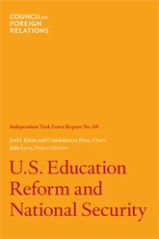
The 32 think-tank participants, organized as a Task Force by the Internationalist Establishment’s Council on Foreign Relations, included Linda Darling Hammond (of SBAC — “Smarter Balanced Assessment Consortium” — fame), representatives of large Gates-funded foundations like the United Negro College fund, the Carnegie-sponsored Institute of International Education, Joel I. Klein of the News Corporation, and former U.S. Secretary of State Condoleezza Rice.

The tangible product of their deliberations is a measly 121-page document titled “U.S. Education Reform and National Security.” It can be viewed at cfr.org, the official website of the Council on Foreign Relations.CFR TFR 68 Cover 20120313 AN B.indd

In this document, these self-appointed education gods bemoan the state of American education (presumably the result of the incompetent masses) without ever once giving consideration to the historical facts: (1) for nearly 200 years the entirely locally directed American education system was the envy of the world, and (2) as top-down federal meddling in education has increased, educational outcomes have consistently declined. If these dictocrats were sincere in their concerns, this historical evidence would demand that they put forward a very different solution from that called for in their 121-page document.

Their solution: the implementation of Common Core education and standards via a partnership between State Governors, corporations, and federal authorities; the use of federal dollars (our money) to incentivize (bribe) states into compliance with national education standards; and the oversight of local education by a broad coalition of corporate leaders, the federal Department of Education, the federal Departments of State and Defense, AND un-named federal intelligence agencies. This oversight is supposed to better prepare the human capital necessary for military service and national economic success.

Enforcement

How do they propose to enforce their top-down authority? Their scheme calls for intensive national evaluation (auditing) of teachers and schools. Audit focuses include: student mastery of Common Core content, mastery of “national security skills” (standards in science, technology, civics, etc.), and a vague statement about auditing the “characteristics of the school.” Where schools underperform, severe penalties are to be imposed, including the “reallocation of resources” (funding and human capital), the replacement of school leadership, and the top-down re-design or re-structuring of school systems.

While these penalties are to be imposed by State and local leaders, the audits are to be directed and published on the national level, effectively removing actual control over audits from state authorities and from the parents of the children who are affected.

I find the militaristic rhetoric of this private task force particularly alarming. Declaring education to be a national security issue (meriting oversight by intelligence agencies and the Department of Defense) lays the philosophical ground-work for a massive top-down power grab. History has shown that when education ceases to be about children and becomes an issue of national security the pretext for federal power becomes absolute. Those who resist or rebel against that power risk being labeled as enemies of the State.

Why We Should Be Concerned

Some may question why the recommendations of this private task force should concern us when they are just that — recommendations. First, this kind of high-level meddling and scheming in private forums provides no transparency to the general public. We are told only what they wish us to know. Second, those involved have clear conflicts of interest: They are the beneficiaries and Gods of the system they propose to impose on us. The power, control, and wealth, these corporacrats stand to gain — as long as Americans will meekly grovel before their statistics and criticisms for a few of our own tax dollars — are staggering.

Third, there is a consistent historical pattern over the past 100 years whereby American public policy is being shaped by corporacrats acting in collusion with high-level federal officials. The powers they seek to obtain and the process by which they are going about it are in direct violation of the Constitution of the United States, which clearly reserves both the direction of education and the establishment of public policy to the states and to elected representatives of the people respectively — not to political or corporate elitists.

The Take-Home Message

What is the take-home message? While many are busy obsessing over the details and drawbacks of Common Core, most remain blind to the bigger picture of what is happening. By simple definition these elitists are imposing a form of fascism on the American people that runs entirely contrary to the form of limited constitutional government established by America’s founders.  These insiders are using propaganda and big money to manipulate the American people into accepting their policies a piece at a time, while pretending that their schemes came straight from the grass-roots all along.

This deceptive power grab, now being carried out without our general knowledge or consent is unacceptable and dangerous. Public officials who sign onto these nefarious schemes are guilty of subverting the liberty of the people.   Inasmuch as any among us support and comply with these kinds of top-down power grabs, we are facilitating the destruction of our own liberty.


The Sovereign Dynamic

State legislators need to beware: Nothing written in a state’s application for a constitutional convention has any force or validity once that convention is called to order. That is the nature of a sovereign assembly. That explains why America’s founders put the needs of the people ahead of all state and federal mandates when they met in 1787. A brief look into the roots of America’s constitution-making system will confirm this essential truth.

Constitutional Conventions are Strictly American

It should be understood that constitution-making through the convention avenue is strictly an American affair. Civilian sovereignty as found in the United States is unknown to other nations where sovereign power is vested in kings and dictators. Under such forms of government the rulers have no need for a people’s convention. They have no reason to allow citizens to make the rules of government, for the monarch or the ruling elite hold all sovereign power. They devise their own structure of government and make and enforce laws according to their desires.

From colonies to states

Until 1775 the American colonies were bound by written charters under which Great Britain directed their governments. These charters were, of course, suspended the moment the colonies declared their independence; however,  three of the thirteen states retained their colonial legislatures and merely revised their charters to serve as constitutions.[1] In 1776, five states adopted constitutions in the same manner in which they would have passed mere statutes, without authorization from, or ratification by, the people. [2]

The origin of constitutional conventions

In 1777 the Massachusetts legislature set itself up as a convention and drafted a state constitution. This constitution was immediately rejected by the voting public who resented the legislature’s assumption that it could call a convention without first obtaining authorization from the citizens of the state.

The principal factor which defeated the Massachusetts constitution was the widespread belief that only the people could define their rights and determine their form of government. The voters insisted that the only valid kind of convention would consist of delegates to whom the powers of the people were delegated for the sole purpose of framing a constitution. It would not be a body of representatives entrusted at the same time with other duties.[3]

The following year the chastened Massachusetts legislature called upon the voters to state whether they wished a constitutional convention and whether they would authorize the legislature to call one. The vote on both questions was affirmative, and accordingly the 1780 legislature called a convention to draft a constitution, which became the present Massachusetts constitution.[4]

The experience of New Hampshire was very similar. In 1777 that legislature also met as a convention and drafted a constitution, which was rejected by the people. They rebuked the legislature because it was not within its authority to organize a convention and make its own rules of governance.

The principle of sovereign power      

Most of the other newly freed states also attempted to frame constitutions under their legislative powers as if they were passing ordinary statutes. Although these constitution-making efforts varied slightly from state to state, the sovereign principle was not fully established until the citizens rejected the statutory route and took charge of the convention process.

In 1781 and 1782 the citizens of New Hampshire authorized a convention following the example of Massachusetts. Both states held America’s first bona fide constitutional conventions, and their example was soon followed by the other states.[5] The people had rejected the statutory form of government-making, insisting that supreme sovereignty of a free state was vested in the whole body of the people having power to create or alter governments “deriving their just powers from the consent of the governed.”[6] Constitutional conventions came indirectly from the people who called upon their legislators to appoint deputies to create a political system that would bind state officers to specific spheres of activity and prohibit them from doing anything else.

The sovereign principle: well understood in the original thirteen states

Nearly all of the original state constitutions, or declarations of rights, affirm the fundamental right of the people to establish or change their form of government. The following list of quotations from these early documents may help establish this point.

Massachusetts — The people alone have an incontestable, unalienable, and indefeasible right to institute government; and to reform, alter, or totally change the same, when their protection, safety, prosperity, and happiness require it. (Massachusetts Constitution, Preamble and Bill of Rights, Art. VII, 1781)

South Carolina — Some mode should be established by common consent, and for the good of the people, the origin and end of all governments, for regulating the internal polity of this colony. (Preamble to the South Carolina Constitution, 1776)

North Carolina — All political power is vested in and derived from the people only. (North Carolina Constitution, Declaration of Rights, Art. I, 1776)

Maryland — All government of right originates from the people, is found in compact only, and instituted solely for the good of the whole. (Maryland Constitution, Art. I, 1776)

Virginia — When any government shall be found inadequate or contrary to these purposes, a majority of the community hath an indubitable, inalienable, and indefeasible right to reform, alter, or abolish it, in such manner as shall be judged most conducive to the public weal. (Virginia Constitution, Bill of Rights #3, 1776)

Pennsylvania — Whenever these great ends of government are not obtained, the people have a right, by common consent, to change it, and take such measures as to them may appear necessary to promote their safety and happiness…. The community hath an indubitable, unalienable, and indefeasible right to reform, alter, or abolish government in such manner as shall be by that community judged most conducive to the public weal. (Preamble to the Pennsylvania Constitution and Declaration of Rights, Art. V, 1776)

Georgia — The people, from whom all power originates and for whose benefit all government is intended. (Preamble to the Georgia Constitution, 1777)

New Hampshire — All government of a right originates from the people, is founded in consent, and instituted for the general good. (New Hampshire Constitution, Preamble and Bill of Rights, Art. X, 1784)

Delaware — All just authority in the institution of political society is derived from the people, and established with their consent to advance their happiness. (Preamble to the Delaware Constitution, 1792)

The federal convention system is born

The principle of a supreme sovereign citizenry was at the root of America’s constitutional convention system. The same format was used as the basis of the Federal Convention which met in Philadelphia in 1787. By virtue of the desire of free citizens to alter their form of government, the state legislatures were authorized to appoint deputies to act for the people in amending the Articles of Confederation.[7] The Continental Congress also acted on the matter by passing a resolution which attempted to set limits on the convention and required that it meet:

….for the sole and express purpose of revising the Articles of Confederation and reporting to Congress and the several state legislatures such alterations and provisions therein as shall when agreed to in Congress and confirmed by the states render the federal constitution adequate to the exigencies of government and the preservation of the Union. [8]

Members of Congress felt that this resolve would bring the acts of the proposed convention within the legal requirements of the Articles, since it was presumed that whatever was proposed by the convention must be agreed to by Congress and confirmed by all thirteen states. It should be noted that none of these mandates were upheld. The Convention of 1787 obeyed its call to convene, but ignored entirely the directives from Congress and the states. Why was this so? Because the deputies were proxies of the sovereign citizens for whom they were acting. As such, the Convention had every right to form a new government.

That is the power and dynamic of the American convention system. James Madison admitted that the Convention violated its orders from Congress and the states but rested his case on the final purpose of the Convention. “…if they [the Convention] had violated both their powers and their obligations in proposing a Constitution, this ought nevertheless to be embraced, if it be calculated to accomplish the views and happiness of the people of America.” [9]

Why must the sovereign principle be understood?

The origin and basis of America’s constitutional convention system is immensely significant. It shows that governments in the United States do not create or alter their own framework. As already noted, when the early legislatures attempted to create constitutions they were soundly rebuked by the voting public for the obvious reason that only the people can determine the system, limitations, and scope of their government. This is a permanent prerogative of all free people. “Whenever any form of government becomes destructive of these ends, it is the right of the people to alter or abolish it….” [10] Are not “we the people” just as sovereign today as we were 239 years ago when the Declaration of Independence was signed?

Turning the process upside down

Sadly, the current movement for a constitutional convention attempts to bypass the principle of citizen sovereignty. We the people rule the convention — not the state, not Congress, nor any government entity. An ambitious group of modern reformers insist, however, that 34 state legislatures have the power to limit the scope of a constitutional convention. What they are asserting is impossible. The state legislature is the creation of a convention and cannot also be its creator, nor can any elective body tell a convention what it can or cannot do. This principle was amplified by George Mason during the 1787 Convention: “Col. Mason considered a reference of the plan [the Constitution] to the authority of the people as one of the most important and essential of the Resolutions. The legislatures have no power to ratify it. They are the mere creatures of the State Constitutions, and cannot be greater than their creators.” [11]

This two-century old rule applies to all conventions called under Article V of the Constitution whether intended for a single amendment, multiple amendments, or for an entirely new government. During the Convention of 1787 Mr. Sherman noted that, absent any stipulations set forth in Article V itself, “future Conventions [would be free] to act in this matter like the present Conventions according to circumstances.”[12] Consequently, future conventions would be sovereign bodies as free as the 1787 Convention to act as circumstances require.

Citizens and state legislators must come to understand the American sovereign dynamic which places authority in its proper order, which recognizes the people as the supreme sovereign power of a free country. Ambitious and creative reformers have invented a whole new convention system. They have relegated the convention to a mere ratifying body and have made the state legislature the deliberative body. They have turned the sovereign principle upside down, making state legislators effectively superior to the citizens who created the framework of their governments.

Again, legislators need to beware: nothing written in a state’s application for convention has any force or validity once the convention is called to order. That is the nature of a sovereign assembly, and that explains why America’s founders put the needs of the people ahead of all state and federal mandates when they met in 1787.

If a modern convention is called, it will have every power held by America’s founders 228 years ago. Certainly a modern convention will have everything — everything except the moral and ethical integrity of George Washington, James Madison, Alexander Hamilton, and the other 52 men who gave birth to the document that Gladstone said was “the most wonderful work ever struck off at a given time by the brain and purpose of man.” [13] It is not likely that our Constitution could survive the mental and moral climate under which a modern constitutional convention would meet and deliberate.


[1] Massachusetts until 1780; Connecticut until 1818; Rhode Island until 1824.

[2] North Carolina, South Carolina, Georgia, Virginia, and New Jersey.

[3] Arthur Lord in II “Mass Law Quarterly,”1,5; cf. Journal, Mass. Conv., 1779-1780, p. 225

[4] George Tolman, “Preliminaries of the Concord Fight” (1902); 1917 Manual of the General Court (Mass.) pp. 86-87.

[5] As previously noted, Connecticut remained under its charter until 1818 and Rhode Island until 1824.

[6] From the Declaration of Independence.

[7] The Articles of Confederation was the “constitution” of the 13 states prior to ratification of the U.S. Constitution.

[8] Resolution adopted by the Continental Congress February 21, 1787.

[9] The Federalist no. 40.

[10] From the Declaration of Independence.

[11] Farrand, Records of the Federal Convention of 1787, Vol. II, p. 88

[12] Ibid., Vol. II, p. 630

[13] William E. Gladstone, Gleanings of Past Years, Vol. 7.

Expose the Article V Con-con Fraud — Report

Our  Expose the Article V Con-con Fraud Campaign Action Report targets, in particular, the “Convention of States” project — one of several insidious attacks on our Constitution using the pretext of addressing legitimate conservative concerns.  Please read the report, and, when you understand the danger, support our campaign to derail this dangerous threat.

Urgent action is called for as the deceptive campaign targeting state legislatures is very well organized.  [A link to this report and additional support can also be found on the “Expose the Article V Con-con Fraud” Campaign Page, accessible via the “Take Action” tab.]

Recommended actions are provided at the end of the Report and also on our “Expose the Article V Con-con” Campaign Page.

The online Campaign Action Report is recommended for emailing.   Hard copies of  this Report can be ordered below through Tools & Products. Note that 25 copies are only $6 including shipping and 100 copies only $15 including shipping. So please be aggressive in your plans.


It’s a Whole New Con-Con Game

I do not believe the Constitution could survive a modern constitutional convention (con-con). So for many years I have been on the front lines of the anti-convention fight. By 1983 a con-con drive had come within two states of the 34 required to trigger a convention. With a profound sense of urgency and the help of many friends we were able create a little breathing space by getting thirteen of the 32 states to withdraw their resolutions.

Again, in 1995 I faced a fierce con-con effort called the Conference of the States and soundly defeated that scheme in fourteen legislative hearings the same year.

The new onslaught

The year 2015 began with con-con bills looming up in many states. Most of them were promoted on the promise of adding a Balanced Budget Amendment to the Constitution. I did not realize the extensiveness of this new drive until research specialist Andrew Carver uncovered con-con bills pending in 40 states. His first alert warned us that hearings on four con-con bills in Wyoming were imminent. So by the quick action of Freedom First Society friends, led by coordinator Nancy Dunn, a large number of letters to the Senate Rules Committee arrived just in time to kill Wyoming’s HB 75, HB 121, SJ 4, and HJ 4.

As a seasoned con-con warrior, I had confidence in our ability to defeat these bills in legislative hearings just as we had done in years past. But I soon discovered that the 2015 convention drive was not business as usual. We faced a whole new con-con game. This new drive is far better funded, made up of multiple groups with “conservative” credentials, and based on cleverly twisted constitutional phrases calculated to mislead Republican state legislators.

These combined con-con forces had spent much of the preceding year laying the groundwork for their 2015 legislative offensive. They had met frequently with state lawmakers to assure them that the solution to our bloated, oppressive, federal government was in their hands — that through Article V of the Constitution the states were empowered to call a convention to rein in this federal monster. All the states would need to do is apply to Congress for an “amendments convention” for the stated purpose. Upon the application of two-thirds of the states (34), Congress would be required to call the convention.

Well, that’s a pretty compelling promise, especially when backed up by false statements attributed to our Founding Fathers and by the dishonest assertion that a state could limit and control the deliberations and proposals of a convention.

The skilled con-con artists make highly emotional pleas for action against the very real problems of costly, overgrown government. Although they correctly identify a very serious problem, their amendment “solutions” are the supreme non-sequitur. They go after some implied flaws in the Constitution rather than government violations of the Constitution that are at the root of our overgrown government problem. I marvel that so many intelligent state legislators get caught up in such a senseless answer to Washington’s disregard for the Constitution.

Those who oppose the con-con in Republican states face bills endorsed by the Republican legislative leaders, and in many cases by the Governor. Consequently most of the reports we received on this year’s committee hearings indicated that that they were merely showcase exercises rather than honest evaluations of the issue. In Utah, for example, Senate hearings on HJR 7 allowed no more than two opposing witnesses who were allowed no more than five minutes each. In Oklahoma the opposition to HJR 1018 was allowed no more than two witnesses to speak for only 90 seconds each! Obviously, a “do pass” was pre-determined and the hearings were shameful pretenses.

North Dakota Surprise

In the year 2000 I worked personally with Senator Duane Mutch who took the lead in rescinding North Dakota’s 1979 con-con application. So when six new convention-related bills popped up recently, I contacted the senator (now retired) for help in blocking these bills.

We had friends on the Senate Judiciary Committee, but we discovered that the bills had been assigned to the Senate Government and Veterans Affairs Committee (GVA), where we could not expect committee members to be sufficiently informed to stand against these deceitfully promoted measures.

Off to North Dakota

I could hardly sit back and watch another blindfolded committee fall for the lies and false promises of the Convention of States Project and their associates. So I decided personally to attend the Committee’s hearings and testify.   It was a good thing I did, because I became the only opposition witness to take the podium.

At the state capital in Bismarck all the big con-con guns were present: Michael Farris of the Convention of States Project; Nick Dranias of the Compact for America; William H. Fruth of the Balanced Budget Amendment Task Force; Roman Buhler of The Madison Coalition, and other pro con-con big shots.

The first of the six bills before the Senate GVA Committee was HCR 3015, calling for a constitutional convention for amending the Constitution, ostensibly to add a Balanced Budget Amendment.

Virtually all testimony from the con-con men began with the usual emotional rant concerning the horrible situation in Washington, the gargantuan $18 trillion national debt, our perpetually unbalanced federal budget, and warnings of the imminent collapse of the United States. All diatribes of the con-con lobby followed this pattern, some lasting for ten minutes. The North Dakota House and Senate sponsors did likewise.

Falsified purpose of Article V

The local sponsors were followed by Michael Farris who came to the podium with a ridiculous fairy tale about the purpose of Article V. I have re-printed here exactly as given by Farris colleague, Ken Coccinelli:

“Our Founding Fathers gave the states a method of proposing amendments to our Constitution to rein in the power and jurisdiction of the federal government. Proud Virginian George Mason insisted that one day the federal government would outgrow its bounds, and when that day came, the states would need to have the ability to amend the Constitution to limit the power of the federal government. An Article V Convention of States is the specific recourse he and our Founders put in the Constitution for that purpose.”  

Not one word of the above statement is true. It is not simply an outrageous lie, but it is a ludicrous assertion that Mason or anyone else would make such an out of context statement during the Convention of 1787.

My turn at the microphone

When called to the podium, I referred the committee to a news item in which the Nevada Assembly had expunged its 1979 con-con on the basis of fraud. I said, “The Assembly had been promised that a convention could be limited to consider only a Balanced Budget Amendment. Later, when competent legal scholars proved that a convention could not be so limited, the Nevada Assembly realized they had been deceived, so in 1989 they expunged their resolution from the record. The bill before us, HCR 3015, makes the same false promise.”

I added that similar dishonest allusions are in the other five bills to be considered here today. “Since the same principles apply to all six resolutions,” I suggested “that in deference to the Committee’s time, I will oppose the similarities now and not take time to repeat them during each hearing.” The committee chairman, Senator Dick Dever, seemed to appreciate that.

I began by refuting the assertion that George Mason said Article V was created for the purpose of reining in abusive, out-of-control government. “George Mason did not make that statement or anything like it. The Constitution that the Convention had just written already reined in the power and jurisdiction of the federal government. That was the whole purpose of the Constitution. It would have been ludicrous for Mason or anyone else to make such a statement.”

The sovereign principle

I also considered it essential to explain to the Committee the sovereign role of a free people, for unless this were understood, I would not be able to refute several other heresies that were written into their HCR 3015 and commended by the preceding witnesses.  I explained that constitutional conventions are uniquely American, based on the reality that in a free country the people are inherently sovereign; meaning superior to the governments they create. Article V, for example, empowers the states merely to apply for a convention, not to set rules or limits on it. And once two-thirds apply Congress has only the authority to set the time and place for it. Why is this so? Because the convention is a sovereign assembly, a higher power than whatever it creates. The state is the creature of a convention and cannot dictate to its creator, the people.

In keeping with this principle I explained that delegates at the Convention of 1787 did not really operate a runaway Convention. “Yes, they violated their mandate from Congress, and ignored the rules of their state resolutions; but as proxies of the people they had every right to create a whole new government. This is what conventions have the power to do. And this is the power future conventions will have because they operate under the sovereign authority of the people.”

State resolutions do not dictate the terms of the convention

As an obvious device to allay the very real threat of an out-of-control con-con and its potential to make radical changes in our form of government, the state resolutions are filled with rules and restrictions intended to limit the convention to specified subjects. By recourse to the sovereign authority of a convention, I told the committee: “All of your precautions are worthless and will be tossed out at the convention door. The state legislature does not dictate to its creator (the convention), and that is what you are now attempting to do.”

Following this, I went through several of the amendments Mr. Farris thought a convention should consider and showed how worthless they would be as restrictions on the power of government. I concluded my testimony with, “Mr. Chairman, not one person in favor of a federal convention has identified a single flaw in the Constitution that needs to be corrected.”

The rebuttal of Mr. Farris

Michael Farris loves to cite his credentials, his great knowledge, his experience before the U.S. Supreme Court, and his extensive travels, which he said would include another trip to Idaho next week.

After bolstering his qualifications, Mr. Farris said, “I must compliment Mr. Fotheringham on his scholarship. He is one of few opponents of our project who understands that the 1787 Convention was not a runaway convention. But regarding his knowledge of George Mason, his scholarship does not go far enough. Had Mr. Fotheringham gone online and searched the University of Chicago Law Journal, he would have found the words which he claims George Mason never made.” Farris then quoted a statement by Mason from the Journal; but it was not even close to the statement he had made earlier about Mason’s reasons for the convention route of Article V.

Farris then asserted that the convention route of Article V was for amendments only, and did not authorize the same kind of convention as the Convention of 1787, and that the states did have the power to set its agenda. He added: “The legislatures have a solemn duty to use the Constitution to restore fiscal responsibility and save the country from certain disaster. That is why our Founding Fathers gave us Article V. Now is the time to use it and the states must have the courage to act now while there is anything left of our country.”

In closing, Mr. Farris took a shot at The John Birch Society and said he knew that “Mr. Fotheringham was engaged in some infighting, or had some problems with the organization and I think he is now affiliated with some other similar group.”

I don’t think that attempt to damage my credibility had the ill effect Farris had expected; for my friend, former senator, Duane Mutch, had served many years in the North Dakota Legislature while a member of the Birch Society, and he was highly respected by his colleagues.

Back at the podium  

Unlike the showcase hearings reported in other states, North Dakota treated me with fairness and respect. The chairman, Senator Dever, never denied me the opportunity to return to the podium and rebut the assertions of any con-con advocate.

Back at the podium I said: “Mr. Chairman, with all due respects to Mr. Farris, I did indeed search the website of the University of Chicago Law Journal, and the statement attributed to George Mason is not there. What Mr. Farris quoted from the Journal today is not the same false statement he has been circulating in his testimony here and around the country. He cannot produce evidence that George Mason ever made such a statement, or even hinted that Article V was created to rein in some future out of control federal government.”

The multiple bill strategy

Another scheme unique to this year’s con-con game is the multiple bill strategy.   Many states hosted several con-con bills that vary slightly, such as demanding a balanced federal budget, imposing term limits, or just limiting federal power. Passage of any one of these would be counted as a convention call and this provided opportunities for the advocates to quell objections to one bill by offering another as an alternative. The six bills considered in North Dakota were examples of the multiple bill strategy.

No committee votes were taken on the day of the hearings, so I left Bismarck feeling good about my defense of the Constitution and my response to the con-con men who had descended on the state in full force. When leaving the statehouse I stopped to shake hands with Mr. Farris. I was not kindly received.

One week later the North Dakota Senate Government and Veterans Affairs Committee voted on all six measures. Four of the bills, HCR 3014, HCR 3015, HCR 3016, and HCR 3017, were formal calls for a convention. Three of these con-con bills (HCR 3014, HCR 3016 and HCR 3017) were defeated. The other bill, (HCR 3015), which was not defeated, was all the con-con men really needed. The other two measures heard on the same day were incidental to the convention applications. HB 1138 was for the adoption of an interstate “compact for a balanced budget,” which passed, and HB 1441 was to provide penalties should the delegates depart from the states’ con-con agenda, which also passed. Had both of these last two measures been defeated, it would have had no effect on the result they were after. They wanted a con-con application under any pretext and, after passage of HCR 3015 in the full Senate, they got their wish.

In my opinion, passage of at least one bill is the cunning purpose of the multiple bill strategy. I regard all six of North Dakota’s Constitution-tampering bills to be merely excuses for plunging the Constitution into a modern convention. I testified against each measure on grounds that the Constitution is not defective and that a modern convention would likely destroy what remains of this wonderful United States.

Off to Boise, Idaho

I remembered what Mr. Farris said about going to Idaho next week, so I headed to Boise. I was determined not to lose anything by default — and just as I suspected — two con-con bills awaited hearings at the Idaho statehouse. I met Sunday evening, March 22, with old friends and learned that one of the bills, HB 67, was scheduled for a hearing the next morning.

This was a bill to establish the selection of delegates to a convention, but not specifically a call for one. So I decided to ask my friends to attend the Monday hearing and testify against the bill. On Monday morning my very capable friends stood boldly against HB 67 and the measure was narrowly defeated in a Senate hearing by a vote of 5 to 4. A fantastic development that led to a victory this year in Idaho.

The other bill, H.R. 18, was the actual con-con bill and a real threat. I was prepared to testify against that bill. However, in view of the exciting defeat of HB 67, I was told that the measure would likely not come up and would therefore die upon adjournment, which was only a week away. And that was what happened. Typically, a bill’s sponsor seeks to avoid outright defeat and instead await a better time and climate.

I did not see the angry Mr. Farris in Idaho. Considering his feeble offensive in Bismarck, it is entirely possible that he remained in ND to counter my charges of fraud. With no one around to dispute his fairy tales, he may have won privately the “do pass” motion on HCR 3015. Mr. Farris seems to have an inside track and high-level influence in the Republican states.

It is not business as usual in this year’s con-con fight. We now face a more corrupt and more sophisticated strategy for plunging the United States into constitutional chaos and for inflicting irreparable damage on the freedom and independence of the United States.

More than ever it is essential to build an informed constituency that will create sufficient pressure on state legislators to overcome the influence of the con-con lobby.


Receive Alerts

Get the latest news and updates from Freedom First Society.

This will close in 0 seconds