Freedom First Society

Posts

“Fool Me Twice …”

Tens of thousands of high school students in cities nationwide plan to skip classes Friday [9-20-19] to attend Global Climate Strike marches calling for immediate action to end climate change. They will be part of a global joint protest aimed directly at the adults who they say are ignoring the destruction of the planet….

Students in more than 800 locations around the United States plan to go on strike from school for the day to attend protests. “It’s going to be a really, really powerful day, the launch of a new era of climate movement. This is just the beginning for us,” said Katie Eder, 19, who is the executive director of the Future Coalition, a youth-led non-profit helping the groups coordinate….

The protests are timed to begin a week of activism at the United Nations, including a Youth Climate Summit on Saturday and a UN Climate Action Summit on Monday. A second strike is planned for Friday, Sept. 27. — USA Today, 9-19-19

Media reports on the youth demonstrations conveniently ignore the revolutionary orchestration guiding the protesting students (e.g., the radical professors and/or outside adult revolutionaries — with subversive aims — motivating and guiding student action.)  By themselves, high school kids clearly don’t have the connections, independent funding, and experience to organize nationwide, let alone global demonstrations.  However, by ignoring the orchestration, the media helps create the illusion that the protesting students represent the genuine concerns of today’s responsible students.

And, of course, the reports completely ignore the subversive aims driving the “climate change” hysteria — unaccountable global power over you and me. That is the most important lesson for Americans to grasp.

More Americans also need to understand how they are being deceived. An old adage states:  “Fool me once, shame on you, fool me twice, shame on me.”  But how about “fool me a hundred times?”  Then we have a real problem.  The recent student demonstrations illustrate a shop-worn but proven revolutionary tactic for pushing totalitarian measures through a national legislature.

Revolutionary Parliamentarianism
In a secret Communist strategy paper, Jan Kozak, official historian for the Communist Party of Czechoslovakia, provided a thorough explanation of the tactic as it was used in the Communist takeover of Czechovakia following World War II. His original Czech paper was titled: “How Parliament Can Play a Revolutionary Part in the Transition to Socialism and the Role of the Popular Masses.”

The uncovered paper with commentary has since been published several times in English as a book under the title And Not a Shot Is Fired.  In his introduction to the American edition, John Howland Snow explained that the Kozak document is a blueprint for how a “representative government can be made authoritarian, legally, piece by piece. The form remains, an empty shell…. And not a shot is fired.”  (The complete RWU press edition is available online at www.robertwelchuniversity.org)

Freedom First Society published this summary of Kozak’s “revolutionary parliamentarianism” in its booklet The Marxist Attack on the Middle Class, (pp. 36, 37):

Revolutionary Parliamentarianism (a fancy name for the “pincers strategy”). This is a technique for driving change through a national legislature by applying “pressure from above and pressure from below.” Agents of the Conspiracy, using their influence with ostensibly independent grassroots organizations will stage protests and demonstrations demanding that the government take a particular revolutionary action. Other agents in government will introduce a measure claiming it is in response to popular demand. Their measure will be supported at the top by business leaders, think tanks, and scholars. The twin pressures are applied to other legislators making it difficult for them to say no.

The “Climate Change” Pretext
There are many fine books exposing the phony science and claims of the global-warming scaremongers as well as the serious consequences if they should have their way completely. However, most Americans don’t want to take a position on scientific disputes, phony or otherwise.   And the most serious consequence, loss of American freedom, has nothing to do with the science of climate change, anyway.

Nevertheless, it still helps to know that many prominent scientists dispute the man-made global warming scare.  (See, for example, Freedom First Society’s review of Steve Milloy’s 2009 exposé Green Hell, our 2018 post “UN Climate-Change Hysteria, and our 2019 post “Repeat a Lie Often Enough …”.)

Unfortunately, many responsible Americans are neutralized by media casting the battle as a mere partisan dispute over science.   And so these Americans never get to join the real battle. Yet they are desperately needed to help bypass the Establishment media and share the evidence, such as Masters of Deception, of high-level corruption in support of a subversive campaign that threatens our freedom.  So please share this post widely.
 

Tenth Circuit Rescues the Electoral College

The NPV (National Popular Vote) Compact has just hit a large bump in its road to “bypass the Electoral College.” On August 20, the Tenth Circuit Court of Appeals rescued that College from two centuries of distortion and misuse.  And by doing so, the court handed us a very big club with which to bludgeon the NPV campaign.

The NPV Compact is, in fact, a fine example of the abuse which this ruling calls on the carpet: By signing onto the NPV compact, a state agrees to coerce its presidential electors to vote a certain way — namely, for the party-ticket that won the national popular vote. Such coercion overthrows the whole purpose of the presidential-election system the Constitution outlines — commonly called the “Electoral College.” (See our earlier post, “Democracy, Tyranny, and the NPV Compact.”) The Constitution created the position of presidential elector in order that presidents (and vice-presidents) would be chosen by the considered, uncoerced discretion of people considered capable of choosing the candidates wisely.

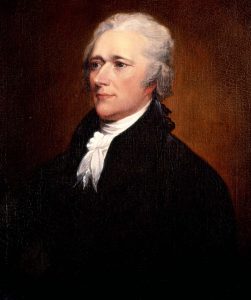
Alexander Hamilton, whose Federalist Paper 68 touts the Electoral College

The problem with the way the Electoral College has been working for two centuries is that most states’ laws have already, by various means, been putting heavy pressure on the state’s presidential “electors” to vote the way the state legislature wants them to — which is usually, to support the party-ticket which won the state’s popular vote. And the Tenth Circuit Court has now called “unconstitutional” the coercion of electors — or, to be specific, states’ punishing or removing the elector, or interfering with the (Constitutional) processing of the votes, when an elector casts any such (so-called) anomalous vote.

Remarkably, this “long train of abuses” has never been treated by the Supreme Court. Apparently that is because no state has ever actually carried out the prosecution of a so-called faithless elector, nor actually removed and replaced him or her, for any of the several historical “anomalous” votes — not until the State of Colorado did it in 2016.  It is ironic that the Colorado legislature signed onto the NPV compact, and yet — by trying to remove a “faithless” elector and to interfere with his vote — Colorado’s Secretary of State had already handed the federal courts a case by which they could address the whole issue.

Plaintiffs v. Colorado Secretary of State
The Tenth Circuit Court did address the issue; and we can give thanks that they handled it masterfully! The court concluded: “Article II and the Twelfth Amendment provide presidential electors the right to cast a vote for President and Vice President with discretion. And the state does not possess countervailing authority to remove an elector and to cancel his vote in response to the exercise of that Constitutional right.” (pp. 112–13)

But if the court’s conclusion is correct (and indeed, it is), then the whole NPV program, which is dependent on states’ passing laws that coerce the electors to vote a certain way, is — now officially— unconstitutional!  As reported by the Colorado Sun, current Colorado Secretary of State Jena Griswold, who seems shocked by the ruling, “said that since the 10th Circuit’s ruling says that Colorado law cannot compel an elector to vote one way or the other, the national popular vote compact’s mandates could be ignored under the decision. She reiterated, however, that she’s optimistic a remedy can be found before that situation would ever arise and her office is still reviewing the long, complex ruling to understand its impact.”

Given the Tenth Circuit’s watertight ruling, the “remedy” Secretary Griswold hopes for seems unlikely to appear, even if the case goes to the Supreme Court. Those battling the NPV have a major weapon now. Even states that have signed onto the NPV should repudiate their acceptance of it, given the Tenth Court’s demolition of their authority to enforce any such law.

Border Enforcement Duplicity

We’ve heard it from every quarter: our immigration system is “broken.” And the current border crisis seems to confirm this. But wherein does its “brokenness” lie?

No one disputes that incentives drive the “flood” of immigrants northward toward the U.S.: Specifically, such incentives comprise “push” factors (motivating the migrants to leave their former country of domicile) and “pull” factors (attractive features of the life they anticipate in the U.S.). And now almost everyone says the basic pull factor — or “magnet” — is the attraction of our government’s continuing practice of “catch and release” — though this term turns out to be imprecise, with no exact legal meaning:

There’s no hard and fast definition, but “catch and release” usually refers to U.S. immigration authorities’ practice of releasing unauthorized immigrants while they await immigration hearings, rather than keeping them in custody.

With some exceptions, only children and asylum-seekers are eligible for this kind of release. They often stay in the United States for months or years while their cases wind through the courts. Many of them do not show up for court dates and end up settling in the country without authorization. — Salvador Rizzo, President Trump’s claim that Democrats created ‘catch and release’ policies, April 4, 2018

There is no reason to deny such analysis regarding incentives. And clearly it implies that “catch and release” is a major cause of our system’s “brokenness.” But it is all the more remarkable, then, that this consensus as to one of our border problem’s major causes has led neither to any solution, nor to cessation of our government’s practice of “catch and release.”  Could it be that some high-level group designed this border problem never to see a solution?

The Government’s Excuse

For its part, the government holds a ready explanation of the reason for its continuing practice of “catch and release.” Media-gurus, political pundits, and officials in the Executive branch have been telling us — for years — that “our immigration laws need fixing!” For that law is — they say — full of “loopholes”!

Former DHS Secretary Kirstjen Nielsen’s standard blame-deflection went like this:

Until these loopholes are closed by Congress, it is not possible, as a matter of law, to detain and remove whole family units who arrive illegally in the United States.

So, according to Nielsen, the immigration law itself is tying the hands of the government.

President Trump has similarly blamed our immigration laws. On April 3, 2018 he complained, “We have immigration laws that are laughed at by everybody…​. We have to change our immigration laws.”

Former Atty. General Jeff Sessions intoned likewise that “as President Trump has warned, the need to fix these loopholes and weaknesses in our immigration system is critical and overdue.”

A recent version of this accusation says, more specifically, that a main “brokenness” in our immigration law is the part which deals with asylum. Media pundits, Executive Branch officials, and White House communications have all been decrying the “asylum loopholes” allegedly crippling our immigration system.

A White House “Fact Sheet” of April 29, 2019 entitled “President Donald J. Trump Is Working to Stop the Abuse of Our Asylum System and Address the Root Causes of the Border Crisis,” explained (red and italics ours):

THE ASYLUM LOOPHOLE: Migrants are flooding to our border to use asylum to gain entry into our country and remain here indefinitely.

  • Our immigration system has reached a breaking point as we continue to see an overwhelming surge of migrants, with more than 100,000 arriving at our border in March alone.
  • As a result of loopholes in United States immigration law, migrants claiming fear are often released into communities across the United States, where they often remain indefinitely.
  • In order to remain in the country, they often fail to show up to court hearings, fail to file an asylum application, or fail to comply with removal orders once their claims have been denied.

Trump echoed the lament on May 30, 2019:

Trump said on Thursday [May 30] that he would not be closing the border as he has threatened numerous times. “The asylum procedures are ridiculous,” he added. “No place in the world has what we have in terms of ridiculous immigration laws.”

Informed Rebuttals of the “Blame Congress and the Immigration Law” Explanation

The standard, “law-loopholes are preventing good border-enforcement” account of our border crisis has its skeptics, however. And most of these skeptics are not amateurs: Rather, they are professionals (including researchers, writers, and Border Patrol agents) who have made it their job to understand our immigration system — and its malfunctions.

For example, Daniel E. Horowitz — who has been explicating the legal and administrative aspects of immigration for years — wrote in a recent post:

How much longer are we going to allow lawless acts of past administrations and lower courts to flip immigration law on its head and act as if the laws themselves are the problems? Our immigration laws aren’t broken, it’s just that carefully selected lower courts violate those laws as well as Supreme Court precedent, plus the executive branch has refused to enforce many laws that haven’t even been tampered with yet by the judges. The American people never voted for the system in place to today. In fact, the people’s representatives voted for the opposite.…​

There is this dangerous perception that somehow our laws declared open borders or at least granted endless rights to avoid deportation until and unless we muster the votes to change the laws. The reality is the opposite.

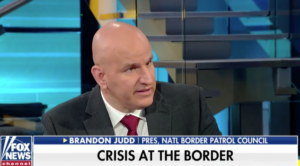
In a post earlier that month, Horowitz mentioned that this is the view also of Brandon Judd, head of the Border Patrol union (NBPC):

Brandon Judd, head of Border Patrol Union

‘Political pundits, talking heads, scholars and politicians have convinced the American public that only legislation can solve the problem. They say there are too many immigration and asylum loopholes preventing the government from deporting illegal border crossers in a timely manner. They are all wrong.’

Those were not the words of yours truly, but of Brandon Judd, the head of the Border Patrol union, in a Washington Times op-ed. He suggests we [should] actually just enforce the asylum laws [that are currently] in statute and have border agents at the front lines, not bureaucrats in other DHS agencies, take the lead on enforcement.

The talking point about the broken laws, in the media and even from the administration, have [sic] been so incessant and emphatic that most people probably think the laws require open borders unless Congress votes to change them. In fact, our laws are very clear that people who come to our border without proper documentation are all illegal aliens and must be deported. In 1996, Congress further updated those laws to preclude endless lawsuits.

Likewise, researchers and writers from the Center for Immigration Studies have rebutted much of this standard account of our border crisis.

Why It’s Untrue, that “Asylum Loopholes” in the Law Tie the Hands of the Executive Branch

The skeptics are correct — the ostensible loopholes are excuses without merit. In this section we will discuss the “asylum loophole,” which the above-cited White House Fact Sheet alleges. In a companion post, we discuss the other category of immigration-law loophole — those relating to minors and families — which the DHS (Department of Homeland Security) claims hinder the enforcement of our border.

There are at least four reasons why the narrative that “asylum loopholes have forced ‘catch and release’” does not hold water. Either of the first two demolishes the narrative all by itself. Let’s review all four, though — and make our point inescapable.

The President’s Unlimited Authority over Immigration

One thing that the media — who are helping push this false narrative — never tell the American people, is that the president has “plenary” (absolute, unrestricted) authority to exclude any and every alien he wishes — at any time. This is an authority that is subject to neither of the other branches of the federal government.

This plenary authority over immigration turns out to be both “inherent” and “delegated.”  The president’s inherent authority is built into the very structure of our federal government. The president’s delegated authority over immigration is that which the immigration statutes attribute to the president explicitly.

The president’s inherent authority over immigration is a foundational, long-standing principle of U.S. constitutional jurisprudence, recognized and openly acknowledged by the courts for over 200 years. The authority stems primarily from the president’s constitutional authority over foreign relations. (Aliens are, after all, foreigners, not U.S. citizens.[1])

One of the clearest judicial statements of this principle is in the Supreme Court’s opinion in Knauff v. Shaughnessy (1950):

The exclusion of aliens is a fundamental act of sovereignty. The right to do so stems not alone from legislative power, but is inherent in the executive power to control the foreign affairs of the nation.

However, to make sure everyone understands the president’s plenary authority to exclude aliens, our immigration law makes it explicit:

Whenever the President finds that the entry of any aliens or of any class of aliens into the United States would be detrimental to the interests of the United States, he may by proclamation, and for such period as he shall deem necessary, suspend the entry of all aliens or any class of aliens as immigrants or nonimmigrants, or impose on the entry of aliens any restrictions he may deem to be appropriate. — INA, §212(f); which is at Title 8 U.S.C. §1182(f)

Therefore, all the other immigration statutes, taken together, couldn’t “tie the president’s hands” if they tried! For this one provision implies that not only those whom the law excludes are to be excluded; but also, any and all whom the president excludes.

The Low Percentage of Arriving Aliens Claiming a “Credible Fear of Persecution”

The impression one tends to get from the media is that the immigration surges of 2018–​19 are, to a large extent, people seeking asylum. According to our same White House Fact Sheet, President Trump has said that “The biggest loophole drawing illegal aliens to our borders is the use of fraudulent or meritless asylum claims to gain entry into our great country.”

But based on reliable reports — including some from the DHS — no more than about 10% at any time have actually been claiming a “credible fear of persecution” — far less a percentage than that of “families” and “UACs” (Un-accompanied children) coming across the southern border. (Issues surrounding “families” and “unaccompanied children,” we discuss in our companion post.)

A DHS release of April 4, 2018 noted: “Before 2013, approximately 1% of arriving aliens claimed credible fear (asylum). Now 1 out of 10 claim credible fear.” And Carl Landrum, Deputy Chief Border Patrol Agent in the Yuma Sector (our third-hardest-hit sector, behind the Rio Grande Valley and El Paso sectors), stated in a Fox News interview on April 22, 2019 that in his area, “Only six percent of the people crossing the border are expressing a credible fear and requesting asylum.”

Daniel Horowitz finds that news disturbing: “This revelation means that our government has essentially vitiated the entire Immigration and Nationality Act (INA) and has declared a de facto open border.…​ We are shredding every word of the INA and processing and releasing almost all of these people, even those who don’t express a credible fear, rather than immediately placing [and keeping] them in expedited deportation.”[2]

The Extremely Low Percentage of Arriving Aliens Possibly Qualifying for Asylum

Another pivotal misconception which our media and Executive Branch have fostered is the notion that people fleeing violence or poverty in Central America are legitimate refugees. In fact, virtually none of them are. Rather, what they are is “economic refugees.” But the criterion which our law applies for refugee status (and thus asylum), is whether the alien has a “credible fear of persecution” — as that phrase is defined, very precisely, in our immigration law.

The crucial part of that definition to understand is the term “persecution”: Once you know the technical sense of that, you may understand why practically no one fleeing violence, poverty, disease, or what have you in Central America (or in Mexico) satisfies our law’s criterion for such a “credible fear.”

Here is our law’s criterion for a “refugee” — including what qualifies as “persecution,” in this context (emphasis in highlighted bold ours):

any person who is outside any country of such person’s nationality or, in the case of a person having no nationality, is outside any country in which such person last habitually resided, and who is unable or unwilling to return to, and is unable or unwilling to avail himself or herself of the protection of, that country because of persecution or a well-founded fear of persecution on account of race, religion, nationality, membership in a particular social group, or political opinion.

That definition is in Title 8, §1101(a)(42)(A) — which section, and which definition of “refugee,” are then referred to in §1158, “Asylum.”

So, if that’s what a refugee is, what exact level of proof makes it “credible” (in this sense) that a person has a “well-founded fear” of such persecution? Title 8, §1225(b)(1)(B)(v) gives this definition (emphasis in highlighted bold ours):

[T]he term “credible fear of persecution” means that there is a significant possibility, taking into account the credibility of the statements made by the alien in support of the alien’s claim and such other facts as are known to the officer, that the alien could establish eligibility for asylum under section 1158 of this title.

What constitutes a “significant possibility” is undefined in the immigration law, and the standard has not yet been discussed in immigration case law. However, a USCIS (U.S. Citizenship and Immigration Services) Basic Training Course for asylum officers has a helpful discussion of what constitutes that “standard of proof.”[3] After reminding readers that the alien is “the party who bears the burden of proof,” and discussing a range of “different standards of proof [which] are relevant in the immigration context,” this training course says that the “significant possibility” standard requires the person bearing the burden of proof to “demonstrate a substantial and realistic possibility of succeeding” in establishing eligibility for asylum under section 1158.  [Emphasis in original.]

Now, Central America countries — and Mexico, for that matter — are each made up of such a homogeneous mass of people, with regard to race, culture, and so forth, that these countries’ likelihood of having “persecution” for any of the above reasons is miniscule or non-existent. It is therefore (to use the USCIS training course’s terms) “a claim that has ‘no possibility of success,’ or only a ‘minimal or mere possibility of success,’ [and thus] would not meet the ‘significant possibility’ standard.”

Daniel Horowitz concurs:

This law was clearly written for a situation where a group is facing religious persecution, such as the Yazidis in Iraq. Nobody can say with a straight face that any of these people coming from the Central American triangle meet any of these five conditions [viz., persecution on account of race, religion, nationality, membership in a particular social group, or political opinion]. These are some of the most homogeneous countries in the world. There is no religious or ethnic persecution. And it is quite laughable to assume they are being persecuted for political opinions. Those teeming across our border are not a bunch of Madisonians railing against the lack of free markets in Honduras. — Daniel Horowitz, How Trump can protect the border without Congress

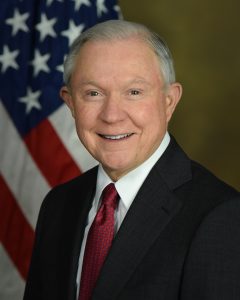
Jeff Sessions, former U.S. Atty. General

Thus, it’s clear that the legal standard of proof is being misapplied in credible-fear determinations — with disastrous results. Even Atty. General Jeff Sessions, speaking in October 2017, admitted that the credible-fear adjudication process was being “gamed”:

[T]he adjudication process is broken as well. DHS found a credible fear in 88 percent of claims adjudicated. That means an alien entering the United States illegally has an 88 percent chance to avoid expedited removal simply by claiming a fear of return.

But even more telling, half of those that pass that screening—​the very people who say they came here seeking asylum—​never even file an asylum application once they are in the United States. This suggests they knew their asylum claims lacked merit and that their claim of fear was simply a ruse to enter the country illegally.…​

The system is being gamed. The credible fear process was intended to be a lifeline for persons facing serious persecution. But it has become an easy ticket to illegal entry into the United States.…​

Our asylum laws are meant to protect those who because of characteristics like their race, religion, nationality, or political opinions cannot find protection in their home countries. They were never intended to provide asylum to all those who fear generalized violence, crime, personal vendettas, or a lack of job prospects. Yet, vague, insubstantial, and subjective claims have swamped our system.…​

… As one immigration judge recently told me about the credible fear process, “any adjudicatory system with a grant rate of nearly 90 percent is inherently flawed.” …​ We can elevate the threshold standard of proof in credible fear interviews.[4]

OK; but if they can elevate it — why haven’t they done so? According to Jessica Vaughan of the Center for Immigration Studies, there have been “reports from whistleblowers at USCIS who say that [USCIS] asylum officers [currently the ones handling all fear-claim interviews] have been instructed by resistant career supervisors to ignore efforts by the Trump administration to return to deciding these cases according to the letter and intent of the law.”[5]

The Necessity that Arriving Aliens Pass a “Credible Fear” Interview or Review

Yet another misconception which media and Executive Branch officials promote is the idea that any arriving alien can just claim a “credible fear,” and they will be released to await their asylum hearing. That is, the media never make clear that arriving aliens who cannot show valid documentation of legal immigration status are each put, immediately, into “Expedited Removal Proceedings” — and kept there until removal, unless that arriving alien instigates and passes a “credible fear interview,” (or an administrative review of that interview).

In short, as long as the alien is in Expedited Removal, they are held in mandatory detention. Thus, there is no question at all of some alien, having just arrived, being “caught and released” legally.

There is a lawful process which is, sometimes, informally classified as “catch and release” — but more properly called, “parole” — but one must argue that, administratively, in many cases it’s given too eagerly after a determination of “credible fear.”.[6] But neither that legal procedure, nor any “asylum hearing,” is available legally to “arriving aliens” by their simply showing up and claiming a “credible fear” of persecution.

Rather, an “asylum officer” (who is from USCIS, as things are working currently,) conducts an “interview” regarding the alien’s credible-fear claim; and based on this interview, makes a determination regarding this claim. If that determination goes against the alien, and he or she wants to contest it, they can ask for an “administrative review” — which will be before an EOIR “immigration judge.” But all of that happens as part of what’s called “Expedited Removal Proceedings,” into which all “arriving aliens” (and some others) who have no documentation of legal immigrant status are placed automatically.[7] (An important qualification: “Expedited Removal” is not the process which the law stipulates for “unaccompanied alien children,” or “UACs”; we discuss those in a separate, companion post.) And detention is mandatory all through those proceedings, according to the law.[8]

In contrast, an “asylum hearing” does not happen for any such (adult) “arriving alien” unless the alien has been determined (during expedited removal) to have a “credible fear of persecution,” and been therefore removed from “expedited removal” proceedings and placed into “formal removal proceedings,” and allowed to make formal application for asylum. And only once they’ve made such application are they eligible for “parole.” And that is what so-called catch-and-release is, for “arriving aliens” — a “parole,” under Title 8 §1182(d)(5).

Legally, then, they cannot be paroled until they’ve been “determined” to have a “credible fear of persecution.” All of which implies that if they fail in that determination — and virtually all Central Americans would fail, were the determination conducted according to statute — then there’d be no question of our immigration authorities ever paroling them, legally, into our country. Ending the fraudulent determinations that these aliens have a “credible fear” would, therefore, end their “catch and release.”

Locating Our Immigration-System’s Real “Breakage”

Besides those related to asylum, there are other alleged “catch and release loopholes” which need addressing as well, such as those pertaining to “unaccompanied minors” — all of which we discuss in a companion post. Taking also those into account, we could summarize the “immigration loopholes” situation this way:

  • The DHS and DOJ are applying an inexcusably and illegally low standard of legal proof, in their credible-fear determinations. And this is the only reason that the vast majority of adult arriving aliens from Mexico or Central America are allowed out of Expedited Removal — with its mandatory detention — and (then) considered for parole (one kind of “catch and release”).
  • As we discuss in our companion post, the government is granting a thoroughly undeserved deference to the dubious features of Judge Gee’s 2015 ruling(s) on the FSA (Flores Settlement Agreement) — including a pivotal one that the Appeals Court overturned! And this is the only reason the government is saying that it must release minors within 20 days — and that it must release whole alien families that happen to include a minor.

Contrary to representations by the president, DHS administrators, and media, though, none of this is a matter of immigration law, or of the FSA (which has the force of law). Furthermore, even if the law did have an actual “loophole,” the president would not thereby be prevented from using his full, plenary authority to restrict — or even to shut down — immigration!

Thus, the loophole-skeptics are correct: there is no law-problem; there’s only an implementation-of-law problem, a lack-of-enforcement problem.[9] In short, contrary to repeated claims by the Executive Branch and the media, the president has by no means required Congress to close alleged “loopholes,” in order to secure our border.

Of course, there are logistical challenges to stemming the current flood. But historically, the hope of catch-and-release has created most of the “magnet” attracting immigrants. And removing the main “pull” factor — that magnet — would have no less impact on the flow than had the mere anticipation of catch-and-release ending, which anticipation slowed immigration dramatically in the wake of Trump’s 2016 election. The logistical challenges could then be handled, as we have handled them in similar (if smaller) border crises time and time again.

Accounting for This Inversion of the Truth

The story of the immigration law’s culpability for our border crisis is so patently, undeniably false, that there is really only one way to account for its dominance in the media and Executive Branch statements: which is, orchestrated duplicity. More specifically: it is an agreed duplicity on the part of much — we’d estimate, most — of the media, and of many top administration officials, lower court federal judges — and even of many Congress-people, insofar as they remain silent in the face of this dangerous disinformation. But what could be motivating this orchestration of duplicity?

Well, if we recall that the Establishment — which controls most of the institutions spouting this story — wants open borders (as the FFS has often documented), then several plausible motives come to mind:

  1. Laying the blame on Congress and immigration law diverts the public’s attention from, and tends to keep them ignorant of, those places in which the system is indeed broken (namely, poor enforcement of the law) — which diversion is crucial for continuing or growing the crisis.
  2. Also, such misdirection has the potential — very appealing to the Establishment — of convincing the public (finally) that our immigration law needs a major overhaul — which overhaul, given Congress’s increasingly wishy-washy stance for strong borders, might well eviscerate our (heretofore basically sound) immigration law.
    • Even if failing to find consensus for a major overhaul (a.k.a. “comprehensive immigration reform”), those seeking open borders may find enough consensus for one or more “amnesties” — which helps keep the crisis boiling.
  3. Also, this crisis offers the ever-increasing possibility (again, appealing to the Establishment) of getting the public to accept an international “resolution” of the problem — which would make permanent of course, rather than repair, our loss of control of our border — through further bilateral agreements with Mexico and/or Central American countries, for example, or even reviving the development of a North American Union, and/or through inviting U.N. “Peacekeeping” troops in — “to help.” Any of those approaches to a “solution” would seriously sabotage our national sovereignty and independence.

There is, therefore, no reason to doubt that the current border crisis is intentional — created, not by Congress, but by conspiratorial elements controlling our media and Executive Branch (with supporting roles played by a few lower-court judges). And this lie about “immigration loopholes” is the main tactic keeping the public from realizing the true cause of the problem — which is intentionally inadequate enforcement by our government’s law-enforcement branch (the Executive).

What to Do

Clearly, the only way that this non-enforcement will be remedied, is for an informed, activated electorate to apply concerted pressure on the government to remedy it. But an electorate not informed, will certainly neither be activated. So, the widespread exposure of this fraudulent “loopholes” tactic is key. That is the most obvious mission we must undertake, therefore.

Less obvious is that we must also use such educational effort to grow — as rapidly as possible — the reach and level of understanding of the Internationalist, conspiratorial intrigue that is seeking to strangle our national sovereignty, independence, and freedom. Indeed, if we neglect this latter mission, then the public’s demand for border enforcement will continue to be betrayed, as it has been for decades.

Both of these are crucially important tasks. In pursuit of the first, if this article has been found enlightening and helpful, then it is certainly worthwhile to share it with friends and acquaintances.

Notes


1. And as such, they have no standing in courts mentioned in or created under the Constitution (in Article III). That is the basic reason the president is not subject to these courts’ rulings on immigration matters. However, note that the president does have a constitutional obligation to restrict immigration at least as much as the immigration law does — since he is responsible to enforce the laws. On the plenary authority of both “political” branches (i.e., the Legislative and Executive branches) over immigration, see the CRS (Congressional Research Service) Report 44969, “Overview of the Federal Government’s Power to Exclude Aliens”; and, for a much fuller and absorbing treatment, see chapters 4–​8 of Daniel Horowitz’s insightful 2016 book Stolen Sovereignty: How to Stop Unelected Judges from Transforming America, Washington, D.C.: WND Books.
2. It seems disingenuous, therefore, to imply that asylum-claims are “tying the hands of” the Border Patrol. What are actually tying their hands are: the taking care of immigrants who arrive sick or hurt themselves clambering over a barricade (an agent must also stay with the immigrant while he/she receives medical care); and also — believe it or not — the running a courier service, to bring in immigrants who are waiting on the other side of the wall! This astonishing DHS policy forced Mr. Horowitz to ask: “[I]f we actively bring in even the illegal immigrants standing outside the fence and believe it is our duty to do so, then what would change if we had more walls?”
3. The training course is cited, on this matter, by the CRS (Congressional Research Service) “Legal Sidebar” 10150, “An Overview of U.S. Immigration Laws Regulating the Admission and Exclusion of Aliens at the Border.”
4. Andrew Arthur of CIS reported that “Credible fear is found in 75 to 90 percent of all cases reviewed by asylum officers.”
5. The quotation is via Daniel Horowitz. Ms. Vaughan suggests strongly, as a remedy for this perfidy, that Border Patrol agents, who are valid “immigration officers,” be trained therefore also as Asylum Officers — the kind of immigration officer which the law requires to conduct all credible-fear interviews — and then be allowed to handle such interviews, rather than being forced to hand over all credible-fear claimants to USCIS Asylum Officers. Brandon Judd, head of the Border Patrol union (NBPC) is strongly in favor of that as well — as is Daniel Horowitz.
6. The reasons for which the regulations and/or administration allow such a parole have traveled a long way from what the law stipulates: The law’s criterion for parole is that it must be for “urgent humanitarian reasons” or “significant public benefit.” But the federal regulations (at 8 C.F.R. §212.5(b)(5)) make the nonsensical determination that this criterion for parole is satisfied for an alien “whose continued detention is not in the public interest.” (Why would it ever not be “in the public interest,” to detain until their removal aliens who have — according to our immigration law — no legal status or permission to be here?) Then, ICE Directive 11002.1 establishes that criterion as automagically satisfied for aliens found to have a “credible fear.” However, one weighty proviso in the regulations — carried over into the Directive — is also being cynically overlooked: the parole is to be awarded only “provided the aliens present neither a security risk nor a risk of absconding.”
7. A helpful, brief summary of the various proceedings, rules, and laws pertinent to admission or exclusion of aliens is available in the CRS (Congressional Research Service) “Legal Sidebar” 10150 — although it exaggerates the power and significance of the FSA, and especially of Judge Gee’s 2015 ruling (on which, see our companion post). This author found even more useful a pictorial representation of the different legal statuses “arriving aliens” go through, related to “expedited removal proceedings”; and so, has diagrammed the various state-changes — and events causing them — in the form of a UML “state-machine” diagram, which one may download from our server. (For any shortcomings of this state-diagram, the author is of course responsible.)
8. Nor can any lengthy delay precede any “administrative review” of their credible-fear interview’s determination: On the contrary, according to the law, this review “shall be concluded as expeditiously as possible, to the maximum extent practicable within 24 hours, but in no case later than 7 days after the date of the determination.”
9. However, something was put into law, so to speak, which was a sort of “loophole”; but it was not in immigration law, but in a short-term funding bill — and not until this year. That was the horrible stipulation, as to expenditure of the funds, in sec. 224(a) of the budget bill Trump signed on February 15. Thankfully, this toxic provision expires when the funding expires — at the end of September.

Groundless “Catch and Release” of Alien Minors

One principal explanation for our ongoing “catch and release” border policy — according to the Executive Branch and most of the major media — is that:

Legal loopholes are exploited by minors, family units, and human smugglers, and are a magnet for illegal immigration.…​ These loopholes create a pull factor that invites more illegal immigration and encourages parents to pay and entrust their children to criminal organizations that will smuggle them in — often while abusing and molesting those children along the way.  — DHS Release, Unaccompanied Alien Children and Family Units Are Flooding the Border Because of Catch and Release Loopholes, Feb. 15, 2018

The two “legal loopholes” which this DHS (Department of Homeland Security) Release cites are the Flores Settlement Agreement (FSA), 1997, and the William Wilberforce Trafficking Victims Protection Reauthorization Act (TVPRA) of 2008. The Release claims that these mandate, effectively, the Executive Branch’s “catch and release” policies for “unaccompanied alien children” (UACs), and for “family units” as well.

However, a careful look at these alleged loopholes shows that blaming them for “catch and release” is a red herring. Let’s examine each of these “legal loopholes” — in chronological order of creation — and what the DHS claims about them.

The Flores Settlement Agreement (FSA)

The DHS Release wails and gnashes its teeth about the 1997 Flores Settlement Agreement — and, how it has spawned “multiple onerous court decisions that handicap the government’s ability to detain and promptly remove UACs.” More specifically, it alleges that the FSA handicaps such ability in two ways:

  1. “Under the Flores Agreement, DHS can only detain UACs for 20 days before releasing them to the Department of Health and Human Services which places the minors in foster or shelter situations until they locate a sponsor.”

But the limit of “20 days” appears nowhere in the Flores Agreement; it says only that the government must release a minor “without unnecessary delay.” In fact, it was Judge Dolly Gee, of the Central California Federal District Court, who in her ruling of July 24, 2015 read into that phrase, arbitrarily, the “20 days” meaning.

Moreover, the FSA applies the “without unnecessary delay” stricture to the minor’s release, only when “the INS determines that the detention of the minor is not required either to secure his or her timely appearance before the INS or the immigration court, or to ensure the minor’s safety or that of others.” [Emphasis ours.] So, if DHS could realistically say that, as a general rule, these minors were not going to show up for their removal hearings, then detention would seem absolutely “necessary [in order] to secure his or her timely appearance before the INS or the immigration court”; and thus, the FSA would not be mandating their release from detention.

But the DHS can realistically say that these minors are not generally going to appear — and indeed, they and other experts have often so implied. In fact, in this very Release the DHS complains that “UACs frequently abscond and fail to appear for their removal hearings before an immigration judge — with 66% of all removal orders for UACs from FY15 to FY17 resulting from a UAC’s failure to appear for a hearing”! How, then, can they turn right around and claim that under the FSA, “DHS can only detain UACs for 20 days before releasing them”?

  1. The second way DHS claims that FSA — or at least, “recent rulings in the Flores consent decree litigation” — have handicapped the government is that it requires the government to release (without unnecessary delay) not just minors, but also any “family units” that happen to contain a minor.  According to the Release:

The 100,000+ UACs who were released [from FY16 to date] are in addition to the more than 167,000 family units (i.e. alien children who are accompanied by an adult claiming to be a relative or guardian) that were apprehended by U.S. Customs and Border Protection from FY16 to date.

    • Nearly all of these Family Units are released into the interior of the United States because of judicially-imposed constraints on ICE’s authority to detain the entire family units as a result of recent rulings in the Flores consent decree litigation. [Italics ours; bold in original.]

This claim that parents of minors must, in general, be released with their minor children is so duplicitous, it’s astonishing. Here again, the FSA said no such thing: this is another invention of Judge Dolly Gee’s 2015 ruling. But don’t take our word for it: on this we can cite the cogently-argued ruling of the Ninth Circuit Court of Appeals (to which the government appealed Judge Gee’s ruling) in this very same case (Flores v. Lynch).

A year after Judge Gee’s District Court ruling, the Ninth Circuit Appeals Court overturned that ruling’s part which said the FSA gives minors’ parents a right to be released. Judge Andrew Hurwitz, writing the opinion for the Ninth Circuit Court, made it unequivocal that: “The district court erred in interpreting the Settlement to provide release rights to adults. The Settlement does not explicitly provide any rights to adults.…​

The fact that the Settlement grants class members [of this lawsuit] a right to preferential release to a parent over others does not mean that the government must also make a parent available; it simply means that, if available, a parent is the first choice. — U.S. Court of Appeals for the Ninth Circuit Opinion on the ‘Appeal from the United States District Court for the Central District of California,’ July 6, 2016, pg. 19

Thus, according to the Ninth Circuit Court ruling in this case, the Flores Agreement has no requirement whatsoever that family units containing minors be released.[1]

The 2008 “Trafficking Victims Protection Reauthorization Act” (TVPRA; a.k.a. “The Wilberforce Act”)

The other “legal loophole” which the DHS Release cites is the 2008 TVPRA, or “Wilberforce Act.” The DHS Release suggests three distinct ways in which the TVPRA presents “catch and release loopholes.”

The Release’s arguments for changing these provisions of the TVPRA are all reasonable. But none of them is at all convincing as to why “catch and release” is continuing. For none of the three TVPRA provisions is at all capable of causing“catch and release.”[2]

Thus, none of the “catch and release loopholes” which the DHS Release attributes to TVPRA seem genuine. On the other hand, the implementation of TVPRA has been disastrously mishandled — in ways that are tantamount to “catch and release” and do contribute greatly — and obviously — to this “magnet” that is causing recent border surges. It is worth taking a minute to see that these are not problems with our immigration law, but with how — and to what extent — the Executive Branch is enforcing it.

The serious problems in the way the government is implementing TVPRA are twofold:

  1. they are ignoring TVPRA’s broad inapplicability to an immigration-inflow with few genuine UACs in it (“unaccompanied alien minors”).[3] And,
  2. they’re likewise ignoring the illegal immigrant-status of the vast majority of sponsors (including parents or legal guardians) the minors are being placed with.[4]

Yet, again, this is all a matter of horrendous misapplication — rather than of bad law. Thus, as far as the TVPRA itself is concerned, it is hard to improve on CIS researcher Jessica Vaughan’s summary of its (non-)impact on the Executive Branch’s authority:

     To be sure, the Wilberforce Act [i.e., TVPRA] could stand some tweaking. It complicates the processing of apprehended illegal-alien children from countries other than Mexico in ways that are easy for the immigration-advocacy industry to exploit, and it has proven to be very costly to administer.

     But this law is not the main problem. Even if this Congress could agree on a fix, the effort would only distract from the larger issue of inadequate enforcement generally. It can be reasonably argued that most of the new illegal arrivals — including many of the children — are not even covered by the Wilberforce Act, since they were not victims of trafficking and are no longer unaccompanied after being reunited with their families…. Lawmakers should recognize that once again it is the president’s interpretation of the law that is the problem, not the law itself. — Jessica Vaughan Don’t Blame the Border Crisis on a “Bush-Era” Law

Conclusion

This and other DHS statements about the border crisis have claimed that both “legal loopholes” and “asylum loopholes” (as we discuss in a companion article) are “tying the hands” of the Executive Branch, such that:

we are stuck with a system that sanctions catch and release. Due to legal loopholes and court backlogs, even apprehended illegal aliens are released and become part of the temporary, illegal population of people that we cannot remove. — DHS Release, Ibid., Feb. 15, 2008 [Emphasis ours.]

But it turns out this is just histrionics and hot air. The American people need to be aware of the falsehood of these claims. For they need to know where, precisely, and why our immigration system is breaking down.

And — even more importantly — they need to understand (as we discuss further in a companion article) that powerful, nefarious conspirators are trying to deceive us about it, hoping to leverage our misunderstanding so as to remove our control of our borders — on the way to destroying our limited-government system and our national sovereignty.

Notes


1. For another thing, even this imaginative construction in the 2015 ruling was crucially qualified — in a way the DHS Release neglects to mention: According to Judge Hurwitz (on pg. 4), the District Court ruling by Judge Gee “ordered the government to:
(1) make ‘prompt and continuous efforts toward family reunification,’
(2) release class members [of this lawsuit] without unnecessary delay,
(3) detain class members in appropriate facilities,
(4) release an accompanying parent when releasing a child unless the parent is subject to mandatory detention or poses a safety risk or a significant flight risk,
(5) monitor compliance with detention conditions, and
(6) provide class counsel with monthly statistical information” (emphasis ours).

Yet, arriving adult aliens are always subject to “Expedited Removal Proceedings” (unless and until determined to have a “credible fear of persecution”) — which do entail mandatory detention!

2. The three TVPRA provisions the Release cites are:
(1) “Under TVPRA, UACs [‘unaccompanied minors’] who are not from Mexico and Canada are exempt from prompt return to their home country [because, instead of being returned almost immediately, they must be put into “formal removal proceedings,” and transferred to the custody of the Dept. of Health and Human Services (HHS)]. We must amend the TVPRA so that all UACs who are not victims of human trafficking, regardless of country of origin, can be safely and promptly returned to their home countries.”
The problem here is that “not returned immediately” does not logically imply, “caught and released.”
(2) “We must amend TVPRA to limit the period to file asylum claims for UACs to one year consistent with all other applicants for asylum and ensure that these asylum cases are heard only in immigration court (no second bite at the apple).”
(3) “We must end abuse of the Special Immigrant Juvenile (SIJ) visa to ensure the applicant proves reunification with both parents is not viable due to abuse, neglect, or abandonment and that the applicant is a victim of trafficking. This is necessary as many UACs are able to obtain a Green Card through SIJ status even though they were smuggled here to reunify with one parent present in the United States.”
This is a reasonable suggestion. But to allege this visa-law’s causal connection with “catch and release” overlooks that going through the process of applying for, and (eventually) receiving, a residence visa is not a sort of thing which people refer to as “catch and release.”
3. The legal sense of “UAC” (Unaccompanied Child) entails that “there is no parent or legal guardian in the United States; or no parent or legal guardian in the United States is available to provide care and physical custody” (emphasis ours).
Given this legal sense of the term, the TVPRA appears to be inapplicable to a vast majority of the children coming in the current border surge. As Daniel Horowitz writes (for Conservative Review), “a vast majority are placed with parents or other relatives who are already in this country illegally.” Andrew Arthur of the Center for Immigration Studies (CIS) corroborated that in 2018: “In FY 2014, according to the Congressional Research Service (CRS), most of the UACs who were released were placed with parents or legal guardians.” And CIS’s Jon Feere, in 2014, commented: “According to advocates and media reports, around 90 percent of non-Mexican and non-Canadian children coming across the border are placed with family or guardians in the United States.”
4. Joseph Kolb is one of few authors to have brought this second issue to light (emphasis in bold here ours):
“The TVPRA calls for the HHS secretary to have the [unaccompanied] children promptly placed in the least restrictive setting that is in their best physical and emotional interest. This is the loophole HHS uses to place children with designated sponsors [who are] illegally in the United States. The law only refers to checking the sponsors’ immigration status, not [to] acting upon it. The perception by ORR [Office of Refugee Resettlement, within HHS] is that regardless of immigration status, placing the children with a parent is the preferred solution. The AP report found that more than 50 percent of the children were placed with parents.”

The Only Responsible Option

(adapted from Freedom First Society’s June 2019 Action Report)

“[T]here is no secret about how [China] plans to destroy American aircraft carriers if rivalry becomes war….

“China’s military is now making giant strides toward replacing the United States as the supreme power in Asia. With the Pentagon distracted by almost two decades of costly war in the Middle East and Afghanistan, the Chinese military, the People’s Liberation Army (PLA), has exploited a period of sustained budget increases and rapid technical improvement to build and deploy an arsenal of advanced missiles.

“Many of these missiles are specifically designed to attack the aircraft carriers and bases that form the backbone of U.S. military dominance in the region….” [Emphasis added.] —  “Special Report: New missile gap leaves U.S. scrambling to counter China”— Reuters, 4-25-19

Even More Serious!
We must not forget that China is a threat today only because American Insiders enabled the Communists to take over China and nurtured Red China to become a world power. Those same forces dominate our media and government today and are using the China threat as part of their plan to enslave us all.

The Reuters’ claim that the Pentagon was “distracted” is simply distraction.  The “Special Report” continues:

“For more than half a century since China’s ruling Communist Party took power in 1949, a vast but technologically backward PLA [People’s Liberation Army] was largely confined to the Asian mainland and coastal waters.”

Obviously, no backward socialist economy develops economic and military prowess without outside help.

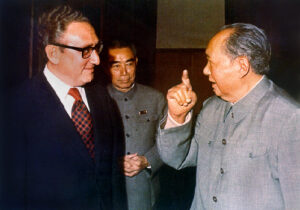
So what enabled China’s “sustained budget increases”?  Arch-Insider Henry Kissinger owns major responsibility for building Communist China into a world economic power.  His secret diplomacy with China under President Nixon opened up diplomatic relations. (See nearby photo of Kissinger with Chinese butcher Mao.)  Later, his firm, Kissinger Associates, helped transfer U.S. manufacturing and industry to China, sabotaging American middle class opportunity.

After the Red regime massacred the Chinese demonstrators in Tiananmen Square, Kissinger would defend the brutality. According to the Wall Street Journal, Kissinger Associates had a $7 million contract with the Chinese government.  Yet when Nikki Haley was appointed as U.S. Ambassador to the UN in 2017, she sought out Henry Kissinger as her personal foreign policy mentor. And, in September of last year, Haley misled conservatives with this assurance on Fox & Friends: “And Dr. Kissinger, you never have to worry that he’s not on America’s side.”

The Internationalists must also be pleased that China has leverage over the U.S. through China’s ownership of over $1 trillion of our national debt. A May 21 report on the Internationalists’ ForeignPolicy.com, “China Raises Threat of Rare-Earths Cutoff to U.S.,” points to further leverage: “Beijing could slam every corner of the American economy, from oil refineries to wind turbines to jet engines, by banning exports of crucial minerals.”  Thank you, Dr. Kissinger!

How about China’s “rapid technological improvement”?  President Bill Clinton should have been impeached over the Chinagate revelations — the corrupt transfer of U.S. military technology and industry to Communist China.  On August 25, 1988, House Majority Leader Dick Armey (R-TX) responded to the revelations: “The more you look into this business of the transfer of advanced, sophisticated technology to the Chinese military, which seems to be clearly for campaign contributions, the harder it is to stay away from words like treason.”

Managed News
Yet an irresponsible House of Representatives, under Establishment pressure, ignored these revelations in its articles of impeachment and, with media help, led the public to believe that President Clinton was impeached (but not convicted by the Senate) merely for “lying about sex.” Our Establishment media has insured that the public forgets about the Chinagate revelations.  Even during the recent investigations into Russian interference in the U.S. presidential elections, the documented evidence of China’s previous interference was ignored.  The American people are not victims of biased news, they are subjected daily to managed news serving totalitarian power grabs.

One facet of that managed news is to ensure that Americans forget the history of Internationalist betrayal.  Consider the following “conveniently forgotten” history, supported by several extensively documented books:

In early 1946, the Nationalist Chinese forces had Mao’s Reds on the run.  However, President Truman had sent General George C. Marshall to China to mediate the fighting, and Marshall forced Chiang to accept a cease-fire (one of several). Marshall would boast: “As Chief of Staff I armed 39 anti-Communist divisions, now with a stroke of the pen I disarm them.”… The Soviets, meanwhile, equipped Mao with vast stores of U.S. military supplies Truman had provided Stalin for the assault on Japan.

In early 1949, John F. Kennedy, a young second-term congressman from Massachusetts, protested the betrayal:  “What our young men had saved, our diplomats and our President have frittered away.”  Later, as Secretary of Defense, Marshall would also prevent General MacArthur from winning the Korean War.

Orwell’s 1984 at Work
The Insider China perfidy was not limited to economic and technology transfers.  As National Security Advisor under Nixon, Kissinger also implemented the one-China policy that betrayed our Nationalist Chinese ally on Taiwan.  In 1971, Red China took over Taiwan’s “permanent” seat on the UN Security Council, joining the Soviets in out-voting the U.S.

With the U.S. outvoted by design, the Insiders continue to promote the CFR-created UN as essential for world peace.  But it’s really a set-up to dazzle the world with endless conflict and justify the progressive seizure of power, in the pattern of George Orwell’s 1984.

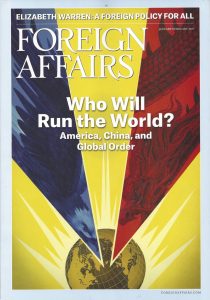
The January/February issue of the CFR’s Foreign Affairs hyped that strategy.  The cover headline asks: “Who Will Run the World?” with sub headline: “America, China, and Global Order” (see graphic, right).

Lesson: Insider-supported regimes murdered more than 100 million human beings during the last century to consolidate their power.  We must not expect the Internationalist Conspiracy to fade way or give up its bloodthirsty ambition on its own.  It will only be stopped and routed if there is informed pressure from the American people to do so.

Creating that informed pressure requires an organized campaign by a growing segment of the American people responding to sound leadership and immune to tangents.  That’s Freedom First Society’s mission.

Realistically, building and supporting Freedom First Society is the only responsible option for Americans to stop the approaching nightmare.  To be sure, success will require a breakthrough in finding dedicated, discerning volunteers among the too-busy and complacent.  After decades of culture war and Establishment attacks on the middle class, finding those patriots willing and able to lead by example is no easy task.

However, the alternative should be unthinkable:  Do nothing, or nothing constructive, and watch as our fellow Americans are slaughtered and starved to wipe out resistance to Internationalist tyranny. Think of all the patriots who gave their lives and fortunes to enable future generations of Americans to enjoy unprecedented liberty.  God forgive us, if we betray their sacrifice!

Repeat a Lie Often Enough …

“Former Secretary of State John Kerry swiped at President Trump while voicing concerns about the effects of global climate change on U.S. national security during an appearance Wednesday on Capitol Hill…. [Kerry told lawmakers:] ‘Each day that we fail to act on climate change, we are risking the health and security of future generations.’

“The former Obama Cabinet members [Kerry and former Defense Secretary Chuck Hagel] also took aim at Trump’s plan to form a committee to re-evaluate the scientific consensus surrounding climate change, with Kerry referring to the plan as ‘a scheme to pretend there are two sides to an issue long since settled.’” — The Hill, 4-9-19

Climate “scientist” John Kerry was following in the footsteps of “Internet inventor” Al Gore, whose claims about man-made global warming were portrayed in the film “An Inconvenient Truth.”

Scam on Display at 1992 Earth Summit
While we don’t claim to be experts on weather and climate factors, we do understand the power grab the alarmists are seeking to justify. The 1992 Earth Summit in Rio de Janerio (officially the United Nations Conference on Environment and Development – UNCED) provided a great window into that deception.

Former Washington Governor and former chairman of the Atomic Energy Commission Dr. Dixy Lee Ray attended the conference, as did Al Gore.  In her subsequent book, Environmental Overkill (1993), Dr. Ray argued:
“First, we must recognize that the environmental movement is not about facts or logic. More and more it is becoming clear that those who support the so-called ‘New World Order’ or World Government under the United Nations have adopted global environmentalism as a basis for the dissolution of independent nations and the international realignment of power.”

A Common Revolutionary Tactic
The incessant climate change warnings also follow the tactic famously used by totalitarians — repeat a lie often enough so that the people accept it as the truth.

One of the environmentalist lies is that there is a consensus among knowledgeable scientists that man-made climate change is a serious threat to mankind.  Dr. Richard Lindzen, now retired from MIT, is one renowned environmental scientist who doesn’t agree.   Last year, he debunked the hysteria in a lecture: “Global Warming and the Two Cultures.” (A link to his lecture, can be found in our website post “UN Climate Change Hysteria.”)

You don’t have to look far to find repetitions of the alarm.  For example, during the April 8th House “debate” over the “Local Water Protection Act,” Texas Congresswoman Sheila Jackson Lee stated:

“As an Energy and Environment Task Force Co-Chair of the Congressional Black Caucus, I understand the necessity of this bill and its funding to managing sources of water pollution…. The strain on the marine life is not the only adverse effect to nature, global warming is also worsened when we turn a cheek to decreasing the pollution of our waterways…. Mr. Speaker, we must not wait to take action when the health of our marine life, the state of Global Warming, and the health of our people are being affected.” [Emphasis added.]


Democracy, Tyranny, and the NPV Compact

“The Constitution is nicely balanced, with the federative and popular principles; the Senate are the guardians of the former, and the House of Representatives of the latter; and any attempts to destroy this balance, under whatever specious names or pretenses they may be presented, should be watched with a jealous eye.” — Senator Uriah Tracy, in the U.S. Senate debates over the proposed 12th Amendment (adopted 1804)

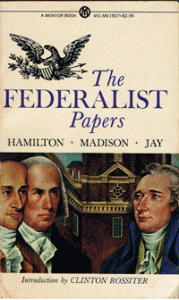
“The mode of appointment of the chief magistrate of the United States is almost the only part of the system, of any consequence, which has escaped without severe censure, or which has received the slightest mark of approbation from its opponents. The most plausible of these, who has appeared in print, has even deigned to admit that the election of the president is pretty well guarded. I venture somewhat further, and hesitate not to affirm, that if the manner of it be not perfect, it is at least excellent. It unites in an eminent degree all the advantages, the union of which was to be wished for.” — Alexander Hamilton, Federalist No. 68

“No matter what happens in America these days — whether by fate or by plan — there is almost always another agenda or some underlying hitch ancillary to the main theme. The Bush-Gore election crisis of 2000 was nothing but a comic opera compared to the events subsequently stemming from it. Among the far more serious evils attributable to the contested election result in Florida is a loud and clear trumpet call for America to DUMP THE ELECTORAL COLLEGE and replace it with direct national elections.” — Don Fotheringham, January, 2001

Overview: The National Popular Vote (NPV) interstate compact seeks to overturn an important part of the plan America’s founders gave us for selecting a president. The drive for the compact is well on its way to becoming reality.  Working below the public radar, the drive has already convinced many state legislatures to join the compact.  This scheme has flourished because it promises to further enthrone the false idol “democracy,” which our founders recognized as a tool of tyrants (we are a Republic, a rule of law, not a democracy).  In this article, we will examine the beguiling NPV pretenses, the original plan of those who wrote our Constitution, how their plan has already been perverted, and why the NPV Compact is a dangerous step in the wrong direction.  And most importantly we will provide readers with the information and perspective they will need to influence legislators in their state to resist the drive.

Anyone researching the drive for an NPV (National Popular Vote) compact between states confronts a bewildering paradox:

  • As the NPV website says openly: “The shortcomings of the current system of electing the President stem [not from the Electoral College, but rather] from ‘winner-take-all’ laws that have been enacted by state legislatures in 48 states.”
  • Yet, what the NPV compact does, in essence, is not to repeal or neutralize these state laws, but instead to translate this “winner-take-all” electoral system from the state-vote level to the national-vote level!

Clearly, there’s more going on here than meets the eye: A national drive which would nullify the Electoral College — without actually abolishing it — justifies its agenda by a critique that points rather to a very different, almost diametrically opposite solution. If we’re to understand the NPV-compact drive, this paradox needs an explanation.

What are the drive’s complaints, then? Why is the Electoral College immune to the critique? Why, and when, did the states’ “winner-take-all” laws arise? And, why does the NPV seek to rectify them with such a strange, unseemly antidote? In answering these questions, we shall draw heavily on the NPV’s own website — mainly to deflect suspicion that we are misrepresenting their position.

The NPV Website’s Complaints
To its credit, the NPV website’s helpful “explanation” page attributes only to state “winner-take-all” laws — rather than to the Electoral College — the situations which it decries. It is quite correct in blaming these situations on these state laws — which have strongly interfered with the functioning and fundamental intent of the (so-called) Electoral College which the Constitution outlines — and, in saying that these state laws have no basis in the Constitution.

The complaints which one finds on this webpage are curious, though, in that clearly they are based on policy-values having little to do with the foundational American system and philosophy of government. Consequently, for those of us not starting from alien, non-American values, the three “issues” the group raises are without force — even if their connections of cause and effect are valid.

The two complaints which the webpage lists first will unlikely tug on the heartstrings of many: One is that “Because of these state winner-take-all statutes, presidential candidates have no reason to pay attention to the issues of concern to voters in states where the statewide outcome is a foregone conclusion.”

This complaint assumes — quite contrary to America’s founding fathers — that campaigning and getting voter-input are both vital parts of a presidential election. Moreover, it makes the outlandish assumption that an electoral candidate who does campaign should be careful to do so just as much in districts where support is overwhelmingly for or against that candidate. (What political campaign-advisor ever urged such a thing?)

The second complaint is scarcely more captivating: “State winner-take-all statutes adversely affect governance. ‘Battleground’ states receive 7% more federal grants than ‘spectator’ states, twice as many presidential disaster declarations, more Superfund enforcement exemptions, and more No Child Left Behind law exemptions.” But given that all these examples of skewed “governance” are unconstitutional, gratuitous, and illegitimate to begin with, blaming them on the electoral laws seems off-target.

The complaint which people will most likely have heard, the website expresses thus:

“[B]ecause of state winner-take-all statutes, five of our 45 Presidents have come into office without having won the most popular votes nationwide. The 2000 and 2016 elections are the most recent examples of elections in which a second-place candidate won the White House. Near-misses are also common under the current state-by-state winner-take-all method of awarding electoral votes. A shift of 59,393 votes in Ohio in 2004 would have elected John Kerry despite President Bush’s nationwide lead of over 3,000,000 votes.”

Interestingly, this complaint is non-partisan: The data the webpage cites show clearly that Republican candidates may be affected by this phenomenon as well as may Democrats.

However, the complaint is also non-American, in the sense that it is based wholly on a non-American political-philosophical assumption — the bare, unargued assumption that presidents should not “come into office without having won the most popular votes nationwide.” The website neglects to elucidate why such an occurrence would be reprehensible.

More fundamentally, it fails to explain why there should be, in any U.S. presidential election, such a number as the “popular votes nationwide.” Nowhere does the Constitution suggest this — not even in the 12th Amendment (which modified the workings of the Electoral College). However, understanding this requires at least a basic overview of the Electoral College, as the Constitution establishes it — a detour which we shall now briefly take.

The “Electoral College”
Regrettably, that NPV webpage seems to buy into the primary misconception Americans hold about the Electoral College: for it states [emphasis ours]:

“The U.S. Constitution (Article II, Section 1) gives the states exclusive control over awarding their electoral votes: ‘Each State shall appoint, in such Manner as the Legislature thereof may direct, a Number of Electors….’ The winner-take-all method of awarding electoral votes is state law. It is not in the U.S. Constitution.”

On the contrary — not only is the “winner-take-all method of awarding electoral votes … not in the U.S. Constitution,” neither is this whole, bizarre notion of state legislatures’ “awarding their electoral votes.”

The “electors” which the Constitution directs each state to appoint were not “messenger-boys” obligated to cast votes as directed; rather, they were the persons appointed in each state (in whatever way the state legislature chose), to cast their free, uncoerced votes to nominate other persons they deemed suitable for the offices of president and vice-president.[1] Except when a majority of the electors voted for the same person, the election of the president — from among the candidates with the most electoral votes — was then to be made by the House of Representatives — with each state’s delegation casting one vote.[2]

It is crucial to understand that neither in the original Constitution, nor under the 12th Amendment, were electors to be obligated, or even influenced, by either their state legislatures, or other Electors (from their own or other states):
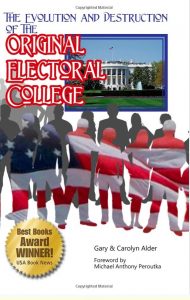
“It is significant to note that there was to be no connection with the Electors of other states, no campaigning, no trading of votes for future influence, or “supporting your program if you support mine.” They were to give it their best shot first — because that was the only shot they had.

“In fact, the Electors met in their separate states on the same day to avoid the chance of collaborating with the Electors from other states during this process. The Electors in each state were able to freely discuss among themselves which individuals were most qualified to be president. They were not, however, forced to conform to the nominations of other Electors from their state. Each Elector’s independent decision of which two individuals to nominate was preserved and respected.” — Gary and Carolyn Alder, The Evolution and Destruction of the Original Electoral College, pp. 23, 24

In order to help ensure this independence, no elector could be a “Senator or Representative, or person holding an office of trust or profit under the United States.”

Each state was allotted as many electoral votes as it has legislators in Congress — i.e., one vote for each of its representatives in the House, plus two votes for the state’s senators. Perhaps the most natural selection method(s), then, would construe two of the state’s electors as being delegates of the state (or the legislature) as a whole, and each remaining elector as a delegate from one of the state’s electoral districts for U.S. House of Representatives.

The latter is still the basic idea in those states which are currently eschewing “winner-take-all” laws: Maine and Nebraska. But each state legislature could adopt any method it wished for selection of its electors; and different states adopted widely varying methods. The NPV “explanation” webpage reports:

“In 1789, electors were chosen from congressional districts in Massachusetts, from special presidential-elector districts in Virginia, and by counties in Delaware. The Governor and his Council appointed the state’s presidential electors in New Jersey. State legislatures appointed presidential electors in the other states.”

The States’ “Winner-Take-All” Laws
We’ve noted that the NPV website’s arguments against states’ “winner-take-all” laws are, rather curiously, without force for those of us not buying into their policy-value assumptions — so alien to the American system. However, this does not mean that we have no complaint(s) of our own, against such laws.

In light of what we’ve just seen about the Constitution’s presidential-electoral system (commonly called the “Electoral College”), the most important thing to understand about “winner-take-all” laws is that any law (state or federal) which compels a presidential elector to vote any particular way is blatantly unconstitutional! That includes, of course, the NPV Compact.

Secondly, it’s helpful to note that such laws, at the state level, are the basis of the unconstitutional party-based-presidential-nomination systems in the 48 states with current “winner-take-all” laws. In these states, the electoral procedure these days is basically this: Each of the major parties selects a whole roster of provisional “electors” who are ready and sworn to serve as electors — and to vote for that party’s candidate — should that candidate happen to win the state’s popular vote. In the latter eventuality, the state legislature then anoints (so to speak) that party’s roster, as the state’s official electors for the election.

The nomination-function was originally the role of the electors. It was usurped first at the national level — by what were called “congressional caucuses.” By 1828, though, the usurpation had moved to the state level: The first election year in which the political parties and their “caucus” meetings at the state level assumed control of the nominating process, was 1832.[3]

Surprisingly, it took less time than that for most states to try out a “winner-take-all” type of statute. The first heavily competitive election, that of 1796, raised strongly the question of whether states’ electors should be chosen “by a general ticket [winner-take-all], or by districts”:  This was how Democratic-Republican candidate Thomas Jefferson framed the issue in a subsequent letter (Jan. 12, 1800) to James Monroe, then governor of Virginia — and likewise a Democratic-Republican.

Jefferson was still smarting from having lost the presidency by only three electoral votes “because presidential electors were chosen by district in the heavily Jeffersonian states of Virginia and North Carolina, and Jefferson lost one district in each state.”[4] In addition, both major parties (Democratic-Republican and Federalist) were disgruntled by the fact that the Electoral College system had engendered a bipartisan team of President (Federalist John Adams) and Vice-President (Democratic-Republican Thomas Jefferson).[5]

In his letter, Jefferson mentioned to Governor Monroe:

“On the subject of an election by a general ticket [winner-take-all], or by districts, … all agree that an election by districts would be best, if it could be general [to all states]; but while 10 states choose either by their legislatures or by a general ticket [winner-take-all], it is folly and worse than folly for the other 6 not to do it.”

Gov. Monroe took the hint, and the Virginia legislature swung into action:

“As a result, Virginia quickly passed a winner-take-all law in time for the 1800 election —​ thereby assuring Jefferson of all the state’s electoral votes.

“Meanwhile, the Federalist majority in the legislature of John Adam’s home state of Massachusetts —​ alarmed by rising support for Jefferson in the state —​ repealed the state’s district system —​ thereby assuring John Adams of all the state’s electoral votes in 1800.

“This triggered a domino effect in which each state’s dominant political party adopted winner-take-all so that it could deliver the maximum number of electoral votes to its party’s nominee. Ten states enacted winner-take-all by 1824….

“By 1836, all but one state had enacted laws specifying that their state’s voters would vote for presidential electors on a winner-take-all basis. By 1880, all states were using this system.”[6NPV “explanation” webpage

And, as they say, “the rest is history.”

The Strange “NPV” Antidote
Summing up: We’ve found that we who are Constitutionalists are in strong agreement with the NPV group, that the state “winner-take-all” laws are egregious — but we are in fundamental disagreement with them, as to why those laws are (in our respective views) egregious. What is less simple to elucidate, though, is why the NPV group’s action-proposal — the interstate-compact which they are pushing — displays no intent to do away with those state laws, even though it lodged all its complaints directly against them — and why it is even, in an important sense, a higher-level establishment of the same corrupt, “winner-take-all” system which those laws undergird.

What do we mean, by its “displaying no intent” to do away with the laws it is critiquing? Let’s look at exactly what the NPV group is proposing.

They are seeking for states to enter into a compact to force their electors to vote for whomever is the winner of the “National Popular Vote.” The compact would not be binding on any state signing it, until the total number of electoral votes of the states signing it is a majority of all the electoral votes.

Since Congress has 535 members, but the District of Columbia has also been given three electors, the total number of electors is 538; so, the required majority of electors is 270. When the compact enrolls states controlling at least that number of electors and those states’ electors are therefore required to vote for the national popular-vote winner, that candidate is (ostensibly) guaranteed election.

As we’ve mentioned already, this proposal is establishing something that’s clearly unconstitutional — the violation of electors’ constitutional right and duty to nominate the qualified persons whom their conscience tells them are the best nominees. That this is so clearly and incontrovertibly the case, while the NPV site argues nevertheless to the contrary, raises serious questions about the veracity and reliability of the NPV-site’s authors (and editors).

Even the NPV website admits (see its alleged “rebuttals” 9.16.2 and 9.16.7):

“[T]he Compacts Clause does not expand state powers. All compacts must be consistent with the U.S. Constitution. In particular, a compact’s subject matter must be among the powers that the states are permitted to exercise….”

As we’ve seen as well, though, they make a grave, even bizarre error, in conflating states’ (constitutional) power to “appoint electors” in any manner they wish, with their (unconstitutional, illegal) power to “award electoral votes” in (allegedly) any way they wish (e.g., “winner-take-all”). And this bizarre confusion appears, not just once, but repeatedly on the website’s pages — particularly on the pages where it is ostensibly “answering myths.”

On the basis of that (false) conflation of two very different notions, it argues that this compact does not violate the Constitution, nor change the electoral procedure stipulated in the Constitution. Much of the verbiage on its “Myths about Interstate Compacts and Congressional Consent” page boils down to this simple, but obviously unsound argument:

  1. “[T]he National Popular Vote compact does not change anything in the U.S. Constitution, and therefore no federal constitutional amendment is necessary …. Instead, the National Popular Vote compact changes state winner-take-all statutes that came into widespread use more than four decades after the Constitution was ratified. None of these state winner-take-all statutes was originally adopted by means of a federal constitutional amendment.” (Under “Myth 9.16.7”)
    1.  The state laws say (in effect): “Following the election, the state will appoint electors who are to cast all their votes for the STATE popular vote winner.”
    2.  The compact changes these state laws, to say (in effect): “Following the election, electors will be appointed in each Member State who are to cast all their votes for the NATIONAL popular vote winner.
  2. (And this is the faulty premise:) Nothing about state “winner-take-all” laws violates the actual procedural requirements laid down in the Constitution; for each state has the Constitutional authority to “award electoral votes” in any way it wishes (e.g., “winner-take-all”).
  3. So, no Constitutional amendment is necessary to effect this change: for not only does this compact leave unchanged the wording of the Constitution; also,it leaves unchanged — i.e., unviolated — the actual procedure required by the Constitution.

Thus, not only are the NPV group’s arguments for the desirability of its changes  based on highly disputable premises; but also, its argument for the legality of its changes, is based on an indisputably false one. So, the question is: Why would a group of presumably intelligent people be presenting — so zealously — such unsound arguments?

There are not very many plausible answers to this. Indeed, we have seen that both the current system’s and the NPV-engineered system’s proponents are quite comfortable with running roughshod over the Constitutional prerogatives of the electors, for the sake of a direct, popular-vote-based presidential election. The difference between the two is thus a surface difference, of implementation and tactics, only.

Let’s take an analogy: It is much like the difference between banks independently allowed to issue their own fiat paper money as “legal tender,” and a centralized banking system, in which only the head office is allowed that piratic privilege. Whether centralized and thus more-coordinated or not, the system is based on a breach of rights. And in either of the more-centralized systems we have in view, though the bumpiness of the road might be rather smoothed out, the danger that the road is heading to disaster — and the potential size of that disaster — are,if anything, actually greater.

The only plausible motive for the compact, it seems, is the same one that belonged, reportedly, to the men who set up the perverted system we have now — the lure of power:

“Ten states enacted winner-take-all by 1824 when Missouri Senator Thomas Hart Benton said: ‘The general ticket system [winner-take-all], now existing in 10 States was … not [the offspring] of any disposition to give fair play to the will of the people. It was adopted by the leading men of those states, to enable them to consolidate the vote of the State.’”NPV “explanation” webpage

This lure exists because granting the populace the conceit that it is in their own values and desires, and the vicissitudes of party temper, that the compass of sound government lies, promises demagogues a road to the heights of tyrannical power. Even before our Constitution was submitted for ratification, one founding father spoke of this conceit as the “excess of democracy”, and described its typical abuse by power-seekers:

“The evils we experience flow from the excess of democracy. The people do not want [lack] virtue, but are the dupes of pretended patriots. In Mass[achusetts] it had been fully confirmed by experience that they are daily misled into the most baneful measures and opinions by the false reports circulated by designing men, and which no one on the spot can refute.” — Elbridge Gerry, delegate from Massachusetts, speaking at the Constitutional Convention, 1787

And James Madison warned us of this same conceit, in a classic statement of the dangers of this “excess”:

“[Pure] democracies have ever been spectacles of turbulence and contention, have ever been found incompatible with personal security, or the rights of property, and have in general been as short in their lives as they have been violent in their deaths.”James Madison, Federalist Paper No. 10

The Way Forward
What should be done, instead, about our current electoral system? Given a desideratum of nullifying state’s “winner-take-all” laws — and any laws that coerce or obligate presidential electors — and given that it was fear of other states’ such laws that drove the domino effect of passing them — the idea of a state compact seems apt: Why not an NEV (National Electoral Vote) compact? When enough states have joined (having 270 electoral votes?), they would each be obliged to rescind immediately their laws that coerce or obligate their presidential electors in any way.

That’s something to be thought about, and worked through. In the meantime, though, we should certainly reject the NPV-group’s agenda. That whole program is an attempt to “remedy” — for the wrong reasons, and with the wrong motive — one grotesque perversion of the Constitution, simply by translating its basic state-vote infringement, to a national-vote scope. This is not the way to get our republic back.

Rather, we need to educate our fellow citizens, and especially our state legislators, about both the fraudulence and the ill-intention of the NPV. (To see whether or not your state has adopted the compact, please check the NPV website’s home-page.) If you have found this article a useful tool for education about those things, please share it with all who need to learn of them.

Notes

1. Their votes were, of course, restricted by the Constitution’s rules about who is eligible to be President or Vice-President; and, in both Article II and Amendment 12, at least one of each elector’s two votes had to be for someone not “an inhabitant of the same State with themselves.”
2. The main change the 12th Amendment introduced is that the two nominations each elector made were now specific to a particular office: one nomination was for the office of president, and the other for the office of vice-president. Also, the Amendment made some minor adjustments to the process of final selection by the House, for each of these offices.
3. Alder & Alder, Ibid., pp. 54, 55. This is a useful book for studying the history of the Electoral College.
4. NPV “explanation” webpage, under “History of State Winner-Take-All Laws.”
5. Alder & Alder, Ibid., pp. 60, 61.
6. Maine adopted district elections for its electors in 1969, and Nebraska did so in 1992.

The Wacky World of “Delegate Bills”

Opponents of state legislatures’ applications to Congress to call an “Article V Convention” are often also battling “delegate bills” — also known as “unfaithful delegate laws.” Such state-legislative bills are ostensibly intended to prevent delegates to an Art. V convention from going beyond the purpose of the state’s request to Congress — which is usually a convention that will propose only one amendment, and only on some specific topic (e.g., term limits).

On first blush, it might seem that by opposing delegate bills, opponents of an Art. V Convention (“Con-con”) are fighting contrary to their own interest: After all, such activists warn against a possible “runaway convention” and preventing that outcome is (supposedly) what delegate bills are for!

In fact, though, a delegate bill is only somewhat less dangerous than an actual Con-con-application by a state. This post will unravel the real nature, and danger, of these bills.

Delegate Bills’ Implicit Assumption Is What Con-con Opponents Reject

Usually, when someone opposes a measure, it’s because they want to avoid the effects mentioned in the measure itself. But in the case of “delegate bills,” we oppose the measure because we want to avoid anyone accepting the false suggestion implicit within the measure.[1]

In delegate bills, the false, dangerous unstated presupposition is the idea that state legislatures can control the proceedings of an Article V convention, once Congress has called it! For a state-legislative committee or chamber even to vote on such a bill is for it to accept implicitly this wildly specious assumption — which assumption, if the bill passes, can only give the state’s legislators false confidence that they can apply for an Article V Con-con with perfect safety.

Therefore, we must oppose any move to bring a delegate bill to a vote. But if it does come to a vote, we must push strongly for the rejection of the bill — which rejection will obstruct the inducement of this false confidence, and thereby make less likely the passage of an Art. V application (and make more likely the rescission of any application already passed).

Are delegate bills really as disconnected from reality, though, as Con-con opponents believe? Oh, yes! The rest of this post will review why the delegate bills’ unstated assumption is truly outlandish.

The Basic American Principle Which That Assumption Ignores

In the first place, the delegate bills’ unstated assumption is strikingly out of touch with a fundamental principle of government our Founding Fathers believed, and which is implicit in the first three words of our Constitution: “We the People….” Our Declaration of Independence stated the principle explicitly (see our emphasis, below, in bold):

We hold these truths to be self-evident, that all men are created equal, that they are endowed by their Creator with certain unalienable Rights, that among these are Life, Liberty and the pursuit of Happiness. That to secure these rights, Governments are instituted among Men, deriving their just powers from the consent of the governed. That whenever any Form of Government becomes destructive of these ends, it is the Right of the People to alter or to abolish it, and to institute new Government, laying its foundation on such principles and organizing its powers in such form, as to them shall seem most likely to effect their Safety and Happiness. — The United States Declaration of Independence, July 4, 1776; Paragraph 2

OK, you say; but did the Founding Fathers, and the People, really believe this principle (which was later called “Popular Sovereignty”) from 1776 to 1787 (the year a convention produced our current Constitution, including Article V)? Yes, definitely — the principle had become very dear to their hearts: In fact, they used it in the creation of, and then re-stated the principle in, the constitutions for most of their newly-freed states.

Therefore, the burden of proof is certainly on those, such as Prof. Rob Natelson, who claim that the drafters of our current Constitution had a quite different notion of constitutions, conventions, and sovereignty in mind while drafting Article V! But there is little need to quibble about who has the burden of proof, for even the founders they most like to quote disagree: we can cite telling statements from both Roger Sherman and George Mason regarding Article V — both of whom were in the group that did the major work on its drafting.

Moreover, we have the full, clear statement of another major participant in its drafting, James Madison, who later, in Federalist Paper 40 (the last 4 paragraphs), cited the Declaration of Independence on this very principle to justify the “runaway convention” of 1787. For Madison, that convention exemplified:

the transcendent and precious right of the people to “abolish or alter their governments as to them shall seem most likely to effect their safety and happiness,”….

At that 1787 convention, in arguing for giving the People, rather than state legislatures, power to ratify the new Constitution, George Mason expressed the principle well:

[State legislatures] are the mere creatures of the State Constitutions, and cannot be greater than their creators.… Whither then must we resort? To the people with whom all power remains that has not been given up in the Constitution derived from them. It was of great moment [Mason] observed that this doctrine should be cherished as the basis of free Government. — Max Farrand, Records of the Federal Convention of 1787, Vol. II, p. 88

Therefore, since clearly the kind of drafting-convention Article V has in view is a convention of The People’s (not the legislatures’) delegates, we can affirm that within the American philosophy of government, state legislatures have no authority at all to command Article V convention delegates as to what they may or may not propose. So much, then, for the viewpoint of American jurisprudence.

But, someone might say — granted, Article V conventions are true constitutional conventions, exercising the People’s sovereign, “self-evident” right to “alter or abolish” forms of government. Even so, couldn’t state legislatures still figure out some way, possibly, to control the delegates to an Article V convention? Aren’t some of these delegate bills quite inventive, after all, in the mechanisms they contrive for making the convention-delegates toe the line? Isn’t it remotely possible, that some of those mechanisms might work?

The Insurmountable Legal Hurdles over Which the Assumption Stumbles

As we shall see, blogger and former litigation-attorney Publius Huldah is right on target in the way she has answered that question: “[A]ttempts to control Delegates with ‘unfaithful delegate’ laws are laughably ineffective.” Let’s consider a few simple reasons why that’s true — even leaving aside, for the moment, the above basic principle of American jurisprudence.

Many or most delegate bills speak as if it were completely up to state legislatures to sort out who the delegates will be (representing the legislature, after all — as these bills wrongly presuppose!), as well as, all the rules and procedures of the convention itself. In short, the people drafting delegate bills tend to do it as if Article V adds, “After Congress calls the (drafting) convention, the State Legislatures shall all go off and figure out everything about how the convention will run: who will be sent to it, what motions shall be in order when, etc., etc.”

Does it say that, though? No, Article V does not say that. It says simply, “The Congress … on the application of the legislatures of two-thirds of the several States, shall call a convention for proposing amendments.…” After applying to Congress to call such a convention, the state legislatures have no further role in the process.

Admittedly, neither does Article V delegate to Congress (explicitly) such tasks as providing a selection-method for delegates. However, Article I, Sec. 8 concludes with the “Necessary and Proper Clause,” which delegates to Congress the right to make any laws “necessary and proper for carrying into execution” all powers given to Congress explicitly in the Constitution — e.g., the Art. V power to “call a convention for proposing amendments” when two-thirds of the states apply for it.

The Congressional Research Service, an agency within the Library of Congress, suggests that Congress alone has the power to organize the convention.  In its 2014 report entitled “The Article V Convention to Propose Constitutional Amendments: Contemporary Issues for Congress,” the Research Service states on page 4:

[W]hile the Constitution is silent on the mechanics of an Article V convention, Congress has traditionally laid claim to broad responsibilities in connection with a convention, including (1) receiving, judging, and recording state applications; (2) establishing procedures to summon a convention; (3) setting the amount of time allotted to its deliberations; (4) determining the number and selection process for its delegates; (5) setting internal convention procedures, including formulae for allocation of votes among the states; and (6) arranging for the formal transmission of any proposed amendments to the states.

Another mechanism one finds in some delegate laws is reminiscent of children playing in a schoolyard, where one of the children, not liking the way the game is going, announces huffily he is through, picks up his toys, and heads for home. Apparently, some state legislators believe that a similar behavior on the part of their delegates, in case the Art. V convention doesn’t go the way they like, will not merely show their displeasure, but also somehow pull the plug on the convention, ending its work.

One way to look at this remarkable assumption is to ask whether Article V says (or implies somehow) that the convention’s work will not be considered to have completed legitimately unless no state legislature withdraws its application, before the work’s completion. But of course, it does not say (or imply) that; nor is there the slightest reason, in the Article itself or in American jurisprudence or legal history, to imagine that a state’s application has any further effect once Congress has accepted and tallied it.

One final delegate-control mechanism we shall consider is the legislature’s threat of punishment — or at least, withdrawal from the convention — of any delegate who votes contrary to the intent of the state’s application for a convention. Indeed, some delegate bills have classified all such “unfaithful” voting punishable as a felony!

Such a mechanism assumes, however, that the state legislature will be kept strictly apprised of what’s going on within the convention — including, who voted how on what. But this is a spurious assumption.  Since state legislatures do not control its procedures, the convention could have voice votes — in which case no one knows who voted how — or, even if the votes be by rollcall, they could be by secret ballot. Or, the secrecy could be made complete: As happened early in our own, 1787 constitutional convention, the assembly could simply vote to keep the entire proceedings secret!

Thus — as we said above — state legislators are quite divorced from reality when they suggest that they can control an Article V convention’s deliberations. Often, it is difficult not to laugh at the ingenious but impotent devices whereby they expect to control such a convention.

However, it is not mere courtesy that prevents us from laughing at these failed attempts. For the danger that these incapable delegate bills present is not a laughing matter: Our brilliant Constitution, a true wonder of the ages, is in danger! We must make clear to all state legislators enticed by these siren songs, that “delegate bills” cannot control an Article V convention!

 * * *

[1] That is to say, whether the measure should be passed or rejected is, in the case of delegate bills, not a simple, but a “complex” (a.k.a. “loaded”) question! And as logicians and rhetoricians warn,

A “loaded question”, like a loaded gun, is a dangerous thing. A loaded question is a question with a false or questionable presupposition, and it is “loaded” with that presumption. The question “Have you stopped beating your wife?” presupposes that you have beaten your wife prior to its asking, as well as that you have a wife. If you are unmarried, or have never beaten your wife, then the question is loaded.…

So, a loaded question is one which you cannot answer directly without implying a falsehood or a statement that you deny. For this reason, the proper response to such a question is not to answer it directly, but to either refuse to answer or to reject the question. — http://www.fallacyfiles.org/loadques.html


The “New NAFTA” Power Grab

Following an agreement with Canada, President Trump claimed victory in the negotiations to replace NAFTA:

The president said it fulfills his campaign pledge to replace NAFTA, which he called “perhaps the worst trade deal ever made,” and claimed it will transform the U.S. back into a “manufacturing powerhouse.”

“Throughout the campaign I promised to renegotiate NAFTA and today we have kept that promise,” he said during a news conference, calling it “truly historic news for our nation and indeed the world.”  — The Hill, 10-1-18

The reality, however, is greatly different. NAFTA was much more than a “trade deal.”  And so is its proposed replacement — “The United States–Mexico–Canada Agreement” (USMCA).

Progressive Regionalization
Both are merely disguised as “trade pacts.”  Their real purpose is to evolve into an Internationalist-controlled regional government, à la the European Union.  And eventually into an Internationalist-controlled world government, while hiding that objective from the American people.

In their excellent 2003 book, The Great Deception: A Secret History of the European Union, British journalist Christopher Booker and Dr. Richard North (a former research director for an agency of the European Parliament) described how the British people were deceived into joining the European Union:

[Prime Minister Edward] Heath’s own bid to join the Common Market began what for the British people was to be the greatest deception of all….  Heath persistently misrepresented Britain’s membership of the Common Market as no more than a trading issue….

Only 30 years later would it come to light from the Foreign Office’s confidential papers just how conscious were its officials of the extent to which Britain was about to surrender its powers of self-government.  None of this was publicly admitted at the time, although the author of the FCO’s internal memorandum on “Sovereignty” justified the concealment by suggesting that the British people would not notice what was happening until the end of the century, by which time it would be too late to protest because the process would have become irreversible.

Edward Heath was not alone, even among British politicians, in perpetrating the deception.  “For 40 years,” says Booker, “British politicians have consistently tried to portray it [the Common Market and EU] to their fellow-citizens as little more than an economic arrangement: a kind of free-trading area primarily concerned with creating jobs and prosperity, which incidentally can help preserve the peace.”

Both the late David Rockefeller (former chairman of the Internationalists’ Council on Foreign Relations [CFR]) and CFR heavyweight Henry Kissinger (whom President Trump now calls his “friend”) lobbied in the nation’s press for NAFTA. Both candidly supported NAFTA as a steppingstone to something larger.  In a 1993 column that appeared in the July 18 Los Angeles Times, former Secretary of State Henry Kissinger declared:

It [NAFTA] will represent the most creative step toward a new world order taken by any group of countries since the end of the Cold War, and the first step toward an even larger vision of a free-trade zone for the entire Western Hemisphere…. [NAFTA] is not a conventional trade agreement, but the architecture of a new international system.

A few months later, David Rockefeller championed the agreement in the Wall Street Journal: “Everything is in place — after 500 years — to build a true ‘new world’ in the Western Hemisphere,” Rockefeller enthused, adding “I don’t think that ‘criminal’ would be too strong a word to describe … rejecting NAFTA.”   (See our earlier post:  “Renegotiate NAFTA? — No Way! Get US out!”)

“Free Trade” Deception
As with NAFTA, the new agreement establishes a regional bureaucracy to “manage” trade in minute detail. The total number of pages for the treaty, its annexes, and side letters amounts to more than 1,800 pages.

At first, the proposal might seem more honest without “free trade” in the name — less doublespeak. Not so. Article 1.1 of the agreement, titled “Establishment of a Free Trade Area” states:

The Parties, consistent with Article XXIV of the GATT 1994 and Article V of the GATS, hereby establish a free trade area.

And the Office of the U.S. Trade Representative website (ustr.gov) lists the USMCA as a Free Trade Agreement.

And so, the agreement still postures as something that “free trade conservatives” would support.  But there is little “free” in a regional bureaucracy that would manage trade.  And, as with the old NAFTA, the USMCA is an unconstitutional alienation of U.S. sovereignty.  Its Free Trade Commission, for example, can modify the agreement without the approval of Congress.

Internationalist Support for USMCA
Just as Henry Kissinger and David Rockefeller both championed NAFTA, so Richard N. Haass, the current President of the Council on Foreign Relations, endorses the proposed USMCA.  In an October 2 tweet, Haass stated:

USMCA is NAFTA plus TPP plus a few tweaks.  Whatever…if @real Donald Trump and the Congress are now prepared to embrace a pro-trade agenda, it is all to the good.  Ideally, US participation in TPP by another name would be next; failing that, a US-Japan FTA would be second best.

And what else would we expect from an agreement negotiated by Robert Lighthizer? The U.S. Trade Representative (left) is a member of the Council on Foreign Relations, which has long championed Internationalist-run world government.  When tapped by Trump, Lighthizer was a partner at a CFR corporate-member law firm.
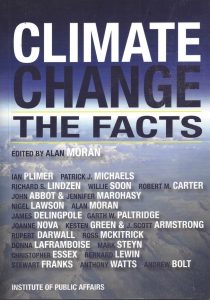
The USMCA agreement clearly supports the Internationalist agenda.  The text demands compliance with rules of the World Trade Organization, the International Labor Organization (ILO) (now a specialized agency of the UN system), and other international agreements, some never ratified by the U.S., such as the UN’s Law of the Sea Treaty.

As just one example of the Internationalist ties, Article 23.2 states: “The Parties affirm their obligations as members of the ILO, including those stated in the ILO Declaration on Rights at Work and the ILO Declaration on Social Justice for a Fair Globalization (2008).”  (See here for full text of the agreement.)

Trump supporters should ask themselves why Trump is supporting this subversion. Is he really being taken in by his advisors or has he been on board with the Insider agenda all along?

Before the USMCA can take effect, Congress must pass an implementing bill, which could be addressed in the Lame Duck session after the November midterm elections.  If Congress approves the USMCA, not only will the U.S. move another step toward totalitarian world government, but the approval will also neutralize much of the needed future opposition from conservatives and conservative lawmakers, as it will be regarded as the product of an “outsider,” conservative president.

Recommended action:  1) Urge your representative and senators to oppose implementation of the USMCA; 2) Alert others to this deceptive attack on our independence as a nation by sharing this post widely.


UN Climate-Change Hysteria

The world stands on the brink of failure when it comes to holding global warming to moderate levels, and nations will need to take “unprecedented” actions to cut their carbon emissions over the next decade, according to a landmark report by the top scientific body studying climate change….

“There is no documented historic precedent” for the sweeping change to energy, transportation and other systems required to reach 1.5 degrees Celsius, the U.N. Intergovernmental Panel on Climate Change (IPCC) wrote in a report requested as part of the 2015 Paris climate agreement. — “The world has just over a decade to get climate change under control, U.N. scientists say,”Washington Post, 10-8-18

The UN’s IPCC is constantly challenged to ramp up its climate-change hysteria, while the Establishment’s Washington Post is all too ready to report the Internationalist propaganda at face value.

Let’s look first at what some experts have to say regarding the reliability of the claims. And then we’ll examine the subversive agenda that is driving the hysteria.

Don’t Trust the UN’s IPCC
The UN, in cooperation with the Establishment media, regularly promotes the fiction that there is a “scientific consensus” re man-made global warming due to the release of greenhouse gases.  And of course, the media refuses to report the mountains of scientific evidence disputing those claims.  Instead, when forced to mention “the deniers” at all, it characterizes such objective contradictory science as industry-financed or even as a criminal threat to life on the planet.

One authority, who has tried to shine the light of day on the topic, is Dr. Richard S. Lindzen, Professor Emeritus, Department of Earth, Atmospheric and Planetary Sciences at the Massachusetts Institute of Technology, now retired. In 2015, he wrote in Climate Change: The Facts:

Global warming is about politics and power rather than science.  In science, there is an attempt to clarify, in global warming, language is misused in order to confuse and mislead the public….

Advocates of policies allegedly addressing global warming use models not to predict but rather to justify the claim that catastrophe is possible.

On the same day as the above Washington Post story, Professor Lindzen delivered a lecture for the Global Warming Policy Foundation in London.  His lecture, entitled “Global Warming for the Two Cultures,” attempted to explain what really drives climate change and how non-scientists and non-specialists were being bamboozled by the “carbon dioxide” is the enemy propaganda.  In conclusion, he says:

So there you have it. An implausible conjecture backed by false evidence and repeated incessantly has become politically correct ‘knowledge,’ and is used to promote the overturn of industrial civilization. What we will be leaving our grandchildren is not a planet damaged by industrial progress, but a record of unfathomable silliness as well as a landscape degraded by rusting wind farms and decaying solar panel arrays.

A number of such experts are incensed by the Establishment’s media line supporting the global warming scare, but they don’t get coverage in most media outlets. However, the Investor’s Business Daily, a business alternative to the Establishment’s Wall Street Journal, has reported the opposition to the UN climate-change propaganda.  On June 2, 2015, the Investor’s Business Daily provided a commentary: “Isn’t It About Time Climate Scientists Confessed?”:

We’ve mentioned before that the climate models the United Nations and others use to claim that the planet is becoming dangerously hot are flawed. In fact, they’re just plain wrong. We base our belief in part on the work of Roy Spencer, a climate scientist at the University of Alabama in Huntsville, who has said that 95% of the models have over-forecast the warming trend since 1979….

Given that there’s so much evidence contrary to the global warming narrative, climate scientist Patrick J. Michaels justifiably wants to know when other climate scientists will finally admit they’ve been wrong.

“Day after day, year after year, the hole that climate scientists have buried themselves in gets deeper and deeper,” Michaels writes on the Cato Institute blog. “The longer that they wait to admit their overheated forecasts were wrong, the more they are going to harm all of science.”

What’s Driving the Misleading Forecasts?
Unfortunately, the misleading forecasts are not just mistakes or even self-serving science.  The climate change hysteria is designed, with major financial backing, to support the Internationalist power grab and its attack on the independence of nations.  Here we draw from one of many authoritative exposés.

In 2009, Regnery published Green Hell: How Environmentalists Plan to Control Your Life and What You Can Do to Stop Them, by Steve Milloy, which exposed a great deal of the agenda (see our 2009 review, “A Masterful Wake-up Call”).  Milloy provided extensive documentation of how the environmental movement was created, its high-level funding, and what its agenda is.  As Milloy expresses it:

Make no mistake: living green is really about someone else microregulating you — downsizing your dreams and plugging each one of us into a brand new social order for which we never bargained. It’s about … having the boundaries of your life drawn by others.

The central concept of this book is that there is hardly any area of your life that the greens consider off limits to intrusion. There is almost no personal behavior of yours that they consider too trivial or sacrosanct to regulate.

Milloy documents that a primary green objective is to create scarcity, which then provides the pretext for government regulation and rationing.  And what better way to bring a modern industrial economy to its knees than to starve it of energy?  The current tactic to achieve energy scarcity is to emphasize the development of “renewable” energy, while attaching burdensome strings to the development of resources that can supply our immediate energy needs.  Colorado, as Milloy points out, is the Saudi Arabia of shale oil. Yet this resource has been off limits to development.

Milloy concludes: “But if the government were to use an energy crisis as a pretext to tighten its grip on the energy supply, it would vastly expand the state’s ability to dictate the everyday parameters of how we live our lives….. [E]nergy — the very thing that has enabled the American way of life — can also be used to quash it.”

Milloy’s book also touches on the broader internationalist agenda that threatens the sovereignty of nations.  He titles one section:  “National Sovereignty: It Was Nice While It Lasted” and notes: “[T]he greens aim to use the specter of a global warming catastrophe to subjugate America to global governance.” And he explains the dangers of global governance to our system of government and the constitutional protections for our rights.

Remember that Milloy wrote this in 2009.  With that background the current UN alarm can be seen for the truly dangerous threat it is:

“It’s like a deafening, piercing smoke alarm going off in the kitchen. We have to put out the fire,” said Erik Solheim, executive director of the U.N. Environment Program. — Washington Post, 10-8-18

The hidden, subversive agenda must be exposed!

Receive Alerts

Get the latest news and updates from Freedom First Society.

This will close in 0 seconds