
Freedom First Society

Posts

Terrorists Welcome!

It is doubtful whether any of us has ever seen such an audacious judicial usurpation, or one with such serious ramifications, as the decision of federal courts to interrupt President Trump’s temporary travel ban.

Settled case law for 200 years, not to mention the Constitution, says that the Congress and executive branch can regulate immigration in any way and to any extent they please; it is therefore NOT a sort of law upon which judges can bring “judicial review”!

In an article for Conservative Review, Daniel Horowitz, author of Stolen Sovereignty, provides overwhelming arguments as to why this is so.

The full case for why courts have no jurisdiction over Trump’s immigration order

If there remains ANY doubt on the settled nature of this legal point, this list of 16 quotations Daniel Horowitz has just culled from his research should settle the issue. In particular, we draw attention to quotes 10 and 11:

“The power of Congress to exclude aliens altogether from the United States, or to prescribe the terms and conditions upon which they may come to this country, and to have its declared policy in that regard enforced exclusively through executive officers, without judicial intervention, is settled by our previous adjudications.” [Lem Moon Sing v. United States, 158 U. S. 547 (1895)]

“[T]he decision to admit or to exclude an alien may be lawfully placed with the [p]resident, who may in turn delegate the carrying out of this function to a responsible executive officer … The action of the executive officer under such authority is final and conclusive. Whatever the rule may be concerning deportation of persons who have gained entry into the United States, it is not within the province of any court, unless expressly authorized by law, to review the determination of the political branch of the Government to exclude a given alien.” [Knauff v. Shaughnessy, 338 U.S. 543 (1950)]

It will be a disaster if the Trump administration and the “conservative” media accept this perversion of judicial authority. Consider, for example, this less than encouraging response by Vice President Mike Pence to a question as to whether the judge also had the authority to stay the order:

“He certainly does, and that’s why the administration is complying with that order as we speak. And we’ll go through the process in the courts to get a stay of that order, so that, again, we can implement this action that is entirely focused on the safety and security of the American people.” — “Pence Defends Trump ‘Speaking His Mind’ About Federal Judge, Promises ‘All Legal Means’ to Challenge Ruling,” — abcnews (2-14-17)

Please share this post widely!
 

House Leadership in 2017

In 2012, Freedom First Society reviewed a hot new book, Young Guns — A New Generation of Conservative Leaders, by the three founders of the Young Guns Program: GOP “rising stars” Eric Cantor, Kevin McCarthy, and Paul Ryan.

In our review of Young Guns, we pointed out serious deficiencies in the program championed by these three Republicans, who misleadingly claimed to support the principles of our nation’s Founders.

As the 115th Congress convenes in January of 2017, Paul Ryan (R-Wis.) has been re-elected as the Speaker of the House and Kevin McCarthy (R-Calif.) continues to serve as House Majority Leader, having filled that position following the upset defeat of their mutual colleague, Virginia Rep. Eric Cantor, in 2014.

To better understand those holding the reins of power in the House today, we urge visitors to read our 2012 Review and share a link to this page with friends and associates.

No Omnibus in the Lame Duck

The September 28th House “debates” over a last-minute continuing resolution to fund the federal government until December 9 (after the November election) were again misleading. They mislead Americans as to the House’s true  power over the purse — IF it had the will to use it.

In The Federalist, No. 58, Father of the Constitution James Madison explained the awesome unused power of the purse, which the Constitution assigns to the House of Representatives:

“The House of Representatives can not only refuse, but they alone can propose the supplies requisite for the support of the government. They, in a word, hold the purse — that powerful instrument [for] finally reducing … all the overgrown prerogatives of the other branches of the government. This power over the purse may, in fact, be regarded as the most complete and effectual weapon with which any constitution can arm the immediate representatives of the people for obtaining a redress of every grievance, and for carrying into effect every just and salutary measure.”

Rather than asserting this power, however, the debates claimed that the House needed to work cooperatively with the Senate and the President, while perpetuating the false notion that all parties are sincerely interested in the good of the country.

House Debates (from Congressional Record)

Leading the majority (Republican) debate in the House, Rep. Tom Cole argued:

“Mr. Speaker, as a member of the Appropriations Committee, I am always disappointed when we are forced to consider continuing resolutions, especially given the work this House has done in the appropriations process this fiscal year.

“For 2 years in a row, the House Appropriations Committee was able to complete all 12 appropriations bills–and complete them before the August recess. In addition, this House passed five appropriations bills. Unfortunately, just as in years past, Senate Democrats prevented consideration of many appropriations bills on the floor of that body. This leads us to the unfortunate situation of having to put forward a short-term CR to fund the government through December 9….

“I think it is worth pointing out that you can’t have regular order in the House if you don’t have regular order in the Senate. The real reason we are here is because the Senate has refused consistently to take up appropriations bills that have been passed by this House. At some point, you simply quit passing the bills because the Senate isn’t going to deal with you.” [Emphasis added.]

We would ask, why must the House bear the blame for a government shutdown if the House has done its job? Why not insist that the Senate (and the President), as a minimum, accept the five appropriations bills as the House passed them or bear responsibility for shutting down just that portion of the government?

Actually, the CR package included one of the least controversial of the 12 regular appropriations bills, funding its programs for the entire fiscal year 2017. Appropriations Committee Chairman Harold Rogers pointed out:

“[T]he package contains the full-year Military Construction-VA bill for FY17, which was conferenced by the House and Senate and passed by the House already in June [H.R. 2577, Roll Call 342, H.R. 2577]…. It is important to note that, once the President signs this bill into law, it will be the first time since 2009 that an individual appropriations bill has been conferenced with the Senate and enacted before the September 30 fiscal year deadline.”

Lame Duck Appropriations

When the Congress resumes in the Lame Duck after the election, the leadership of both parties will lobby for either an omnibus appropriations bill, funding the government through September 30, 2017 for the other 11 areas, or for kicking the ball to the next Congress with another short-term continuing resolution. True constitutionalist should not support either option.

While the four appropriations bills passed by the House and not taken up by the Senate may not have been worthy of support individually, constitutionalists in the House should not allow a new CR or omnibus to include those areas. A House that asserts its dominance in appropriations is a necessary base from which to roll back unconstitutional government. And in a world dominated by a hostile Establishment media, that requires regular order.

So, as a minimum, constitutionalists should refuse to vote for any omnibus appropriations bill that includes those four. And best, insist on 11 separate votes.


A Troubling Example

Many Americans wonder why our federal government keeps working against our interests and how it can be brought under control. An important step in the solution is to understand what Washington is doing — no easy task, as we shall see.

The “Electrify Africa” act is a prime example of what Congress is doing that it should not.   The Act would set development priorities for foreign nations and subsidize that development (through loans and loan guarantees).

In the previous (113th) Congress, the House passed this unconstitutional foreign meddling as H.R. 2548 on May 8, 2014 (see our scorecard, 113th Congress, Session 2, roll call 208). Only 1 Democrat opposed the measure, whereas Republicans were fairly evenly split —106 in favor to 116 against.   Fortunately, the Senate didn’t pick up the authorization measure, and it died — that year.

However, a similar version, S. 2152, was brought up in the Senate late last year and passed on a voice vote. Then on February 1 of this year, the House suspended the rules (2/3 vote required) to pass S. 2152, again on a voice vote. Not a single representative demanded a recorded vote. The president signed the measure into law a week later.

During the February 1 House debates (actually self-aggrandizing campaign statements, masquerading as debate) on the Electrify Africa Act, the legislation’s leading Democrat advocate, Pennsylvania’s Brendan F. Boyle, undoubtedly reassured conservative voters when he stated: “This legislation puts into law President Obama’s 2013 Power Africa initiative.”

Pretext vs. Reality

Those U.S. representatives arguing in favor of the measure spoke forcefully regarding how the Act would address the terrible electricity shortage that is holding back Sub-Saharan Africa economically.   The lead Republican advocate in the House, Representative Ed Royce of California, stated:

“[T]oday 600 million people living in sub-Saharan Africa — that is 70 percent of the population— do not have access to reliable electricity….

“Why do we want to help increase energy access to the continent? Well, to create jobs and to improve lives in both Africa and America. It is no secret that Africa has great potential as a trading partner and could help create jobs here in the U.S.”

Sounds reasonable, doesn’t it? Yet we see several major problems. First the U.S. Constitution does not authorize foreign aid. Our government has neither responsibility nor authority to advance the welfare of other nations with taxpayer dollars, particularly when our nation is seriously in debt.

Second, private enterprise and foreign capital should be eager to make such investments as long as the regimes in those nations are stable and respectful of foreign investment.

However, here is the crux of our concern: Supporting socialist regimes may help build Internationalist control, but it is no way to help a people economically.

Ever since World War II, the Internationalist-controlled U.S. State Department has established a long, consistent track record of supporting socialist, even Communist regimes (e.g., Red China, and initially Fidel Castro), and undermining pro-Western regimes (e.g., backing the Sandanistas in Nicaragua against Anastasio Somoza and working to oust the Shah of Iran, replaced by the Ayatollah Khomeini).

As informed skeptics, we have to regard the humanitarian arguments as insincere pretexts to support a power-grabbing agenda.

The techniques employed in collectivist strategy are not new. Nineteenth-century French statesman Frederic Bastiat wrote that governments seek to increase their power by “creating the poison and the antidote in the same laboratory” — that is, by using government resources to exacerbate problems which can then be used to justify statist “solutions.”

The same strategy has damaged our economy. Government programs have provided both the carrot and the stick to drive heavy industry and manufacturing abroad. And collectivists would have us believe that more government programs are the solution to restoring our economic health.

For more on the solution, please see our “Congress Is the Key!” menu item.

What You Won’t Hear on Fox

“A coalition affiliated with the anti-racism Black Lives Matter movement called for criminal justice reforms and reparations for slavery in the United States among other demands in its first policy platform released on Monday….

“The agenda was released days before the second anniversary of the slaying of unarmed black teen Michael Brown by a white police officer in Ferguson, Missouri. Brown’s death, along with other fatal police shootings of unarmed black men over the past two years, fueled a national debate about racial discrimination in the U.S. criminal justice system.” [Emphasis added.]
“U.S. slavery reparations sought in first Black Lives Matter agenda,” Reuters (Yahoo News), 8-1-16

Rather than informing the public, the mainstream media slavishly cooperate with revolutionaries to provide “pressure from below” by reporting their propaganda at face value, even using that pressure and media coverage to suggest there has been a genuine “national debate” (see above).

Of course, the mainstream “liberal” media say nothing about the real agenda driving these movements. But what about the media that portrays itself as providing the other side of the story, designed to appeal to conservatives?

There you will find plenty of discussion of current issues from a conservative standpoint, but discussion primarily restricted to media-managed “common understanding.” The subversive forces and their agendas that are creating our problems are not part of that understanding.

A good example is the reaction of “conservative” media outlets to the revolutionary “furor” over police shootings of blacks. In the argument over whether a particular policeman’s action was justified, you won’t hear what people desperately need to learn in order to preserve their freedom.

The Real Objective — Pave the Way for a Police State

You won’t hear that, in 1961, the Internal Security Subcommittee of the United States Senate published “A Communist Plot Against the Free World Police,” describing a highly organized campaign “directed primarily toward discrediting the police in the eyes of the people.” A principal tactic of that campaign was to charge local police with “brutality” and demand outside oversight, initially by leftist-controlled civilian review boards.

The world Communist movement (supported by the Insiders) developed the campaign to undermine a critical bastion of freedom — independent, decentralized local police, accountable to the communities in which they live. The ultimate goal was, and is, to nationalize our local police. (See also Media-Controlled Delusion, Chapter 2 “Police Brutality.”)

The liberal media emphasize the phony idea that federal oversight is necessary to overcome all kinds of state and local shortcomings and un-American biases. And the conservative media provide stirring rebuttals to engage their audience, but they ignore the real threat. Why? Not because they don’t know what’s going on, but because at the top, they, too, are Insider-controlled.


If It Ain’t Broke, Don’t Fix It!

Pity the poor proponents of an Article V con-con. How could they ever have happy holidays?

For they are self-impaled on the horns of a brutal dilemma. They must argue either:

  • that amending our Constitution will somehow, magically, turn Constitution-despising government officials into Constitution-obedient ones; or else,
  • that the Constitution, as it stands, has some significant flaws that have allowed the federal government to get “out of control.”

Very oddly, though, despite such a daunting dilemma you never see a con-con proponent backing off from his or her insistence that we must amend our Constitution — and, that it needs to be done through a (colossally dangerous) Article V constitutional convention! Only this magic (albeit never-before-used) formula will save us from our “out of control” government, they keep saying.

Take, for example, the odd insistence of Mr. Nick Dranias.

Nick Dranias’s criticism of the U.S. Constitution

Mr. Dranias, who leads Compact for America, has apparently enough sense to realize that though proving the second point (flaws in the Constitution) would be a formidable challenge, proving the first is clearly impossible. He has thus, almost alone, taken on the challenge of proving that our Constitution is to blame for our bloated federal government.

Unfortunately, Dranias’s case rests on a misconstrual of the Constitution and of the history of our federal government’s borrowing and spending.

According to Dranias (on his Compact for America website), “The Constitution as it exists fully authorizes unlimited spending, taxing and borrowing in support of the enumerated powers.”

He adds quickly, “Of course, the federal government is doing much much more than what the Founders thought the enumerated powers authorized. But that is politically inevitable when you give elected officials an unlimited credit card with which they can promise anything to get elected at no immediate cost to current voters!”

Dranias is very fond of using this phrase “unlimited credit card” to describe the Constitution’s lack of explicit limitation on federal-government borrowing. He means, apparently, that they can borrow as much as they want, at any time, with no penalties felt at all soon.

The metaphor is clever but misleading. A look at the actual historical data on U.S. federal government debt makes clear how misleading it is.

How did we REALLY get our mountain of national debt?

If the Constitution is an “unlimited credit card” that allows Congressmen to buy their way to re-election, how does Mr. Dranias explain the fact that our national debt was relatively under control until the Vietnam War was winding down, and then suddenly exploded in the early 1970s?

Even though there was concern over our growing national debt before the 1970s, compared to today’s enormous debt, the debt was miniscule. Although it grew significantly during World War II, a time-chart of the debt will show that it grew practically none between 1945 and 1970. Not until the early 70s did our debt begin its exponential climb to its current astronomical heights.

Why was that? Were U.S. Congressmen generally so obtuse before 1971 or so, that they never noticed the Constitution gives them an “unlimited credit card” with which to buy votes? Or were they perhaps all angelic statesmen, before that time, who kept to the Constitution’s spending-bounds out of the goodness of their hearts?

Or, was there perhaps something that happened in the early 70s that opened the spigot for unlimited government borrowing? There was indeed: On August 15, 1971, President Richard Nixon made a catastrophic structural change to our monetary and banking system. This change allowed for virtually unlimited creation of (new) money by the Federal Reserve System, to lend to the government (at below-market-level interest rates).

For it was on that date that Nixon “shut the gold window” to foreigners,

refusing to let foreign central banks redeem their dollars for gold, facilitating the devaluation of the U.S dollar which had been fixed relative to gold for almost thirty years. While not strictly a default on a US debt obligation, by closing the gold window the US government abrogated a financial commitment it had made to the rest of the world at the Bretton Woods Conference in 1944 that set up the post-war monetary system. At Bretton Woods, the United States had promised to redeem any and all U.S. dollars held by foreigners — later limited to just foreign central banks — for $35 dollars an ounce. This promise explains why the Bretton Woods monetary system was called a “gold exchange standard” and why many believed the US dollar to be “as good as gold.” (http://triplecrisis.com/a-first-default-closing-the-gold-window/)

Redeemability is what a “bank note” is all about: It is simply a bank’s I.O.U. for the bearer’s “demand deposit” of true, commodity money (namely gold, in this case). It is understood to be strictly redeemable in that money, on demand, to whomever is bearing the note.

Perusal of a 1934 Federal Reserve 10-dollar note, for example, shows that the note declares it is “legal tender for all debts, public and private, and is redeemable in lawful money [initially, actual dollars, of gold or silver, or redeemable U.S. Treasury Gold or Silver Certificates] at the United States Treasury, or at any Federal Reserve Bank.” It states further that “The United States of America will pay to the [note’s] bearer on demand Ten Dollars.” (interpolations in square brackets ours.)

President Franklin Roosevelt had already “shut the gold window” to U.S. citizens back in 1933, allowing the banks to forego honoring their commitment to redeem the notes in gold (or Gold Certificates). But at that time they were still exchangeable for U.S. Treasury-issued Silver Certificates; and those were redeemable, in silver coins.

Then in 1968, President Johnson and Congress had nullified the pledge to redeem the Silver Certificates — again, for U.S. citizens only. But not until Nixon “shut the gold window” to foreigners also in 1971, were U.S. “dollars” — including, paper Federal Reserve “Notes” — completely unshackled from redeemability in precious metal.

Did that major change indeed open the spigot for creation of Federal Reserve paper “dollars”? Yes, of course: If banks no longer have to redeem their “notes” at all, yet those notes are “legal tender,” they will really go to town with their “money”-printing presses! They’ll be more than happy and ready to loan these fraudulent paper “notes” into circulation.

One may readily confirm that that is what has happened, by glancing at a time-chart of the M3 U.S. “money” supply: Clearly it was right around 1971 that our supply of (paper) “money” began to increase by leaps and bounds. Before then, the “money” supply was somewhat limited by the gold supply in the Federal Reserve’s vaults.

Did the Constitution permit this debt disaster?

So, is Mr. Dranias correct, in blaming our national-debt disaster on the Constitution? No — unless the Constitution permits government to declare irredeemable paper money a “legal tender” in payment of debts. For only if they are declared “legal tender” must such fraudulent, irredeemable and therefore essentially worthless notes be accepted as real “dollars,” when the government (or anyone else) offers them in payment of a “dollar”-denominated charge or obligation.

But in fact, not only does the Constitution not permit this; it forbids it. At the time of its ratification, the states had created an inflationary crisis by declaring a burgeoning mountain of irredeemable bank notes “legal tender.” This is why the Constitution forbade states to “make any thing but gold and silver coin a tender in payment of debts” (Art. 1, Sec. 10). That provision brought an end to the inflation.

Naturally, the Founders would not have permitted the federal government to step in and re-create this disaster of worthless “legal tender.” But they did not feel it needful to state explicitly that the federal government is (with the states) forbidden to do this, since (as the Tenth Amendment says) any power not explicitly delegated to the federal government, by the Constitution, is understood not to be granted to it.

Thus the Constitution also did not permit the government to take these other actions that were crucial in its drive to substitute paper, irredeemable currency for our sound money:

  • creation of the Federal Reserve System, in 1913;
  • “shutting the gold window” to U.S. citizens, in April 1933;
  • forbidding them, at that same time, to own or use monetary gold; and
  • the final, complete repudiation of our currency’s redeemability, in 1968 and 1971.

So it turns out that, thru his misdirecting of the blame, Mr. Dranias is implicitly exonerating our leaders and the Fed, and irresponsibly risking our liberty. For the Constitution is not the problem. Disobedience to the Constitution is!

Tragically, the constitutional requirement to limit government to its enumerated powers has virtually disappeared from media-led political discussion, in favor of a dangerous “how much can we afford?” debate. Without an informed electorate forcing its representatives to adhere to the Constitution, the government’s substitution of irredeemable Federal Reserve bank notes for our once-sound monetary system has supported a massive explosion in the national debt. Our need is not to alter, but to return to, that wisely crafted form of government that our Founders outlined so clearly.

For Whom the Court Toils

What most Americans considered unthinkable just a few decades ago — Supreme Court mandated recognition of same-sex marriage —is now reality. Those concerned about the widespread attack on traditional morality and the family would do well to learn more about what the Supreme Court has done, what drove the decision, and what can and must be done to return America to Constitution-based Federal-Court rulings.

A Flagrant Judicial Usurpation

There are few Supreme Court rulings, we must assume, where a large number even of those supporting the decision feel compelled nevertheless to repudiate, publicly, the Court’s reasoning. Yet there was widespread, serious dissatisfaction among those who longed for the Court to vindicate same-sex marriage and who read its opinion.

One of the clearest summaries of the consensus spanning the political spectrum comes from just such a same-sex-marriage supporter:

To phrase things delicately, the Supreme Court’s recent decisions in King v. Burwell and Obergefell v. Hodges are unequivocally horrendous. Legal textualists and political conservatives will remember these majority opinions as among the worst of the twenty-first century. While Kelo v. New London and NFIB v. Sebelius were equally despicable, these cases at least were based on plausible, albeit highly flawed, interpretations of existing law. King and Obergefell, in contrast, are purely results-oriented decisions that are at best maladroit workmanship and at worst flagrant judicial usurpations of legislative authority.

Was Obergefell really an instance of well-intentioned but “maladroit workmanship” or instead one of ill-intentioned, “flagrant judicial usurpation of legislative authority”? And if the latter, what was the real motive?

An Unexpected Argument

Same-sex-marriage supporters had generally expected the Court to pursue the line of argument usually taken in same-sex marriage cases that had been brought in state courts. That line was based on the Fourteenth Amendment’s “equal protection” clause: That clause forbids every state to “deny to any person within its jurisdiction the equal protection of the laws.”

The contention was that, given this clause, marriage laws should not treat homosexual couples any differently than they treat heterosexual couples.

However, for reasons that we explain in a separate article, an argument based on “equality” alone would have been quite frail and susceptible to devastating criticism. Another main argument was needed. And for this, the majority availed themselves of the long discredited appeal to the Fourteenth Amendment’s “substantive due process” clause.

And, in doing so, the majority, led by Justice Kennedy, relied on a slippery meaning-change for the term marriage.

Redefining Marriage

In the view of Chief Justice Roberts, who strongly opposed the ruling, that slippery meaning-change was, in fact, the real point:

The fundamental right to marry does not include a right to make a State change its definition of marriage. … There is no serious dispute that, under our precedents, the Constitution protects a right to marry and requires States to apply their marriage laws equally. The real question in these [current] cases is what constitutes “marriage,” or—more precisely—who decides what constitutes “marriage”? … These precedents say nothing at all about a right to make a State change its definition of marriage, which is the right petitioners actually seek here.

Roberts summarized his objection to the very thinly argued case of the proponents: “The majority’s decision is an act of will, not legal judgment.” The other dissenting Justices seemed to agree.

For Whom, REALLY, Was This Ruling Made?

But why would a majority of the Supreme Court risk their judicial reputation on such an obviously unconstitutional decision – which is already seen widely as such? What goal would make it worthwhile? And in particular, if the justices didn’t see “dignity”-seeking gays as the constituency that their ruling was serving, whom did they see it as serving?

A scholarly article, by Douglas NeJaime, in The Yale Law Journal in Sept. 2013, helps us answer that question. That article approved thoroughly of Justice Kennedy’s redefinition of marriage as expressed in United States v. Windsor (2013, striking down the Defense Of Marriage Act), also using the “substantive due process” approach to gay rights that he had first displayed in Lawrence (2003). And the article argues that the redefinition is responding to a revolutionary movement:

This Essay relates Windsor to a model of marriage ascendant over the course of the last several decades and to LGBT advocacy that has mapped same-sex couples onto that model. … a shift from a marriage model rooted in procreation and gender differentiation to one characterized by mutual emotional support, economic interdependence, and community recognition. … Justice Kennedy’s treatment of marriage in Windsor fits within this trajectory….

Of course, the Court is not conceptualizing marriage and its relationship to same-sex couples in a vacuum. Instead, it is responding to legal, cultural, and demographic shifts relating to marriage, as well as to LGBT advocates’ appeal to those shifts to claim rights for constituents. … Beginning in the 1980s, LGBT advocates mapped same-sex couples onto ascendant marital norms that stressed adult romantic affiliation and emotional and financial interdependence—marriage’s private dimensions….

Justice Kennedy’s rendering of marriage in Windsor is responsive to LGBT advocates’ contextualization of same-sex couples within extant marital norms. [Emphasis ours.]

Hey! Hang on a minute: Who are these “LGBT advocates,” to whose “contextualization of same-sex couples within extant marital norms” Kennedy’s new treatment of marriage “is responsive”?

Well, there were the more open advocates, and the more secretive ones: but they had all been pushing, for many years, the strategy of holding out same-sex “marriage” as just another, valid kind of marriage. Michael Gerson, exulting over the Obergefell v. Hodges ruling, credits two of the better known advocates of this strategy:

Why has the gay rights movement been so dramatically successful? Certainly, the people who came out to family and friends — often at considerable risk and cost — humanized an abstract debate. Fictional gay characters — see “Glee” and “Modern Family” — did much the same.

But perhaps the most significant shift in strategy came from public intellectuals such as Jonathan Rauch and Andrew Sullivan, who urged gays to embrace the conventional, bourgeois practice of marriage. What had seemed to many Americans a sexual liberationist movement requested access to the institution designed to limit sexual freedom for the sake of social order and effective child-rearing (while delivering joys that arise only out of commitment). Many gay rights advocates essentially made conservative arguments — concerning the individual and social benefits of faithfulness — to secure their legal goal.  It is a form of gay rights that Middle America — already inclined to live and let live — could readily embrace.

Then there were the more private “LGBT advocates” — the revolutionaries making the war plans and directing the troops. If anyone doubts the existence of a more or less secretive cabal of LGBT war-planners, they should read articles that have been documenting their subversive agenda since the 1990’s.

In 1989, Marshall Kirk and Hunter Madsen, professionals in neuropsychiatric research and commercial advertising, respectively, published After the Ball: How America will conquer its fear and hatred of gays in the ’90s. Their book constituted a manual for the “overhauling of straight America.” In particular, they mapped out a strategy for deceptively promoting homosexuality in entertainment, the media, and education under the guise of a struggle for homosexual “rights”:

At least at the outset, we seek desensitization and nothing more. You can forget about trying right up front to persuade folks that homosexuality is a good thing. But if you can get them to think that it is just another thing — meriting no more than a shrug of the shoulders — then your battle for legal and social rights is virtually won.

But their ultimate objective was the conversion of straight America:

[B]y Conversion we actually mean something far more profoundly threatening to the American Way of Life…. We mean conversion of the average American’s emotions, mind and will, through a planned psychological attack, in the form of propaganda fed to the nation via the media. We mean ‘subverting’ the mechanism of prejudice to our own ends — using the very processes that made America hate us to turn their hatred into warm regard — whether they like it or not. (p. 153)

According to Douglas NeJaime, it is to such (revolutionary, subversive) “advocates” that Justice Kennedy’s new treatment of marriage “is responsive.”

In short, the Supreme Court ruling was not an attempt to enforce ostensibly Constitutional rights. Its intention was a revolutionary one, and it had no other motive.

What, Then, Is To Be Done?

Therefore, the solution is not in another Court case or better arguing before the Court. Justice Alito was unfortunately mistaken in believing that his “colleagues in the majority sincerely see in the Constitution a vision of liberty that happens to coincide with their own.” Yet in the same passage he shared some perceptive concerns about the future of American jurisprudence:

Today’s decision shows that decades of attempts to restrain this Court’s abuse of its authority have failed. A lesson that some will take from today’s decision is that preaching about the proper method of interpreting the Constitution or the virtues of judicial self-restraint and humility cannot compete with the temptation to achieve what is viewed as a noble end by any practicable means. …

Most Americans—understandably—will cheer or lament today’s decision because of their views on the issue of same-sex marriage. But all Americans, whatever their thinking on that issue, should worry about what the majority’s claim of power portends.

That last statement is exactly right. This Court has thrown out the Constitution and the American system of jurisprudence. Its decisions no longer have anything to do with them.

And lest anyone think that the revolutionary assault is over, they need to realize that revolutionaries are never satisfied, short of total revolution. With any victory, standard revolutionary practice is just to up the ante.

Consider the story in the July 3, 2011 Northern Colorado Gazette, “Pedophiles want same rights as homosexuals”:

Using the same tactics used by “gay” rights activists, pedophiles have begun to seek similar status arguing their desire for children is a sexual orientation no different than heterosexual or homosexuals.

Critics of the homosexual lifestyle have long claimed that once it became acceptable to identify homosexuality as simply an “alternative lifestyle” or sexual orientation, logically nothing would be off limits.

The story documents studies and federal actions already underway leading up to just such legitimization of pedophilia. It would be a great mistake to put beyond this current Supreme Court the overturning of state laws against pedophilia.

This Court understands only power – and, the ability and will to use it. Therefore, the only solution available to us is to learn about, and then to show the courage and ability to wield, the powers that we have under the Constitution for the reining in of a rebellious, or even revolutionary Supreme Court.

As Don Fotheringham has explained, impeachment is not the only solution – although certainly it is one route available. Another, of which most Americans are unaware, is to restrict the appellate jurisdiction of the Supreme Court. Don Fotheringham explains the means that the Constitution provides for curbing a federal judiciary run amok, in the lead article for our “Campaign for Decency – Curb the Courts.”

This concerted-action campaign needs the volunteer membership of many concerned Americans, to help convince Congress to reign in this revolution-seeking Supreme Court. Moreover, an out-of-control Supreme Court is only one part of a larger revolutionary assault that must be confronted in its entirety. We invite readers to consider the program of Freedom First Society.


The Court’s Strange Argument in Obergefell

Same-sex-marriage supporters had generally expected the Supreme Court to pursue in Obergefell v. Hodges the line of argument usually taken in same-sex marriage cases that had been brought in state courts. That line was based on the Fourteenth Amendment’s “equal protection” clause, which forbids every state to “deny to any person within its jurisdiction the equal protection of the laws.”

The contention was that, given this clause, marriage laws should not treat heterosexual couples any differently than they treat homosexual couples. (One writer distinguished between this line of argument and that of “non-discrimination.” But since “equality” under the law implies non-discrimination in the application of the laws, most writers treated these two as basically the same argument.)

As at least one writer mentioned, the majority in Obergefell did vaguely “nod to” this previous line of argument. For example, the majority framed the situation thus in the Syllabus (i.e., summary) of their opinion: “The marriage laws at issue are in essence unequal: Same-sex couples are denied benefits afforded opposite-sex couples and are barred from exercising a fundamental right.”

But their “nod” to equality seemed to be more or less window dressing for the real argument. As Chief Justice Roberts writes,

The majority goes on to assert in conclusory fashion that the Equal Protection Clause provides an alternative basis for its holding. … Yet the majority fails to provide even a single sentence explaining how the Equal Protection Clause supplies independent weight for its position….

And anyway, in retrospect it is clear that that to use “equality” as a serious line of argument would have failed spectacularly. That becomes obvious from a reading of the four dissenting justices’ opinions.

One reason it would have failed is that non-discrimination or equality of access to certain legal benefits that the government has attached to marriage, though potentially an issue, was not what the petitioners were asking for: again to quote Chief Justice Roberts,

It is important to note with precision which laws petitioners have challenged. Although they discuss some of the ancillary legal benefits that accompany marriage, such as hospital visitation rights and recognition of spousal status on official documents, petitioners’ lawsuits target the laws defining marriage generally rather than those allocating benefits specifically. The equal protection analysis might be different, in my view, if we were confronted with a more focused challenge to the denial of certain tangible benefits.

A second reason for it to fail is that the idea of non-discriminatory application of laws of marriage, as that had been argued (successfully) in a number of “right to marry” cases, cannot apply to same-sex couples, because, as Roberts points out, they all had to do with “marriage” as traditionally defined:

None of the laws at issue in those [‘right to marry’] cases purported to change the core definition of marriage as the union of a man and a woman. The laws challenged in Zablocki and Turner did not define marriage as “the union of a man and a woman, where neither party owes child support or is in prison.” Nor did the interracial marriage ban at issue in Loving define marriage as “the union of a man and a woman of the same race.” … Removing racial barriers to marriage therefore did not change what a marriage was any more than integrating schools changed what a school was. As the majority admits, the institution of “marriage” discussed in every one of these cases “presumed a relationship involving opposite-sex partners.”

In short, the “right to marry” cases stand for the important but limited proposition that particular restrictions on access to marriage as traditionally defined violate due process.

A third reason for the “equality” line of argument to fail is that it could be possible to argue that same-sex couples did not have equal treatment under the marriage laws – and thus did not have equal access to its benefits – but only if the argument assumed the radically altered definition of marriage which was, in effect, what the petitioners were requesting. But in that case, the majority would clearly be arguing in a circle – which is a well-known type of fallacy.

Justice Alito saw this difficulty clearly (interpolations and emphasis ours):

Attempting to circumvent the problem presented by the newness of the [same-sex marriage] right found in these [recent state-level] cases, the majority claims that the issue is the right to equal treatment. Noting that marriage is a fundamental right, the majority argues that a State has no valid reason for denying that right to same-sex couples. This reasoning is dependent upon a particular understanding of the purpose of civil marriage. Although the Court expresses the point in loftier terms, its argument is that the fundamental pur­pose of marriage is to promote the well-being of those who choose to marry. Marriage provides emotional fulfillment and the promise of support in times of need. And by benefiting persons who choose to wed, marriage indirectly benefits society because persons who live in stable, fulfilling, and supportive relationships make better citizens. It is for these reasons, the argument goes, that States encourage and formalize marriage, confer special benefits on married persons, and also impose some special obligations. This understanding of the States’ reasons for recognizing marriage enables the majority to argue that same-sex marriage serves the States’ objectives in the same way as opposite-sex marriage.

This understanding of marriage, which focuses almost entirely on the happiness of persons who choose to marry, is shared by many people today, but it is not the traditional one. For millennia, marriage was inextricably linked to the one thing that only an opposite-sex couple can do: procreate.1

Thus, the openly circular nature of the only “equal protection” argument they could have offered, made it inadvisable to use that line of argument at all seriously. The majority needed another main argument – or at least, one that would take the lion’s share of the scrutiny, so people wouldn’t notice the obvious weakness in the “equality” argument.

Switch to Plan B

What they did was bring in the idea of a “fundamental right to dignity”. It could hardly be denied, after all, that same-sex couples might feel deprived of dignity if not given access to marriage.

To find that “right” in the Constitution, the majority invoked the Fourteenth Amendment’s “due process” clause, interpreted as guaranteeing “substantive due process.” We wrote about “substantive due process” in our article about the idea of a “living” Constitution. This specious and empty concept, which has given rise to many federal court cases, was well summed up by Justice Scalia in his dissenting opinion in Obergefell: “It stands for nothing whatever, except those freedoms and entitlements that this Court really likes.” It is thus just a blank check for judicial activism.

Though on the surface this seems a dubious change of tactics, at least a couple of scholars had noticed its potential, and already written journal articles in favor of it. Interestingly, these writers seem to be not only of a more scholarly ilk, but also more interested in tactics and bringing about radical change, than in same-sex couples’ felt need for “dignity” or “equality.”

Consider for example this abstract (summary) of a May 2012 journal article by Peter Odell Campbell:

This essay discusses Justice Anthony M. Kennedy’s choice to foreground arguments from due process rather than equal protection in the majority opinion in Lawrence v. Texas. Kennedy’s choice can realize constitutional legal doctrine that is more consistent with radical queer politics than arguments from equal protection. Unlike some recent critiques of Kennedy’s opinion, a queer rhetorical analysis of Lawrence reveals a futuristic, always-open-to-change vision in Kennedy’s rhetorical framing of constitutional law that is significantly less damaging to possibilities for “queer world making” in the United States than other contemporary US judicial arguments of and about sexuality.

For “futuristic, always-open-to-change vision” we can read, “such a vague notion of ‘due process’ it can never be pinned down or refuted.” But note especially the author’s dominant interest in “radical queer politics” and “‘queer world making’.” (The above article is entitled, “The Procedural Queer: Substantive Due Process, Lawrence v. Texas, and Queer Rhetorical Futures.”)

Another scholarly article, by Douglas NeJaime, appeared in The Yale Law Journal in Sept. 2013, with more reserved language than the one just cited but with apparently the same, mainly tactical motivation. It approved thoroughly Kennedy’s continuation, in United States v. Windsor (2013, striking down the Defense Of Marriage Act), of the “substantive due process” approach to gay rights that he had first displayed in Lawrence (2003). And the article seemed very optimistic that this approach would be a powerful one in future, same-sex-marriage cases.

The Subtle Fallacy in the “Substantive Due Process” Approach

However, if only very few commentators seem to have noticed a weakness in the “equal protection” line of argument, even fewer have noticed one fatal weakness in the “due process” line of argument (besides the widely doubted “substantive due process” notion). That overlooked but serious fallacy is related here also to the desire to change the meaning of “marriage.”

But in this argument, the fallacy is that the meaning of that key term is altered in the course of the argument. Such a key term’s meaning-change within an argument is called “equivocation” – another well-known type of logical fallacy.

The argument goes like this, after all: “The laws at issue have kept these petitioners out of the marriage bond. But marriage is a right that is so fundamental it should be available to all couples, regardless of gender. So, those laws should be thrown out.”

The overlooked problem with this “fundamental right” argument is that its first premise is clearly false unless in it the term marriage means traditional marriage (i.e., defined as between a man and a woman). Yet, the second premise is clearly false unless in it the term means something else, i.e., the watered-down meaning of “marriage” that the majority was arguing for. Thus, either the argument contains at least one false premise; or else, it suffers from the fallacy of equivocation.

This fallacy of equivocation would more likely have been noticed, if the “equality” issue had not been invoked also and claimed as relevant. So that is probably why the majority brought it up. By mentioning both lines of argument, and claiming a close connection between them, they used each one as an effective smokescreen for the (otherwise more obvious) fallacy in the other.

_____________________________________________________________________________________________

Note 1: To give the Devil his due, the majority did actually – in one place and in a seemingly token gesture (three sentences long) – argue that for all those millennia, the concept of marriage was really not “inextricably linked” to the idea of procreation. In short, the definition of marriage as only between people of opposite genders does not accurately define the essence of the age-old concept! The true meaning of marriage is no less applicable to homosexual couples! Here is their entire argument (pp. 15-16 in their opinion, emphasis ours):

That is not to say the right to marry is less meaningful for those who do not or cannot have children. An ability, desire, or promise to procreate is not and has not been a prerequisite for a valid marriage in any State. In light of precedent protecting the right of a married couple not to procreate, it cannot be said the Court or the States have conditioned the right to marry on the capacity or commitment to procreate. The constitutional marriage right has many aspects, of which childbearing is only one.

So, all judges down through the millennia stand corrected! But unsurprisingly, the audacious, little argument is fallacious: it attacks a “straw man”, i.e. a position its opponents do not really hold. It assumes, falsely, that the traditional definition of marriage entails “an ability, desire, or promise to procreate.” But in Justice Alito’s paragraph next after those just quoted, he states the traditional position more accurately (emphasis ours):

Adherents to different schools of philosophy use different terms to explain why society should formalize marriage and attach special benefits and obligations to persons who marry. Here, the States defending their adherence to the traditional understanding of marriage have explained their position using the pragmatic vocabulary that characterizes most American political discourse. Their basic argument is that States formalize and promote marriage, unlike other fulfilling human relationships, in order to encourage potentially procreative conduct to take place within a lasting unit that has long been thought to provide the best atmosphere for raising children. They thus argue that there are reasonable secular grounds for restricting marriage to opposite-sex couples.

The definition of “marriage” that the States were using was thus concerned with, not “an ability, desire, or promise to procreate”, but “potentially procreative activity.” Thus, it has in view only opposite-sex couples, whose sex is naturally “potentially procreative activity.” But this definition, which is perfectly rational and historically correct, escapes completely the force of the majority’s straw-man argument, since it has in view any and all normal sex between persons of opposite genders (but leaves out of view, really, all abnormal, i.e. not-potentially-procreative “sexual” activities, e.g. anal and oral “sex”).

The Power of the Purse

“Sen. Jeff Sessions, R-Ala., said Congress has a duty to decide how money should be spent and can’t see how Obama would be able to say Republicans were shutting down the government when they were offering to fund all of it except for Planned Parenthood.” — Roll Call (9-10-15)

Senator Sessions points to an important strategy regarding how Congress should be using its power of the purse in today’s political climate, a climate dominated by an Establishment media that supports big government. Washington’s Roll Call continued by quoting Sessions directly:

There is no reason whatsoever we should fund Planned Parenthood. If you acquiesce and acknowledge the president is correct then Congress has no power whatsoever over the purse.… I just don’t see how that’s a losing issue. I think the president would look awful. He’s going to veto the Defense bill? He’s going to veto all these other bills? …We don’t need to be hiding under the table.

Sessions was referring to the president’s threat to veto any bill that would defund Planned Parenthood. And the Establishment media, the GOP leadership, and liberal politicians have created the impression that the only alternative to an unpopular government shutdown is a negotiated compromise or caving in to liberal demands.

A month earlier, liberal New York Senator Charles Schumer, the Number 3 Democrat, had made just such a claim — that liberal programs must be regarded as untouchable:

“You cannot hold the entire government hostage to make your ideological point and try to get your ideological way, and so Republicans are knowingly putting us on a path to shut down the government if they pursue this reckless strategy. And let me just say, it’s not just on this issue, they have four or five others. Any of them will be a path to shutdown and shutdown will fall on their shoulders. If they try to take hostages. If they try to add extraneous riders and say you have to keep those riders … they’re headed for a government shutdown,” Schumer said. “We hope they are not. We hope they’ve learned their lessons.” — Roll Call (8-4-15), “McConnell Says No Shutdowns as September Agenda Takes Shape”

However, Sessions was correctly pointing out that the Congress really holds the upper hand. It merely needs to use its power of the purse correctly, which it has not.

Power of the Purse

In The Federalist, No. 58, Father of the Constitution James Madison explained the awesome unused power of the purse, which the Constitution assigns to the House of Representatives:

The House of Representatives can not only refuse, but they alone can propose the supplies requisite for the support of the government. They, in a word, hold the purse — that powerful instrument [for] finally reducing … all the overgrown prerogatives of the other branches of the government. This power over the purse may, in fact, be regarded as the most complete and effectual weapon with which any constitution can arm the immediate representatives of the people for obtaining a redress of every grievance, and for carrying into effect every just and salutary measure.

Of course, the politics are more complicated today than in Madison’s time. Now many Americans depend on various federal programs and most Americans depend on the Establishment-controlled media for their information. In 2013, that media put the blame on a House unwilling to compromise, as responsible for shutting the government down, and the House backed down.

But the House had long ago forfeited the leverage Madison spoke about by regularly passing last-minute omnibus appropriations bills allowing the Senate or President to refuse the entire package as unacceptable. Instead, what a determined branch must do is insist that the other branches deal with the 12 individual appropriations bills. Even continuing resolutions, should they really become necessary and advantageous, should target only specific areas of appropriation.

Indeed, Sessions’ argument regarding how a determined Congress could defund Planned Parenthood needs to be heralded and applied to roll back a host of unconstitutional programs and agencies.

Of course, effective use of this power presumes that the House of Representatives has the backbone to roll back an out-of-control federal government, using the Constitution as its guide. Ultimately, that kind of backbone has to come from an informed public back home

Realistically, there is insufficient will in Congress today, even among Republicans, to roll back and eliminate unconstitutional programs and departments or to even defund many clearly subversive programs such as Planned Parenthood. To support that conclusion requires an understanding of the Establishment forces that dominate the leadership of both parties and the political environment that regularly drives the actions of most congressmen.

The Right Thing to Do

Nevertheless, Americans who want to see real change in Washington need to understand the right way for Congress to leverage its power over the purse in today’s adverse political climate. They must then insist that their congressman set the example even if he or she stands alone.

As a start, that means rejecting any omnibus appropriations bills.

Next, congressmen need to honor their oath to uphold the Constitution (and its limits) by supporting only individual appropriations bills designed to restore constitutional government.

That does not mean every supportable bill must go cold turkey on all unconstitutional spending. What it does means is that any appropriations bill deserving support must be part of a serious plan to roll back or eliminate unconstitutional spending and programs.

Many unconstitutional programs should be curtailed immediately. Let America enjoy and be encouraged by the benefits of early relief from their burden. Still other programs may need to be phased out over a few years to reduce disruptive hardships and to honor prior government commitments. But that action must be initiated immediately, not deferred to future Congresses.

In short, we need to reject the widespread notion that congressmen must compromise on vital principle, such as their oath to uphold the Constitution, in order to cut the best deal possible. That rationalization just keeps America on a route to disaster.

To be sure, more congressmen setting the right example means, for the present, that the GOP leadership will continue to build its majority with liberal support. The opening Roll Call report concluded: “[P]retty much every major budget deal since Republicans took back the House has required the votes of at least some of Democratic leader Nancy Pelosi’s flock.”

But those congressmen who set the right example also help drive the real solution — more congressmen marching to the drumbeat of the Constitution supported and pressured by informed constituents.

There is no constitutional justification for the Department of Housing and Urban Development ushered in by President Johnson, for a Department of Education, or for a Department of Health and Human Services — to cite just a few examples of where the Federal government has been allowed to exceed its authority.

America cannot survive with congressmen who accept these prior socialist inroads and destructive decisions as irreversible and work only to prevent the next socialist usurpation. As Napoleon correctly observed: “The purely defensive is doomed to defeat.”

No, the real solution must come from building an informed electorate that will demand that Congress use its power of the purse to restore the federal government to its constitutionally authorized limits. In the face of media misdirection, building that informed electorate is no easy task.

But it can be done by an organized minority of Americans following a sound plan and leadership, such as Freedom First Society offers.   And with the mess we’re in, there is simply no easy way out.

Conviction, Courage, Commitment

A talk delivered by FFS Chapter Leader Mrs. Julianne Young at the FFS Freedom Rally in Shelley, Idaho on Saturday, September 12, 2015

I would like to invite you to imagine with me for a moment a scene from a movie. This movie follows a common plot. An evil villain seeks to rule the world. Most people don’t realize what’s going on and are naively falling for the trap laid by this dark would-be ruler. One ordinary fellow providentially becomes aware of the grave danger posed by the villain and his secret plots and the future of the world now rests in his hands. He sits alone, distraught, with his head in his hands agonizing over what he will do.

Consider with me the likely outcome of each of the options he is agonizing over. He can minimize the risk in his own mind and ignore what he has learned, hoping it will go away. He’s really a ‘nobody’ anyway and has plenty of activities and responsibilities to fill his life and cauterize his conscience. On the other hand, he can acknowledge the danger and sit fretfully by, angry that someone else is not doing something about it. He might safeguard his own immediate comfort, living up the time he has left and perhaps, build a bunker or two. A third option might be to jockey for a favored position in the new kingdom, accepting it as inevitable. But ANY movie that ended in ANY of these ways would be disappointment and a tragedy. In order for our movie to have a happy ending our could-be-hero needs the conviction, courage, and commitment to acknowledge the danger and wisely and courageously confront it. Friends, sometimes it is easier to see the truth about our choices when the dilemma we are dealing with is not quite so real to us.

The message of the Freedom First Society is that we are each living this story. It is real. There are real men and women, today, who seek to use their wealth and influence to consolidate control over the nations of the world. They are deliberately and successfully working in an organized way to un-define family, undermine morality, weaken our national economy, and erase national borders. Using a bought and paid for main-stream media they seek to replace sovereignty with dependency, education with political indoctrination, and free exercise of speech with deceptive propaganda that monopolizes our attention with inconsequential gibberish and mocks anyone who dares disagree about anything significant.

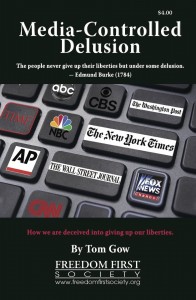
Media Controlled DelusionIf you are here today you have been given the opportunity to understand who these people are, how they are operating, and what can be done effectively to oppose them. You have been given the opportunity to pick up and read Don Fotheringham’s book The President Makers, Vance Smith and Tom Gow’s book Masters of Deception, and Freedom First Society’s new release Media-Controlled Delusion. Unlike many others who are naively falling into the trap which is being laid for us, you have providentially been given the opportunity to know and understand the grave danger we are in.

And so here we each sit, holding the future in our hands, choosing now what we will do. If we are to win the battle raging around us, we must first win the battle within us. We are each sorely in need of the conviction, the courage, and the commitment that are required if we are to acknowledge the danger we are in and courageously confront it.

Conviction

First, we each need conviction. Conviction is a spiritual and emotional power that comes from understanding and wholeheartedly believing truth. Conviction is contagious. Our Blackfoot Chapter experienced a significant increase in our conviction this past year. We decided to read Don Fotheringham’s book, The President Makers and discuss it together a few chapters at a time. As we discussed this well-written, well-documented book we shared feelings of outrage and sorrow with each other over the loss of lives, liberty, and property that have been destroyed at the hands of conspiring power mongers. We drew hope from the way this understanding changed us, leading us to desire with our whole hearts to reject these men and the tools they’ve used deceptively to manipulate themselves into power. If this knowledge changed us, it could change others. We drew hope from understanding that the success of their schemes depends on our willingness to compromise the standard of government laid out in the United States Constitution. We HAVE the antidote. It IS the Law of the land.

Later, we took the advice given by Don in The President Makers and also read and discussed the book Classified Woman together. This book stands as another witness of the truth of the things Don wrote and strengthened our understanding that those in positions of power are guilty of numerous crimes; crimes against the Constitution and against mankind. We do not have to face them on equal ground as long as we stand on the moral high ground of truth. Their own treachery is a deep pit beneath their feet. All that is left for us to do is to pull the gauzy web of deception out from under them and they will fall into their own pit.

As our conviction grew, we grew determined to do something more about it. We took Don’s advice again and decided to distribute 500 copies of his book to our families, friends, and neighbors. But this was not easy to do. Many of our friends and neighbors prefer NOT to know the things we were learning. It can be easy for those who do not yet share our conviction to think that if they just ignore these concerns and fill their lives with other things they will not have to deal with it. We needed courage.

Courage

Courage is the result of taking the long view in a situation. It leads us to act in accordance with truth even when the immediate outcomes are uncertain or even unpleasant. I learned that it is not my place to decide who might read or listen and who won’t. It is my job to open my mouth and offer as many people as I can the chance to understand, and then to graciously accept their decision, always leaving the door open for another day. I cannot control their response, but I can courageously invite them with a smile again and again. I can find different ways to reach them, knowing from my own experience that I received many invitations and learned a little at a time over several years before I was ready to publicly commit to a role in the freedom fight. Our Chapter’s courage grows as we see the positive fruits of our efforts, but I don’t want to give the impression that our meetings are getting flash-mobbed. The results we are seeing have come gradually and quietly. I often remind myself that trashy trees grow quickly. We are interested in growing a strong and steady mighty oak of a Chapter, and that will take time and commitment.

Commitment

Commitment is consistent, undeterred action over time. If conviction and courage move us to act, commitment sees us through. Commitment leads us to make the defense of freedom a primary priority; more important than social gatherings, ball games, and personal pursuits. It understands that faith, family, and freedom are each important legs on a three-legged stool. We cannot afford to become so exclusively busy with faith and family obligations that we fail to defend our freedom — for if we lose our freedom, our ability to care for our families and follow our faith will vanish with it. Those committed to the freedom fight do not come only to activities that interest or entertain them. They show up in spite of poor health, busy lives, and long days, and they bring others with them time after time.

Inspiring Examples

I am so blessed to be surrounded by inspiring examples of conviction, courage, and commitment. I would like to close by telling you about three of them.

One is a young man I really hardly know: Ben Marsden. I met him a number of years ago while he was still in high school and I was impressed by the great love he had for principles of freedom and his desire to defend them. He left home to serve a mission for his church and attend school and I lost track of him, but just this last week I got a phone call from him. He has now completed his mission and his college degree and heard about our Freedom Rally this weekend. He called to offer to do an “introduction” of sorts. He wanted to talk about people like Martin Luther whose conviction, courage, and commitment led them to act. Many of these people died having never seen the fruits that came from their sacrifices, and yet their efforts changed the world forever. He wanted to express his conviction that one ordinary person, courageously acting in defense of truth can, indeed, make all the difference. Ben, I thank you for the conviction you carry in your courageous lion-heart and hope that we will see much more of you in the years to come. We have work to do together.

Another inspiring example is a middle-aged realtor: Gary Gifford. Many of you met Gary today when you attended the mini-class he taught, “Organize for Victory.” When our Chapter finished reading The President Makers, Gary said, “Now what? What are we going to DO about this?”, and he then took the lead in creating a specific action plan for our Chapter to consistently work toward the 1,000 educated, organized people we need in our congressional district if we are to turn the tide in the freedom fight.

I hope Gary will forgive me for embarrassing him a little, but his good wife has some serious health struggles. Consequently, he carries the burden of caring for her as well as many of the household responsibilities. Yet, he consistently attends meetings, brings guests, and even finds time to serve as our Chapter recruitment chairman. He is always asking us, “Why are you here? Why is this worth your time?” He tells us that if we can clearly articulate why we are involved we will be prepared to convince others to join us. He has created a spreadsheet to help Chapter members keep track of our contacts and is now working with a committee to outline and organize regular personal visits to prospective members, new members, and existing members who are not regularly attending.   Gary, thank you for your unflinching courage to “DO something about it,” to act, and for the courage you inspire in us.

Last of all, I would like to tell you about a sweet Grandma: Beverly Rocks (and you will see that her name is very fitting: Beverly does “rock”!) She is more active, tough, and determined than most people half her age. She lives alone far out on the Pingree Prairie. When I was a girl growing up in the metropolis of Moreland, Idaho, we used to jokingly refer to Pingree as “Outer Darkness” because we thought it was so remote. If Beverly wanted an excuse to not be involved she could easily tell herself that she is too unimportant to make a difference, but that is not what Beverly is about.

I first met Beverly several years ago when we felt a need to canvas our entire county with some voter information. Beverly knocked our socks off knocking doors. She canvassed several precincts — by herself. When the Freedom First Society was organized in our area, Beverly was one of our first members. Beverly is committed. She heads up our telephone tree making phone calls to remind Chapter members of every upcoming activity. She is on the ball. I never have to call and remind her. She is better than the post office — through rain, sleet, hail, snow, blizzard, or drought she is there. And she invites others. She knows “who thinks what” from all of her canvassing and never misses an opportunity to extend an invitation. This summer, she found two new prospective members — at a yard sale. She got their contact information and then referred them to the Chapter leader in their area.

Most recently, Beverly gave me cause for reflection — when she brought me a table. The table is here today in a place of honor, not because it is amazing on its own, but because of what it represents to me. As we began preparing for this rally I put out the word that we needed picnic tables. A couple of days later I heard a rattling sound coming down my bumpy lane and looked out to see Beverly’s little red car pulling a large trailer loaded with a grey, weathered table and four benches. Beverly informed me that she had brought it for the rally, that she knew it wasn’t fancy, but that she thought we could tighten it up with a few screws and it might be useful. After we were done with it, she wanted it donated to the Chapter.

If there was a need and Beverly had anything at all that could fill it, she was there, willing to offer all that she had. It didn’t matter to her that it wasn’t fancy or new. It didn’t matter that she didn’t have a nice pick-up truck to load it into or young strong muscles to load it up. It was enough for her to offer her best and trust that someone else would do the rest.  Beverly, thank you for your example of selfless, unwavering commitment to the cause of freedom.

We live in perilous times. I am a witness that there are conspiring, organized forces deliberately working to undermine freedom. I have witnessed, first-hand, the way that local government and school policies are being manipulated and controlled by organizations exterior to the electorate in ways that conflict with and even undermine local values and local control. I set out to understand how these organizations became so influential and, through my own, current, bottom-up research discovered the same story told by Don, Vance, and Tom in their books. This is not just a story about the past. It is the real story behind every current issue of concern today. The new Freedom First Society publication Media-Controlled Delusion does an excellent job of illustrating this by taking current issues, from socialized medicine and police “brutality” to immigration reform and the national debt, and tying each issue back to its organized roots. It’s concise and well-documented and available at our book table for just a few dollars. Every person here needs to take a copy home.

Best of all, this booklet ends with a chapter reminding us that there is a sound, reasonable, effective counterstrategy available to Americans — it is for us to also organize. We don’t have to have super powers to defeat the real villains of today. We just need the conviction, courage, and commitment to build a strong, resilient community of organized, informed Americans. I am so thankful for my association with the Freedom First Society, for the leadership it offers, and for the opportunity it has given me to stand shoulder to shoulder with other Americans who are also determined to do just this. That we may have the conviction, courage, and commitment to do so is my prayer. Thank you.

The story of Beverly’s table is not over. I called Robert Welker, a steadfast member in Shelley. This is one of the benefits of being organized; being able to work together and share our different talents.  Mr. Welker was to this table what Gepetto was to Pinocchio. He has given it new life, tightened up joints, added some supports, sanded it smooth and given it a coat of primer. It’s a really cute little table. It’s been of good service to us at this event, and it is now waiting for a new owner to claim it, take it home, and paint it with a final coat of their own choosing at the conclusion of a silent auction which will open after the closing prayer and close when the last chairs are put away and the last banners are taken down tonight. The proceeds from Beverly’s table will be used to start a Rally fund for next year so that we can hopefully be a year ahead on our Rally budget. So after the prayer feel free to mosey up here and write your name, your bid, and your contact information on one of these silent auction slips and drop it in the jar on the table. Thanks.

Receive Alerts

Get the latest news and updates from Freedom First Society.

This will close in 0 seconds